
September 1, 2026 by Marni Ellery
Growing up, many of us were taught to drop, cover and hold on during an earthquake. The guidance is straightforward, but how people actually respond when the ground starts shaking can be far more complicated. Now, UC Berkeley researchers are studying what happens in those critical moments and how fear and risk perception influence people’s actions.
“Drop, cover and hold on provides important guidance for earthquake safety, but knowing the recommended action does not necessarily tell us how people will respond during a real earthquake,” said civil engineering professor Luis Ceferino, who is leading a new study on earthquake risk perception. “Our own research, along with past literature, suggests that people’s perception of risk is key to what they do during an earthquake — and, more importantly, plays a critical role in how injuries occur.”
In fact, his recent fieldwork on the 2023 Türkiye and Syria earthquakes found that nearly 40% of building occupants surveyed felt “incapacitated or frozen” due to panic in response to the shaking, while very few successfully executed standard safety protocols. Other studies have documented social responses during earthquakes, such as running because others were running or rushing to protect family members.
These decisions can place people in greater danger, said Ceferino, but they are not factored into earthquake safety policies or guidelines.
The reason seems to be a lack of information. Current data on perceived risk is limited to post-event surveys, which cannot provide a complete or accurate picture of what happened. Because the surveys rely on people’s memories, it’s nearly impossible to connect reported experiences to any metrics, such as the intensity of shaking at a specific location and time, without wall-to-wall sensors in place.
UC Berkeley researchers — including Ph.D. students Yan Liu and Luis Cossio and postdoctoral scholar Yvonne Merino — are collaborating with the California Academy of Sciences to try to capture this missing information using a combination of earthquake simulations, virtual reality and real-time reporting.
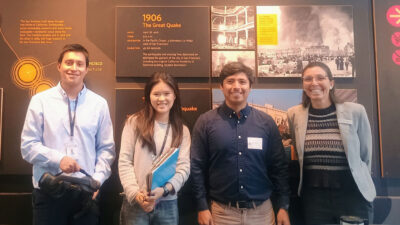
(from left to right) Luis Cossio, Yan Liu, Luis Ceferino and Estefanía Pihen González, chief of education and learning at the California Academy of Sciences. (Photo courtesy the researchers)
“We’re hoping to build a framework that will help us understand how risk perception — the fear that people have of getting injured — is modulated by the shaking intensity of the earthquake,” said Ceferino, who also serves as director of the Disaster Risk Analysis Lab. “Getting answers would give us more information to develop policy, recommendations and guidance for what to do when there is an earthquake to further reduce people’s risk of injury.”
Creating an immersive experience
To create a realistic earthquake experience, the researchers set out to synchronize the motion of the Shake House, an earthquake simulator at the California Academy of Sciences, with a virtual reality environment they developed showing objects moving and falling. After measuring the accelerations used by the Shake House to simulate the powerful 1906 San Francisco and the 1989 Loma Prieta earthquakes, they calibrated their virtual reality environment accordingly. So when participants saw things falling in virtual reality, the physics corresponded to the shaking they felt.
“By synchronizing what participants see in virtual reality with the shaking they physically feel, we can create a much more immersive representation of an indoor earthquake,” explained Ceferino. “For earthquake engineers, this gives us a new way to go beyond computational models and study how people perceive risk and make decisions as earthquakes unfold.”
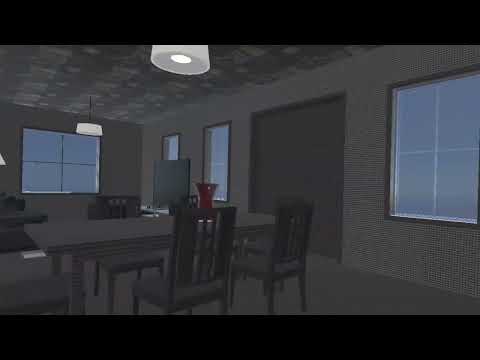
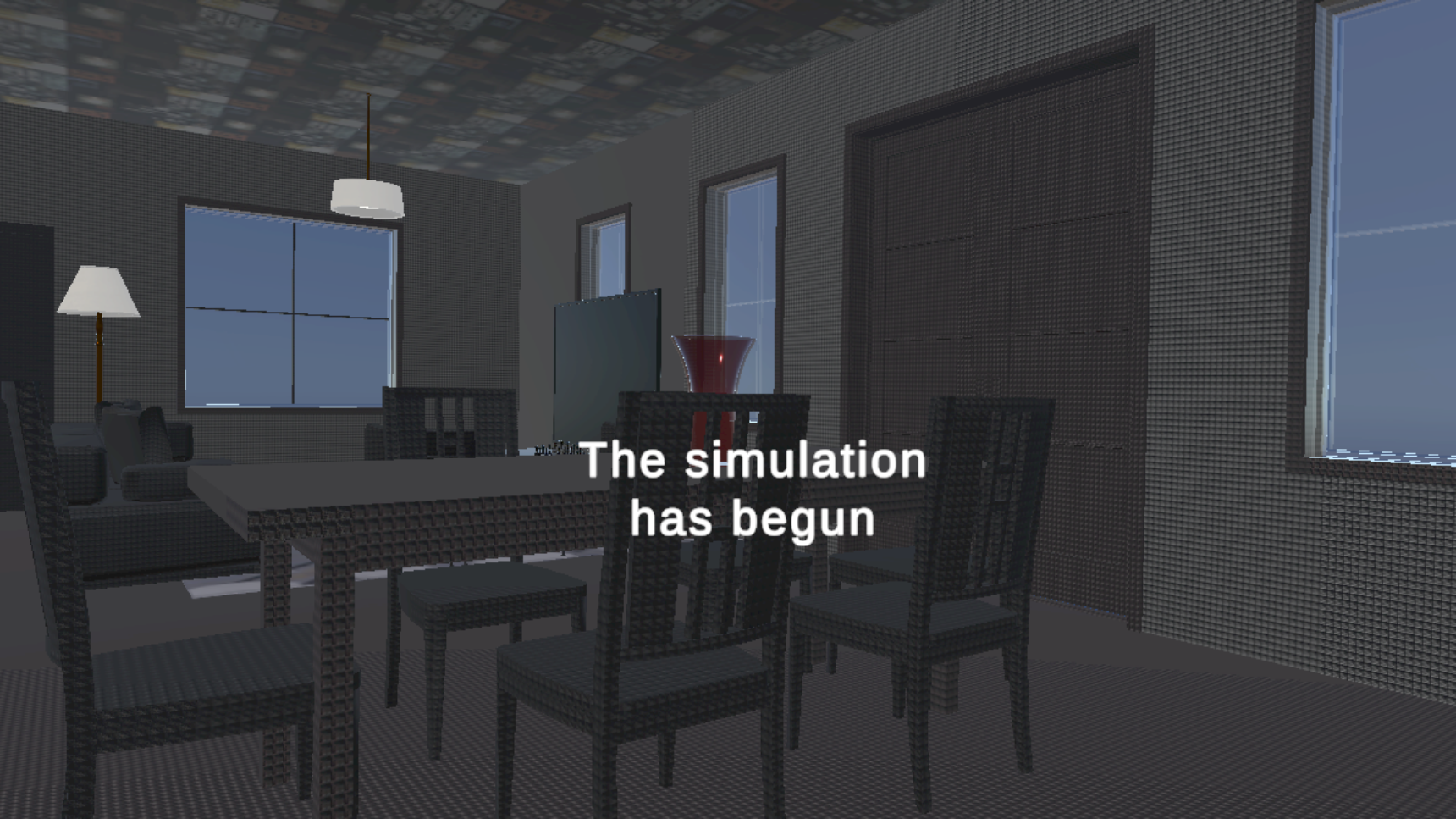
Virtual simulation of the 7.9M 1906 San Francisco earthquake spotlights human behavioral response
Prior to the start of the experiment, the 50 participants filled out a survey about their earthquake knowledge and whether they had ever experienced a large quake. Once inside the Shake House, they put on VR headsets and became immersed in a digital world: a living room inside a one-story building, with a partially visible kitchen and bedroom. Suddenly, the earthquake simulator started shaking, along with everything in their virtual environment.
“It’s what we call a 4D simulation,” said Ceferino. “Participants experience the three-dimensional virtual space while also feeling how that environment changes over time as the earthquake unfolds.”
Measuring earthquake risk perception in real time
During the experiment, the VR headsets also recorded the participants’ gaze. This allowed researchers to see what they were looking at during the earthquake and while they were communicating their experience in real time via the VR controller. Participants pressed a button on the controller whenever they felt that they could be injured during the shaking.
“We asked participants to tell us, in real time, when they felt they may be at risk of injury,” explained Ceferino. “By combining those reports with the gaze data, we can examine what they were looking at when they perceive the risk to be higher.”
While in the Shake House, test subjects experienced simulations of the 7.9M San Francisco and the 6.9M Loma Prieta earthquakes, enabling researchers to compare the intensity of shaking with participants’ reactions.
According to Ceferino, preliminary findings showed that people’s responses were not linear. “The risk perception at some point increases dramatically because things are falling and the shaking is so high that you start to feel like you’re a little off balance,” he said.
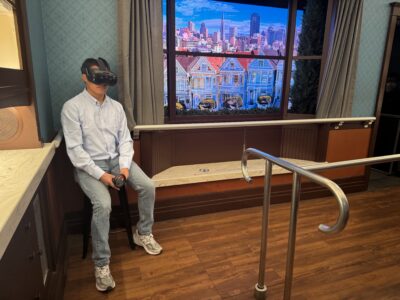
A researcher inside the Shake House at the California Academy of Sciences awaiting the start of the simulation. (Photo courtesy the researchers)
Test subjects completed a post-experiment survey to document their levels of perceived injury risk during the earthquake, what they did in response and additional details about their experience.
The researchers also took turns experiencing the simulations and were struck by the intensity of the shaking — and the sense of vulnerability it created. Ceferino compared the Loma Prieta simulation to an earthquake he had experienced in Lima, Peru, but noted one major difference: he was outdoors then.
“Experiencing the shaking indoors, even in the virtual environment, felt very different,” he said. “I immediately started thinking: Could I be injured by the glass? Is something going to fall on me? What should I do? Could the building collapse?”
That experience, Ceferino said, underscored to him the importance of what researchers are hoping to learn as they start to analyze the data and further evaluate the success of this proof of concept. Ultimately, they aim to quantify human behavioral responses and identify the key factors influencing earthquake decision-making.
“The knowledge we gain could be used to educate people and provide practical guidance about safety actions to take during quakes,” said Ceferino, “such as using safer paths to access rooms or avoiding dangerous building elements, like broken glass or fallen objects.”
This project was partially supported by the National Science Foundation CMMI N 2410291.