
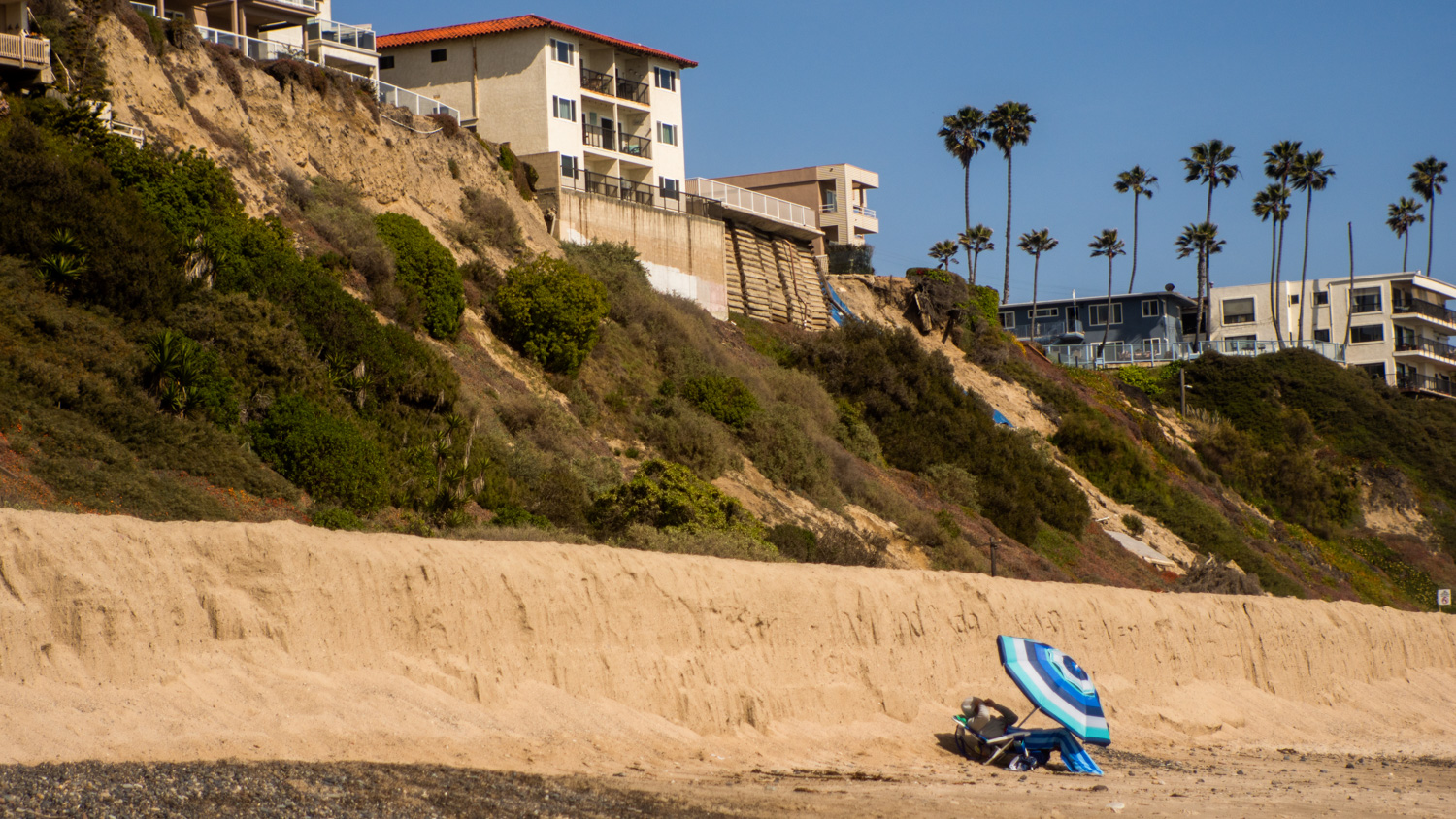
Orange County’s disappearing beaches aren’t a new problem for the City of San Clemente.
City leaders have spent the past several years grappling with the best ways to address coastal erosion and widen the coastline that’s been shrinking. The dwindling beaches have led to several closures for the rail line that runs along the coast and has prompted questions about if the Spanish Village by the Sea is sinking into the waves.
[Read: San Clemente’s Long Struggle to Save Its Disappearing Coast]
The city is continuing to focus its attention on the beaches and is looking to take the lead on saving the coastline to remain a beach town with a thriving tourism industry.
It comes just a few months ahead of the November election, when San Clemente voters will weigh in on a 1% sales tax increase that, if approved, would create a designated funding source for coastal projects — like sand placement — and wildfire prevention.
It’s a citizen-lead initiative that was created after the city tried to pass a similar sales tax increase last year, but that effort failed because it didn’t reach the 66.7% “yes” votes needed to pass, since the funds generated from the tax increase would have been earmarked for sand.
That ballot measure narrowly failed with 64.62% “yes” votes. Since this year’s ballot measure is a citizen-lead initiative, it only needs a simple majority vote to pass — more than 50% “yes” votes.
[Read: San Clemente Residents to Vote on Another Sales Tax for Sand]
“I think there’s hope for more sand on the beach,” Councilmember Victor Cabral said at the Sept. 1 City Council meeting. “Obviously we have a lot of work to do with the county and the state and OCTA [Orange County Transportation Authority]. I think we’re on it as a city, and I hope to continue working to get that done.”
San Clemente Leaders Want Sand, Need Funding
City leaders discussed their Coastal Strategic Plan during their Tuesday night council meeting, detailing their multi-pronged effort to get sand on the beaches in the short and long term.
Leslea Meyerhoff, coastal administrator for the city, said the vision is to create a 250-feet-wide beach that allows residents to walk from one end of the beach to the other at any time of day.
The city’s partnership with the U.S. Army Corps of Engineers is expected to bring two million cubic yards of sand to the beaches over the next 50 years. It’s expected to be dumped in 250,000-cubic-yard batches every five to six years, with costs being split between the city and federal and state governments.
The San Diego Association of Governments is also working to widen beaches along the Southern California coastline, including San Clemente. That project is still in the planning phase, and sand could be brought in starting around 2030.
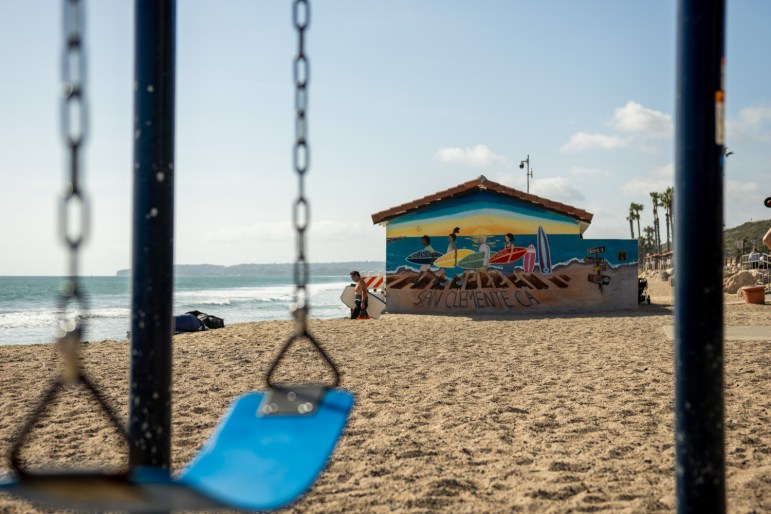 The swings and mural behind the bathrooms at North Beach in San Clemente on April 24, 2025. Credit: EFREM PLAWNER, Voice of OC
The city’s offshore sand source investigation, which gathered various sand samples from locations offshore of the city, could see a draft report by the end of this year.
The city also has a Sand Compatibility and Opportunistic Use Program (SCOUP) permit ready to go, meaning they’re permitted to add a maximum of 300,000 cubic yards of sand to the beaches each year, granted they have a sand source and funding ready to go.
Meyerhoff said the SCOUP permit, which is valid for 10 years, is meant to supplement the larger sand projects.
The city also conducts a regional shoreline monitoring program to review the way the sand behaves on the beaches and optimize sand longevity after more is added.
Yet city leaders said they don’t have enough funding at the current moment to fulfill most of these efforts to their fullest potential.
“Some people don’t understand the real crisis we’re in,” Councilmember Cabral said at the meeting while showing the public an image of the city’s beaches near Cotton’s Point, where there is practically no sand between the train tracks and ocean.
“What used to be beaches with volleyball courts and swing sets; this is the future of our beaches, not just in this area, but the entirety of the 8 miles of San Clemente beaches if we don’t do something about it.”
Cabral also criticized the county transportation authority for dumping rocks to protect the train tracks, acknowledging that the agency has a responsibility to protect the tracks but emphasizing that the city has a responsibility to save the beaches.
“It’s also equally important that if we’re going to be a beach community we have sand on our beaches,” he said. “This is what our future is unless we put sand in.”
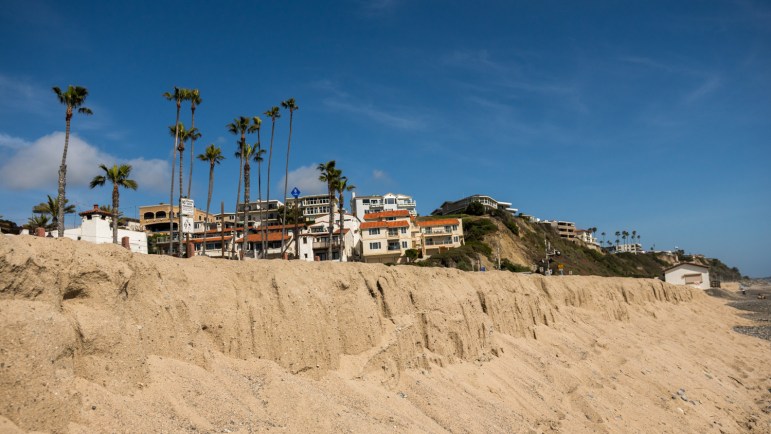 Cliffslide houses overlook the degrading beach at North Beach in San Clemente on April 24, 2025. Credit: EFREM PLAWNER, Voice of OC
During Tuesday night’s meeting, council members also voted to accept a $2 million grant from the State Coastal Conservancy to help fund the city’s sand retention pilot project that could see breakwaters constructed offshore to help disperse wave energy.
“At this moment, we’re not deciding to build it,” Councilmember Zhen Wu said about creating breakwaters in the city. “This is free money from the state.”
OC Transportation Officials Prioritize Train Tracks
At a meeting on Aug. 24, county transportation leaders discussed possible solutions to protect the 7-mile stretch of railway that runs through San Clemente and is being threatened by the eroding beaches, landslides and wave activity.
In some areas, the tracks run directly adjacent to the coast, less than 200 feet away from the water line. During high tide, this proximity means that waves can crash onto the tracks and passing trains.
OCTA’s ongoing study aims to protect the railway for 30 years instead of relying on emergency actions.
“For the past several years, too much of our work along the coastline has been driven by emergencies, whether its bluff failures, erosion [or] other coastal conditions to keep the railroad operating safely,” OCTA Chief Executive Officer Darrell Johnson said at the Aug. 24 meeting. “This study is about being more proactive.”
The eroding beaches caught the authority’s attention because of the railway.
“If not for the train tracks, this would be someone else’s coastal resiliency problem,” Jamey Federico, OCTA chair and Dana Point City Councilmember, said at the meeting.
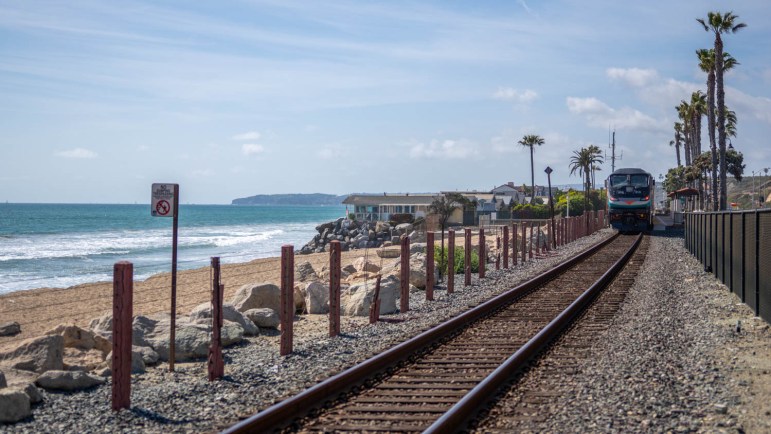 A train arriving at the San Clemente Train Station in San Clemente on April 24, 2025. Credit: EFREM PLAWNER, Voice of OC
But San Clemente isn’t the only agency looking to place sand.
The transportation authority plans to place approximately 560,000 cubic yards of sand onto San Clemente’s shoreline to protect the railway from coastal erosion issues. It’s expected to be completed by fall 2028 after the county finishes acquiring the necessary permits and approvals.
OCTA spokesman Eric Carpenter said sand is an important part of addressing the eroding beaches because a wider beach is able to provide a natural buffer between the crashing waves and the railway.
However, it might not be enough in some locations, he said.
“Sand moves naturally with tides, storms and currents, so protecting the railroad over the next 30 years cannot rely on sand alone,” Carpenter wrote in an email to Voice of OC. “In the most vulnerable locations, engineered protection is also necessary.”
According to the presentation from the meeting, all beach concepts include a one-time sand replenishment paired with placing boulders and rocks — known as riprap — engineered rock revetments, seawalls or a combination of those.
At the meeting, OC Supervisor and OCTA board member Katrina Foley said getting the permits to place the sand has proven to be extremely difficult.
“Under the current proposal, we’re not going to be placing sand, at best, for another two years, so that length of time does not address the sense of urgency,” Foley said.
“We need to be depositing sand now,” she said.
Foley also said that transportation officials need to coordinate with San Clemente to attempt to streamline the permitting process.
Federico said the transportation authority needs to be good partners with whoever leads coastal residency efforts because those efforts can also help protect the railway.
“Until now, cities have been left to their own devices to solve this — Huntington Beach and Newport Beach have,” Federico said. “No fault to the current leadership in San Clemente, they are woefully behind on that and they’re working diligently towards it, but we need to help them and work with them and partner with them.”
According to Carpenter, the state will be conducting a study to look at possible solutions for beyond the next 30 years, including the possibility of relocation of the tracks.
The final feasibility report for the railway resiliency study is expected this fall after continuing stakeholder coordination and public engagement.
Federico said the transportation authority is doing all they can.
“This agency would dump that sand tomorrow if we could,” he said. “Those things are beyond our control.”
Angelina Hicks is the Voice of OC Collegiate News Service Editor. Contact her at ahicks@voiceofoc.org or on Twitter @angelinahicks13.
Lauren Contreras is a Voice of OC Tracy Wood Reporting Fellow. You can reach her at laurencontreras615@gmail.com.
Related