
Want to feel like a kid again? Walk into any Geppetto’s store.
For decades, the San Diego County toy store chain has been helping parents and other grown-ups make magic on birthdays and holidays by supplying San Diego’s children — and schools and charities — with trending and classic toys and games.
The person behind that magic is Brian Miller, the company’s owner and chief toy executive. For most of the company’s 50 years, Miller has been the one who chooses what stuffed animals and puzzles get stacked on the company’s shelves. He has a knack for stocking toys that will end up on every kid’s wish list. Like NeeDohs, the squishy, sensory toys people have been lining up for and that are currently in scarce supply. Geppetto’s has sold hundreds of thousands of them — this year.
Part of Geppetto’s signature is how unchanged it is against the tide of e-commerce and video games, two disruptors to brick-and-mortar stores and the toy and games industry. Yes, it has a website and a catalog, but its main persona is its physical stores, where you can walk in, talk to a person who gets toys, and kids, and let your child play and discover things right there.
Some aspects of Geppetto’s have changed though. It started as one store and steadily grew to nine, scattered across the county. It was relatively early to Instagram, opening its account in 2014. In the 34 years Miller has been at the helm after taking over from his parents, he has become an authority, advising creators and manufacturers on new ideas and packaging.
For a retail toy seller like Geppetto’s to thrive for decades is an accomplishment, said Adrienne Appell, the executive vice president for marketing and communications with The Toy Association, a national trade group. Appell has visited several Geppetto’s stores and called the chain wonderful.
“I think it’s an amazing achievement,” Appell said. “There’s a lot of trends that drive toy sales and drive the toy industry. So to have that staying power as a retailer for 50-plus years, you have to be in the know and create an environment where families want to come and want to explore, and have the trendy products, but also create the unique experience that really only neighborhood toy stores can do.
“Their staying power really speaks to them being innovative, them being creative and them really being on trend,” Appell said.
Rules of the game
Miller, on a recent Thursday morning at the store in Del Mar Highlands Town Center, before any customer set foot inside, said people often ask him what the secret sauce is for running as successful a business as his, for as long as he has.
His answer: the sauce has a few ingredients. It’s not just one thing. Instead of a recipe, Miller outlined what you could call the rules of the game for running a successful brick-and-mortar toy business. Or business, period.
“No. 1 is people,” Miller said. The people he hires are friendly, hardworking, eager to help customers and passionate about toys. To find such gems, Miller trusts his first impression. “I think job experience matters less,” he said. “It’s what kind of person are they? Are they going to be friendly? Are they going to greet people with a smile? And are they going to work hard? Because you have to work hard.”
Soon after, two employees and his younger son, Jared, 23, entered, and all sported smiles and offered a hand to shake. One woman has been with the company 26 years; the other is a newer hire. Miller named two nonstarters for team members — showing up to work on time and looking presentable — which goes without saying. But, he added, he’ll say them.
The next rule is carefully curating what you offer.
“I want to carry products that I can stand behind, that I can be proud of selling, that are good quality,” he said.
That much is clear from setting foot in a Geppetto’s store, where shoppers might spot a common thread running through the offerings. All those toys, from Legos to science and art supplies to board games to high-octane sporty gear, all tend to feed the imagination, build skills and build connection between people.
Miller picks out every toy. He touches them at trade shows. Inspects stuffed animals for snuggliness. Smells them. (As he described this, he picked up a Jellycat teddy bear and gave it a sniff.) “I mean, you want to know those things, right?”
A good toy, Miller said, must be educational, durable, and challenging but not frustrating. It should grow with the child. It needs to have a fun factor.
When he evaluates pitches, he trusts a sixth sense sharpened over decades of experience.
“It’s my gut,” he said. “I’ve done it for so long.”
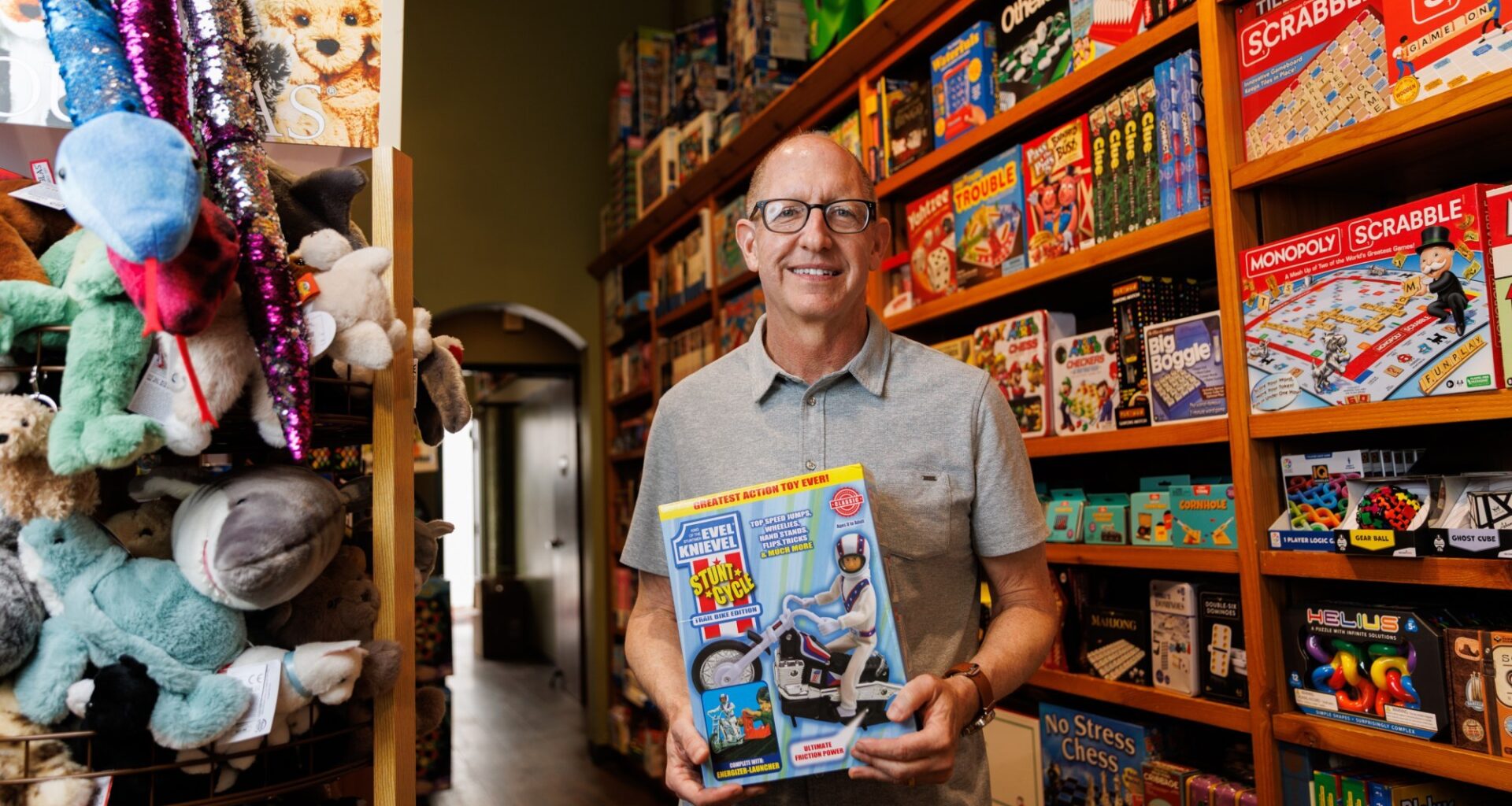
One toy he stocks has a personal memory for Miller. “I had a little Evel Knievel motorcycle that my sisters gave me when I was little, and we still sell a version of it.” The main buyers are nostalgic parents grabbing one for the next generation.
With NeeDohs, he knew they’d do well when he noticed the clever designs, the price point kids can afford with their own spending money and how satisfying they are to play with. He was right: they have outsold Beanie Babies, Cabbage Patch Kids and Furbies, he said. The rise of tactile, sensory toys and fidgets has surprised him, he added. A large shelf at the front is dedicated to such items, and that was not the case five years ago.
About half of what the stores carry is trendy and half are classics, he added. Fads might have a shelf life of a few years. Some are an intersection — a twist on a Rubik’s cube.
Geppetto’s stores aren’t big. At around 2,000 square feet, the Del Mar Heights store is on the bigger side. The smallest, in Coronado, is less than 1,000 square feet.
That squeeze is by design. “I only have so much square footage.” So he must apply focus and discernment. That’s different from Amazon or eBay, which sell millions of toys and games that vary wildly in sourcing, quality and subject.
A physical venue also offers something “that you can’t get online. You know, the warm, fuzzy feeling of coming into the store,” he said.
Appell echoed this, saying the brick-and-mortar model is especially suited to toy sales, because toys are by nature interactive. “You can actually touch the products, see how they work. The displays are set up that way. Whereas online, you may not understand what it does or how magical that toy can be,” she said.
Geppetto’s offers free gift wrapping. Those signature papers — including comic book pop art — his favorite, dinosaurs — are an instant tell at parties. They work double duty, as both customer service and word-of-mouth marketing.
Speaking of marketing, Miller’s third rule of the game is “location, location, location.” Geppetto’s are on cute main streets, bustling malls, places with great foot traffic. All the stores are leased, with long leases, he added.
“I wish I owned the real estate. I wasn’t as smart as McDonald’s,” Miller joked.
He closed one location at Otay Ranch Town Center several years ago because it was not working. The decision was difficult and costly. Lesson learned: growth comes with risks.
Another big lesson came during the COVID pandemic, which was the greatest challenge the business faced in its 50 years, Miller said. The lasting takeaway: be flexible.
Rule No. 4: be a good citizen
As Geppetto’s, founded in 1976, turns 50 this year, it is gearing up for a double celebration. On Sept. 19, it will host parties at all nine locations from 9 a.m. to 3 p.m., with goodie bags, discounts, activities, treats and entertainment. The company is also pledging a donation of $50,000 to Rady Children’s Hospital San Diego. The method is unusual: Geppetto’s will sell a custom 50th Anniversary NeeDoh, which it created with the viral toy maker, Schylling. Proceeds will go to the hospital.
“Rady Children’s is honored to celebrate this incredible milestone with Geppetto’s and grateful that their success is being shared in a way that directly benefits the patients and families who rely on Rady Children’s every day,” Alex Loker, vice president of Philanthropy for Rady Children’s Hospital Foundation, said in a news release.
He does this year in and year out, not just for milestones.
“I don’t delegate this to someone else … I pick out toy packages that we give as donations to different organizations,” Miller said. Those become auction and raffle prizes at schools and nonprofits.
Before the interview with the U-T, he had been stacking items for an elementary school readathon prize. He also donates each year to Toys For Tots during the holidays, and contributes funds and toys to Rady Children’s.
He also recently got something back. A manufacturer sent him a $500 tariff refund check, “out of the blue,” a few weeks ago. Tariffs still touch nearly every item he sells, Miller said.
“Most manufacturers have absorbed them in their costs and are passing it on. So they raise prices, but they’re not calling it a tariff surcharge,” he said. “It doesn’t matter if it’s from China or it’s from Europe. So to some degree, everything is affected. And there are some things made in the United States that are not, but I couldn’t fill our store with just things made in the USA. There aren’t enough toys made here.”
Customers aren’t balking at increase prices, he said.
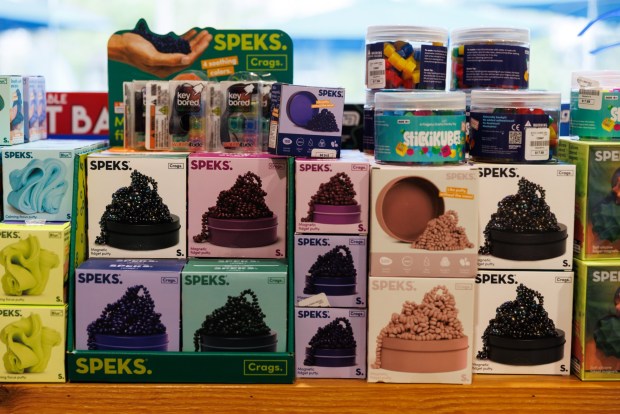 Tactile and sensory toys are popular items at Geppetto’s toy stores. (Kristian Carreon / The San Diego Union-Tribune)
“Business has been very strong. I think that people are used to paying higher prices” across the board, he said. They might spend $40 instead of $50, he added, but they’re not cutting toys and games. “They still spend for their kids.”
That mirrors a national trend. Market data company Circana wrote in August that “the U.S. toy industry delivered its strongest first-half performance in six years, with dollar sales increasing 17% from January through June 2026, compared to the same period last year.” Shoppers were drawn to “collectibles, sensory toys, licensed products, and hobby-oriented play, underscoring the broad appeal of toys despite ongoing affordability pressures. These trends are helping expand toy engagement across a much wider consumer base than the industry has historically served.”
While he declined to share the company’s annual revenue, Miller said Geppetto’s is consistently profitable. “Except for the COVID year, every other year our business has increased from year to year. And this year, 2026, we’re having the largest increase … that we’ve ever had.”
That is stronger than typical performance for the toy industry, whose sales have nearly, but not fully, caught up to pre-pandemic levels. Monthly sales were around $3.3 billion last December, after increasingly steadily from a holiday low of around $1.19 billion in 2018. Sales reached $3.4 billion in December 2015, according to the Federal Reserve Bank of St. Louis.
Goldilocks approach
“People have asked me, Why haven’t you grown?” Miller said.
In fact, Geppetto’s has grown. The first store, opened by his parents, was in Old Town. Miller took over the Hotel del Coronado store in 1992 and bought the Old Town store in 1993. Now, with nine shops, Geppetto’s is the country’s largest regional independent toy seller. That is, by number of stores.
But there’s growth, and then there’s growth.
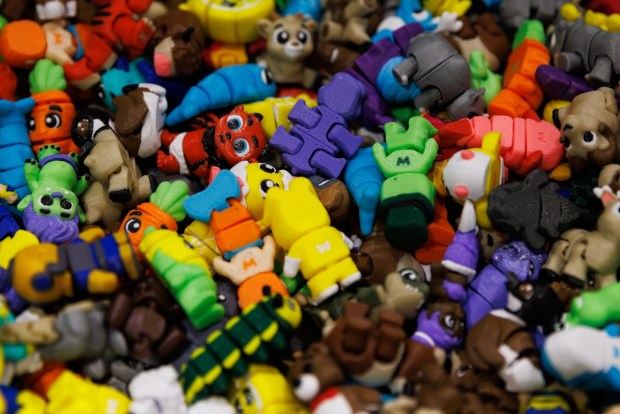 Small toys called Wigglitz at Geppetto’s. (Kristian Carreon / The San Diego Union-Tribune)
Miller’s approach embraces moderation.
“We get lots of offers from developers, from malls. ‘I need a toy store here in St. Louis. I need a store in Florida.’” Companies have reached out to partner, buy a stake. And he gets pitches to open stores with new concepts. He’s great at selling toys, so why not kids’ clothing? The answer has consistently been, pass.
“I really appreciate the offer, but I think that would just be a distraction,” he said.
Why not expand? A Geppetto’s in every airport, in Manhattan, on the moon?
“I have to stay focused on what I do well,” Miller said. “And not that I couldn’t do it. But I know what I do well, and I want to keep fueling that fire.”
He actually did consider a location in Beverly Hills. “I thought, this is perfect for us. And then I drove up there in the traffic, and I drove home in the traffic, and we loved the location, and I couldn’t figure out why I would want to do it at this stage.”
He and his wife, Danielle, the company’s co-owner, decided against it. He also sought input from employees.
“We’re happy with what we have,” he concluded. “Now, I won’t say no to other opportunities if something pops up in San Diego. But I’m not really interested in going outside of San Diego at this stage.”
Turning down offers and staying focused comes with an opportunity cost, however. Does he ever worry he made the wrong call?
“That would be a feather in my cap, this fancy store in Beverly Hills,” he conceded. But Miller let go of the feather with no regrets. “Maybe because I turned 60 this year,” Miller said. Asked what’s next, he said he has no plans to retire soon.
“‘Cause I love it.”
Competing in the digital age
He’s also not worried about competition the way he used to.
The $45.6 billion toy industry, according to 2025 figures from Circana cited by The Toy Association, has been affected, like others, by consolidation.
When Geppetto’s first opened, the nearest threats came from stores down the street. Now there’s Amazon, big-box stores, online marketplaces like eBay. A formidable competitor, Toys R Us, filed for bankruptcy in 2017 and closed stores in 2018. That was after it bought another legendary toy retailer, FAO Schwarz, which now sells its products in a Manhattan store — and at Target.
Now there’s also Snapchat. TikTok challenges.
Miller has noticed that in the past decade, the upper age of children playing with physical toys has dropped from 12 or 13 to younger. The industry term for this is age compression. But there’s room for both toys and screens in a balanced approach, he said.
He has noticed a growing backlash among parents against screens and digital play. Adults, he added, are showing a renewed interest in board games and stuffed animals. UC San Diego students are big shoppers at the Westfield UTC location.
Instead of worrying about competition and downsides, Miller’s full energy goes into running the business.
“I can only do what we do and do it well, and stay in our lane, and keep going forward with that. There’s too many distractions out there, and I want to stay focused on what we do.”
That strategy matches what Appell described as a path to success for toy retailers.
“If you’re able to stay ahead of the curve, you have to really be price conscious, trend conscious.” A good toy store develops a sense of community so that “families are going to want to come. They’re going to trust you, and they’re going to know they’re going to have a great experience there.”
The store’s name, Geppetto’s, says a lot about its values. It’s the story about a parent’s love, about telling the truth, but also about cherishing and honoring humanity. What better way to do that than through play?
“I think of the craftsmanship, but I also think of longevity, and that’s what we’ve done,” Miller said. “When I think of being a successful business over five decades, the name Geppetto’s says it. It gives you that sense of history and staying power.”
Miller’s top picks
This is what Miller recommends again and again when people come in asking for ideas.
For littles, a train set. Not battery-powered. The kind they push around with their tiny hands.
Next, a musical instrument. For example, this xylophone and pound and tap bench combination.
For all ages he likes art supplies. It’s not just about how the child’s drawing or artwork turns out, but how it feels during the making, he said. He likes the brand Ooly, which is based in Carlsbad. He also sells a loom for making bracelets, which he tested against other looms and decided it’s the easiest to use.
Last, every kid should have a few classic board games. He pointed to Monopoly because it teaches kids about using money. (His personal favorite is Qwirkle, “an elevated Dominoes,” he said.)