
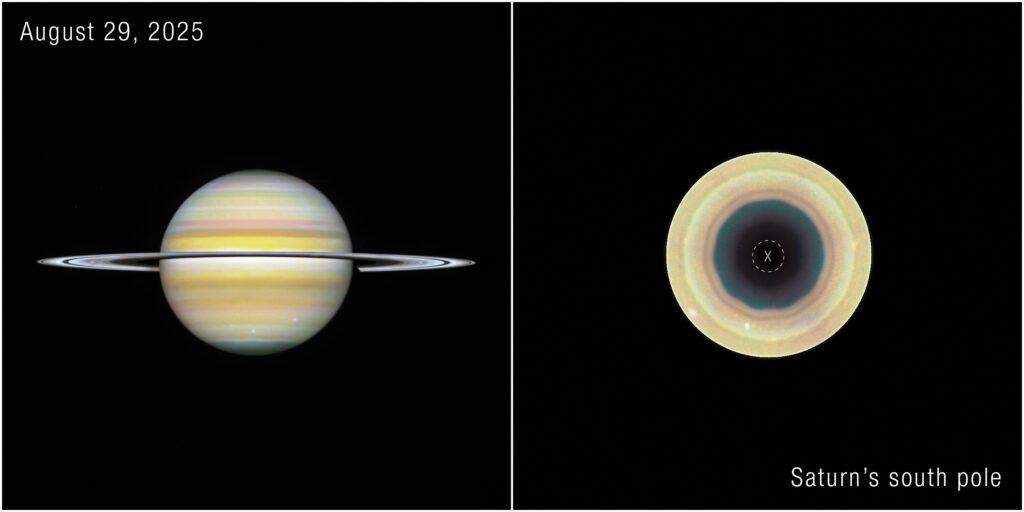
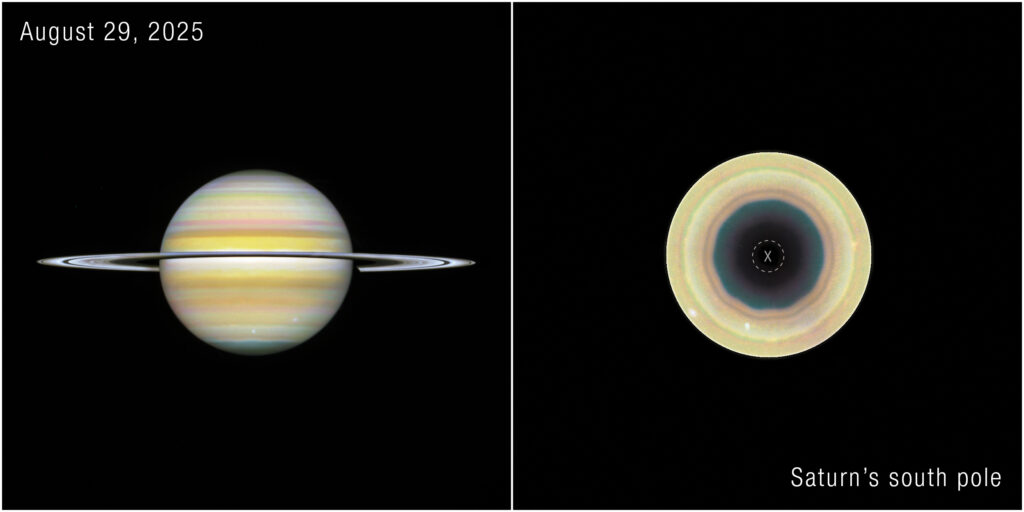
Two views of Saturn from NASA’s Hubble Space Telescope reveal a giant, evolving 10-sided atmospheric wave encircling the planet’s south pole. Credit: Image: NASA, ESA, STScI, Agustin Sánchez-Lavega (UPV), Amy Simon (NASA-GSFC), Michael Wong (UC Berkeley); Image Processing: Alyssa Pagan
Since its discovery in 1980, the hexagonal polar jet stream that surrounds Saturn’s north pole has perplexed scientists. The symmetrical six-sided polygonal wave has been duplicated in laboratory experiments by spinning a circular tank filled with liquid, but the reasons for its formation on Saturn and for its gradual color shift from blue to gold are still being debated. Now, scientists with the Outer Planet Atmospheres Legacy (OPAL) program, have uncovered another Saturnian mystery. They found that a blue decagon has recently emerged surrounding the planet’s south pole.
In a paper published today in Science Advances, scientists from the UC Berkeley Space Sciences Laboratory (SSL), NASA’s Goddard Space Flight Center, and the University of the Basque Country, described tracking the gradual emergence of the ten-sided jet stream wave by examining Hubble Space Telescope images going back to 2023. Features like Jupiter’s Great Red Spot, a cyclone which has persisted through nearly 200 years of observation, can create the impression that the outer planets are timeless and unchanging. Saturn’s decagon shows how changeable these planets can be.
“A few years ago, this feature wasn’t there,” said Michael Wong, study co-author and a researcher with SSL. “It demonstrates the importance of regular observation of the outer planets.”
After the discovery of Saturn’s northern hexagon, scientists were curious when no southern polygonal wave was discovered. In 2004, NASA’s Cassini spacecraft imaged Saturn’s entire southern hemisphere. It didn’t find a hexagon, but it did find that the circular band of east-to-west jet currents at 60.5°S showed perturbations that had a polygonal appearance, but that feature lasted for no more than a few days and was never seen again before the Cassini mission ended with a planned dive into Saturn’s atmosphere in 2017. With Cassini out of the picture, an observation gap opened on Saturn, and the OPAL project stepped in to fill it.\
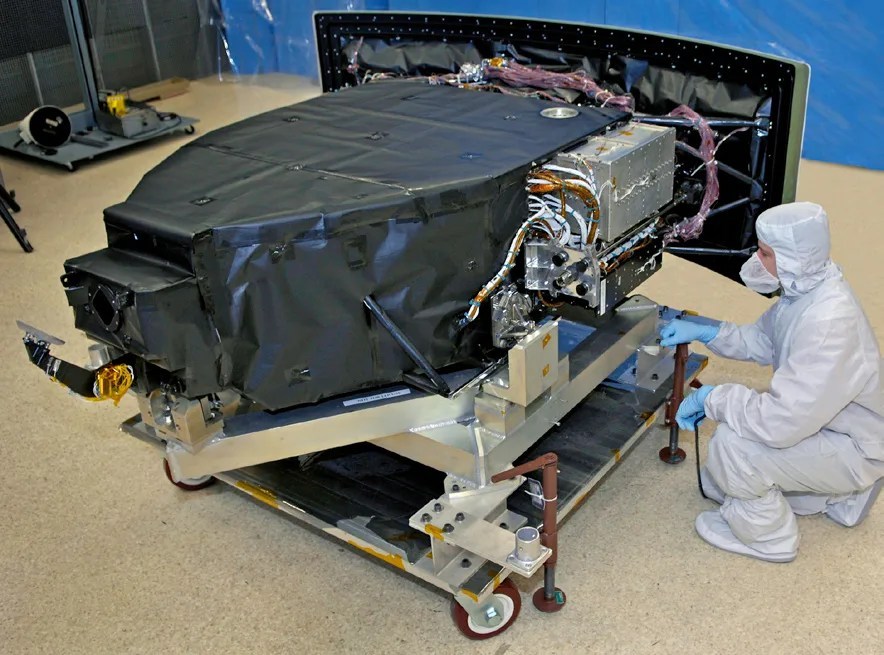
A person in a cleanroom suit working on the Wide Field Camera 3 in a cleanroom. Credit: NASA
Inspiration for the OPAL project can be traced to 2009. At the time, Wong was a visiting scientist with the Space Telescope Science Institute, participating in the calibration of Hubble’s recently installed Wide Field Camera 3(WFC3). A large impact event was observed on Jupiter that year, and Wong trained the WFC3 on the planet, capturing the first science images taken by the instrument, but long gaps in Hubble outer planet observations followed with no images of Jupiter taken in 2011 and 2013. Those gaps led Amy Simon, the principal investigator of OPAL and a planetary scientist at NASA Goddard, make the case for yearly WFC3 survey of the four outer planets: Jupiter, Saturn, Uranus, and Neptune. The project was approved, with Saturn observations starting in 2018 following the end of the Cassini mission.
OPAL’s annual observations began bearing fruit in the years that followed. In 2021, the OPAL team — consisting of Wong, Simon and Glenn Orton, a senior research scientist at NASA’s Jet Propulsion Laboratory — found that wind speeds in Jupiter’s Great Red Spot were increasing. In 2023, they found that Uranus’ northern polar hood was brightening over time, and this July, they published observations on a complete lifecycle of one of the dark spot cyclones on Neptune.
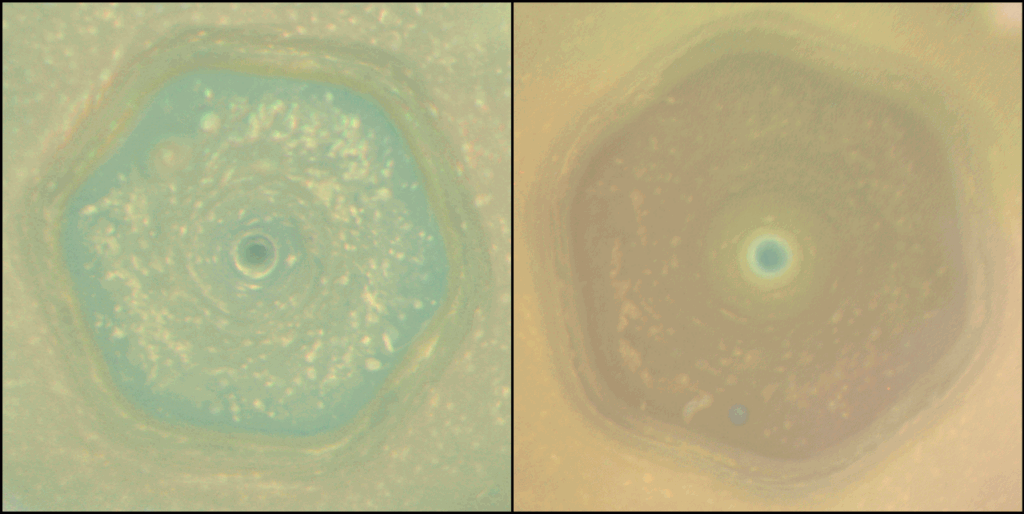
Saturn’s Hexagon. These natural color views from NASA’s Cassini spacecraft compare the appearance of Saturn’s north-polar region in June 2013 and April 2017. Credit: NASA/JPL-Caltech/Space Science Institute/Hampton University
Saturn’s decagon was first noticed by Agustín Sánchez-Lavega, lead author of the study and a researcher at the University of the Basque Country, which accepts ground-based images from contributors through its Planetary Virtual Observatory Laboratory (PVOL). An image received by PVOL in 2024 contained a perturbation similar to the one Cassini observed twenty years earlier, and Sánchez-Lavega got in touch with the OPAL team to study Hubble’s higher-resolution images of the southern hemisphere. When Hubble’s images from 2024 and 2025 were projected onto a polar view, the decagon was clearly visible at some 63°S.
Reviewing the images through different filters revealed that the decagon wave has a 3-dimensional structure. The part of the wave that is visible to the naked eye is in Saturn’s upper troposphere, and the winds that create it are moving at some 400 kilometers per hour. Sánchez-Lavega developed a shallow water equation model to show how a decagon could emerge in turbulent liquid, but most aspects of Saturn’s decagon remain mysterious. The composition of the aerosols that give the wave its blue color is not known, and neither is the structure of the wave as it extends lower into the atmosphere.
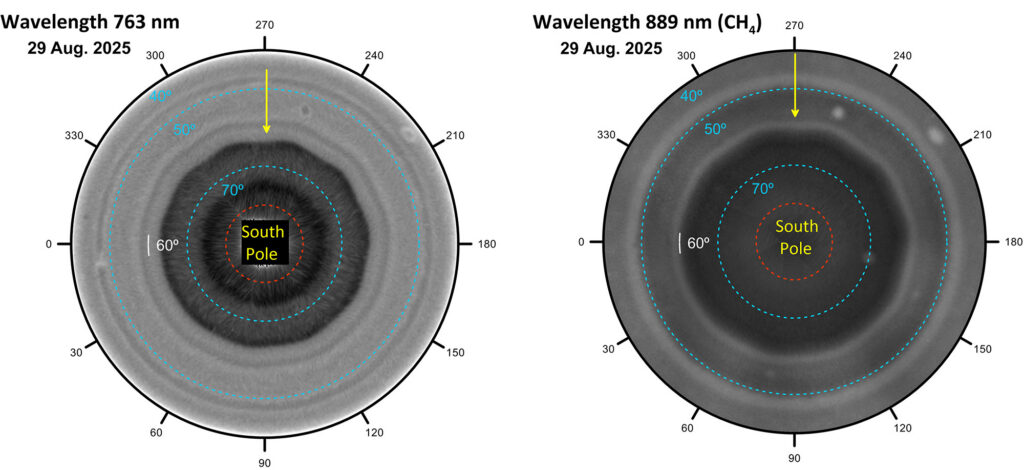
Polar projections of Saturn’s southern hemisphere at two wavelengths: red at 763 nm and a methane absorption filter at 889 nm. The decagon is indicated by a yellow arrow. The dashed lines show the circles of latitude in blue, with their values indicated. Images obtained on 29 August 2025 by the Hubble Space Telescope. Credit: EHU/NASA/ESA
The study authors may be closer to answering the mystery of the decagon’s formation. They noted that it is located just to the south of an anticyclone vortex at some 55°S. The compact vortex was first observed in 2023, but it darkened precipitously in 2025, just before the decagon emerged.
“Perhaps the vortex caused the initial perturbation, and then the balance of forces caused the persistent decagon,” said Wong. “We really need more detailed simulations of its 3-D structure to know for sure.”
Correction: A previous version of this story incorrectly listed some study authors from the Space Telescope Science Institute rather than NASA’s Goddard Space Flight Center.