

The camera pans over a bustling Port of Oakland. Cranes lift colorful shipping containers. Diverse workers in neon vests and hard hats huddle in conversation.
“Real jobs, real industry,” narrates mayoral candidate Mindy Pechenuk. “This is the American 21st century.”
In the campaign ad, one of numerous Pechenuk has shared across social media and over email in recent weeks, the candidate describes her vision for a city that embraces a coal terminal and high-tech jobs, and she blasts current leadership for leaving Oakland in the dark and lying to the electorate.
“Oakland first,” Pechenuk narrates — right after the city’s skyline, confusingly featuring San Francisco’s Transamerica Pyramid, flashes on the screen.
More than any other local candidate, Pechenuk has embraced artificial intelligence as a tool for political advertising this election cycle. But if you look closely, you’ll see artificially generated visuals and music cropping up elsewhere in Oakland political materials, too. You’ve probably spotted images with that uncanny sheen; heard music that’s perfectly on pitch but perhaps lacking in soul.
It’s a noticeable shift from previous election cycles. Even as recently as the special election in 2025, AI was less prolific, less accessible, and less accurate.
Experts say the increasing use of artificial intelligence to create campaign materials presents candidates and committees with opportunities and risks.
Consultant says AI ads can undermine campaigns
Ahead of the Los Angeles mayoral primary in June, candidate Spencer Pratt made national headlines for sharing eye-catching AI ads seemingly created by supporters. The most viral video portrayed Pratt as Batman combating armed DSA members, while the incumbent mayor, Karen Bass, appeared as the Joker presiding over a decadent Democrat dinner party.
Pechenuk — a Republican like Pratt — also portrays herself as a superhero (“Mighty Mindy”) in AI-generated graphics directly referencing him.
An AI-generated political ad from Mindy Pechenuk’s campaign.
“You have absolute control — that’s what’s so beautiful,” Pechenuk said in an interview about her use of AI. “If you don’t like what it came up with, you can correct it.” She said she’s used the programs Grok, Abacus AI, and ChatGPT.
Artificial intelligence tools are also relatively inexpensive. In the mayoral race, incumbent Barbara Lee has vastly outraised her challengers. Most lesser-known and grassroots campaigns don’t have the budgets to hire professional graphic designers or video editors. In this way, artificial intelligence can help level the playing field.
But longtime Bay Area political consultant Jim Ross said AI presents three clear risks for campaigns. The first is a big one.
“It kills credibility,” he said.
A study by the nonpartisan American Association of Political Consultants Foundation found that political ads featuring disclaimers that the content was created with AI “measurably increase mistrust and skepticism toward the advertised message.”
California has a law requiring politicians and campaigns to disclose, in most cases, whether they’ve partially or entirely used AI to create ads. Many states have enacted similar laws, in a broader attempt to reduce misinformation and increase transparency in politics.
But many California candidates fail to include the required disclaimers — sometimes to avoid the hit to their credibility, said Ross, and sometimes out of ignorance.
When we asked Pechenuk why her ads didn’t include the required disclosures, she said she’d look into the rules, and then ended up adding several disclaimers on her website during our conversation.
“The second reason is it’s frequently wrong,” said Ross about why he thinks campaigns should avoid AI-generated ads. He recalled working on a San Francisco supervisor’s campaign and, out of curiosity, asking Anthropic’s Claude AI to write a bio for a candidate. The bot produced an impressive resumé.
“I was like, wow, this is amazing that he did all of this,” Ross said. “I asked it to give me the sources. It said, ‘Well, these would be normal duties you’d expect of a supervisor.’”
For Pechenuk, however, the explicit goal in her videos is not to portray Oakland as it realistically looks today, but how she envisions it in the future, she said, with shimmering streets, thriving businesses, and plentiful jobs.
But even this made-up Oakland world of the future has comedic flaws.
In a video where Pechenuk lambasts Oakland’s low literacy rate, the screen portrays a child poring over a book — whose cover ironically features a nonsensical, AI-generated mish-mash of letter-like shapes in lieu of a title. (Yes, the TransAm Pyramid makes an appearance in Oakland’s skyline in this ad too.)
 An AI-generated ad about literacy ironically shows a book with an incomprehensible title. Credit: Screenshot from Pechenuk campaign ad
Problems with accuracy aren’t unique to AI, however.
“There used to be people who’d outsource video and web production overseas, Ross said. “Every cycle there’s a campaign that uses a piece of stock footage and you look at it like, that’s in Europe!”
Lastly, he said, AI’s frequent sameness or genericness can undermine a candidate’s ability to stand out, which he called “the most important thing in campaigns and politics these days.”
AI used in political graphics, videos, songs, and websites in Oakland
Fabian Robinson didn’t qualify to appear on the ballot as a candidate for the District 6 City Council race, but he said that’s not slowing down his effort to oust the incumbent, Council President Kevin Jenkins, from his East Oakland seat.
Robinson, who is running a write-in campaign, posts prolifically on social media, including several video montages set to an AI-generated song that promotes him and criticizes current leadership.
The song features the memorable line Town stinkin’, smell like Kevin Jenkins.
Speaking with The Oaklandside, Robinson claimed he used artificial intelligence out of concern for the incumbent’s safety.
“I could have had several rappers do it,” he said, “but if they would have done it, it would have turned into conflict.” Though he said a rapper friend did write the diss about Jenkins.
Calling AI “smart” and typically accurate, Robinson said he embraces technology in his political pursuits. “I love Instagram, Facebook — I don’t do my campaign like everybody else,” he said. AI, he said, is “better than a campaign manager” and is only used nefariously when it falls into the rare wrong hands.
Robinson emphasized that he’s in the field knocking on doors too, campaigning for public safety in D6.
We sent his song to Jenkins to hear his reaction. He wasn’t impressed.
“That shit was trash. AI-generated trash,” Jenkins wrote in an email. “What a waste of water. No need for me to get in the [recording] booth and respond.”
Another music video making the rounds features an AI-generated avatar of Oakland mayoral candidate Brenda Grisham. In the video, set to a rousing gospel-style song called “Let’s Come Together,” AI-Grisham distributes meals, attends a community safety meeting and a vigil at a homeless camp, and appears to oversee crews of volunteers cleaning streets and painting over graffiti — all while singing about unity and love.
The video was originally posted by musician Grady L. Harris and reposted by Grisham. While the song and video don’t mention the election, the caption by Harris says she’s adopted it as her campaign’s theme song.
Grisham told The Oaklandside it’s not a campaign ad. She said Harris, who’s her friend, unexpectedly wrote the song and set it to AI visuals.
“Grady’s video was great, he surprised me,” she said. “But I would never personally go that route.” She said she uses AI tools like Canva to design signs for her own business but wouldn’t artificially generate images of herself for her campaign.
“I’m a people person — I’m in the community,” said Grisham, a public safety advocate who co-led the 2024 recall campaign against former DA Pamela Price. “The AI videos are just made-up stuff. I want the real stuff.”
Indeed, the music video shows lots of made-up stuff, like something called the Oakland Community Hall and a liquor store labeled Laquor. But comments on the video indicate that at least one viewer didn’t realize it was AI, demonstrating the potential for misinformation.
“I wish I knew ahead of time when you are doing events for the homeless,” the commenter wrote. “I would try to make it there!”
The most prolific use of AI in Oakland politics so far hasn’t come from any politician or official campaign. Rather, it’s from a somewhat shadowy source.
Earlier this summer, a PAC called Americans for Opportunity, registered to a young political consultant from Piedmont, published a series of websites and social media accounts attacking Bay Area politicians and weighing in on ballot measures. The websites and posts are replete with AI-generated images, many of Oakland leaders — such as one of Mayor Barbara Lee wearing something resembling a kente cloth and drinking champagne in the back of a limo with a local businessperson who’s facing corruption charges.
While we couldn’t reach the person behind these images, one of the accounts appeared to respond to our article about him with an AI-generated image of an Oaklandside reporter taking money from politicians.
The AI industry is coming to Oakland — and not just in the form of political ads
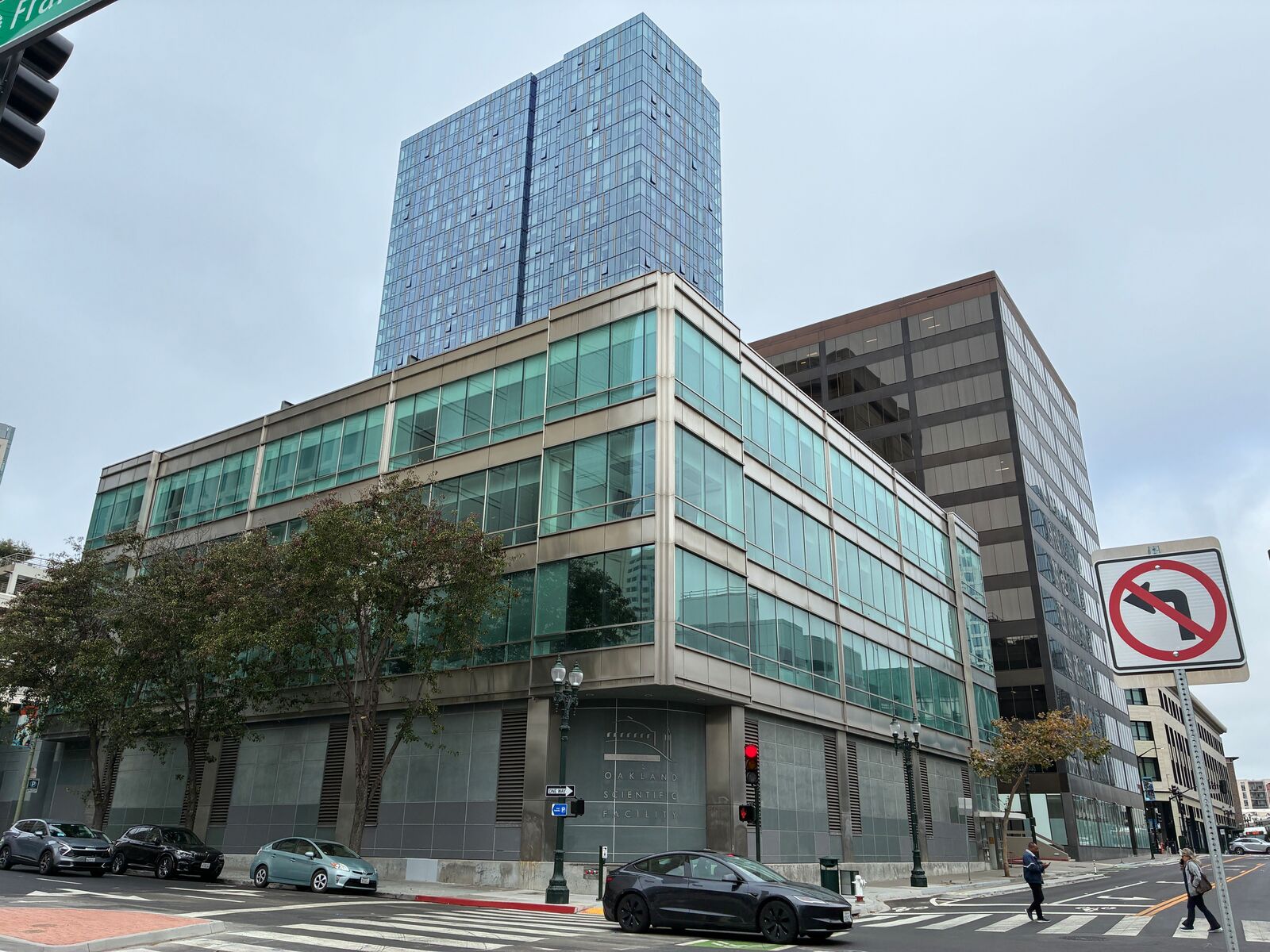 Behring Companies plans to transform a building at 415 20th St. into a data center supporting AI. Credit: Darwin BondGraham/The Oaklandside
For Pechenuk, artificial intelligence is not only an advertising tool but also the product of an industry she’d want to attract as mayor. To her, it’s purely another technological development we’ll eventually rely on, like the lightbulb or the TV.
“I don’t think people should be afraid of AI coming into Oakland,” she said. “If you think about what physical AI does in manufacturing, it’s amazing. When you look at auto production, mining, it has such advanced capabilities.”
Pechenuk argued that AI will create jobs rather than destroy them, if done right: “People have to create it, they have to program it, they have to run it.” (There are conflicting studies and analyses on the current and future impacts of AI on job loss.)
The San Francisco Business Times recently reported that Jeff Bezos’ physical AI startup, Prometheus, is renting warehouse space in West Oakland. So is Tesla’s automated vehicle arm.
The news came at the same time as the revelation that a developer is seeking to install a data center in a downtown Oakland building. Together, these announcements caused a flurry of speculation, excitement, confusion, and concern about the impacts on Oakland’s workforce, housing costs, and environment.
As mayor, Barbara Lee has largely embraced the expansion of the tech industry in Oakland. She recently obtained funding for a city staffer focused on making it easier for “mission-driven” startups to do business in the city. This week, she posted Instagram photos where she’s posing with a humanoid robot developed by a company called Formic, which she says recently opened in Oakland.
“We’re building an economy that competes on the world stage,” she wrote in the caption.
As for political advertising, the videos and flyers in the 2028 and 2030 races will probably be more accurate and harder to distinguish from reality.
But Ross thinks the real advantage AI provides campaigns is not found in the visuals but in its ability to process and act on large amounts of data. According to him, voters might expect to see ultra-targeted political ads in the future — created and disseminated in seconds by bots and totally different from the ones fed simultaneously to your brother, colleague, or friend.
“*” indicates required fields