
A 13-year-old has been sentenced to 365 days in the New Horizons program at the Juvenile Justice Campus in connection with the shooting death of 19-year-old Edgar Hernandez.
The sentence comes just over two months after the June shooting at the Reflections apartment complex in Fresno.
According to Fresno police, officers were first called to the apartment complex after a gunshot was reported around 8 p.m.
Officers initially found no evidence of a shooting.
Minutes later, police received another call about a victim inside an apartment.
Hernandez was found suffering from a gunshot wound. He was taken to the hospital, where he later died.
Police arrested the 13-year-old, who was initially booked for manslaughter.
The teen appeared in juvenile court Friday for the disposition hearing, where the court ordered him to spend 365 days in the New Horizons program, a rehabilitation program for juvenile offenders.
Hernandez’s mother, Emma Infante, said the sentence is difficult to accept.
“My son for the justice system was only worth one year. One year. I’m not going to get my son back. This kid, he’s gonna get out in one year,” Infante said.
Infante also questioned the teen’s account of what happened, saying he initially claimed the shooting was an accident before later acknowledging that he knew the gun was loaded.
She said she believes the sentence does not provide enough accountability for her son’s death.
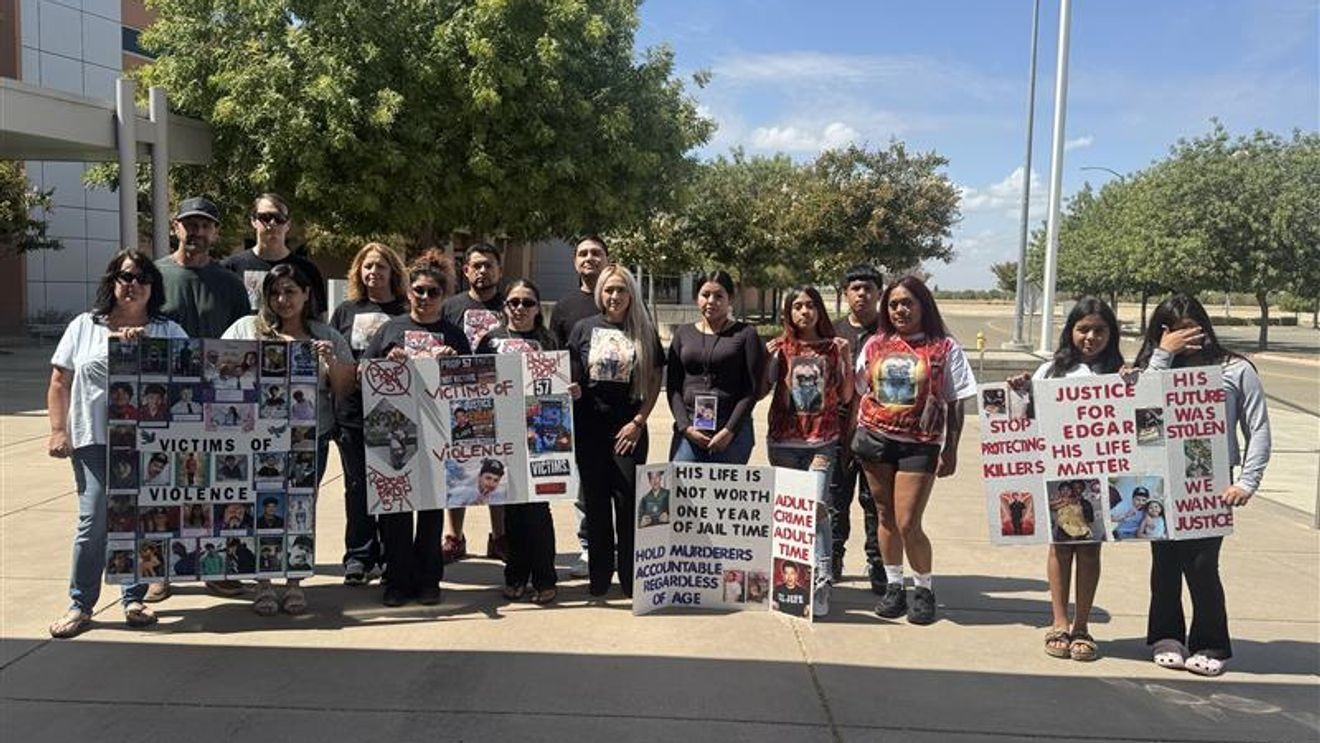
Infante was joined outside court by other families who have lost loved ones in cases involving juvenile offenders.
Samantha Bautista, whose 16-year-old son was killed in another case, said her son’s killer received a seven-year sentence.
She said the juvenile later assaulted another person while in custody.
“It shows that it’s not working,” Bautista said, referring to the system’s focus on rehabilitation.
Susan Grote also attended the hearing.
Grote said four members of her family were killed in January 2024 and her family is still going through the juvenile court process.
She said seeing another family go through a similar experience has strengthened her push for changes to California’s juvenile justice system.
“We want to repeal Prop 57,” Grote said.
The families say their concerns go beyond Hernandez’s case.
They are calling for changes to Proposition 57, which was approved by California voters in 2016 and changed how juveniles accused of serious crimes are handled.
Under the law, prosecutors cannot directly send juveniles to adult court. Instead, a juvenile court judge determines whether an eligible juvenile should be transferred to adult court.
The law also placed a greater emphasis on rehabilitation within the juvenile justice system.
Critics argue the law has shifted the balance too far toward rehabilitation and away from accountability for serious offenses.
Supporters, however, say rehabilitation can help reduce future crime and give young offenders a chance to change.
Stephen Quick, who has been advocating alongside families affected by juvenile crime, said the group plans to push for a repeal of Proposition 57.
“They’re at the point now where we are going to try to get signatures to repeal Prop 57 altogether,” Quick said.
The group says it plans to begin collecting signatures next summer for a measure it hopes to place on the 2028 ballot.
The families say they will continue showing up for one another at court hearings and advocating for changes they believe could prevent other families from experiencing the same pain.
FOX26 News reached out to the Fresno County District Attorney’s Office.
The Fresno County District Attorney’s Office said the 13-year-old pleaded to involuntary manslaughter and was ordered to spend 365 days in the New Horizons program.
The DA’s Office said the case was filed as involuntary manslaughter because the evidence available to prosecutors did not establish the intent required for a murder charge.
Prosecutors also said they asked the court during Friday’s hearing to reject the negotiated resolution after receiving additional information in the probation report, including statements from the teen that differed from his earlier account.
The court denied that request and proceeded with the disposition.
The DA’s Office said the case is governed by California’s juvenile justice system because the teen was 13 at the time of the shooting. That system operates under a different legal framework than the adult criminal justice system and places rehabilitation at the center of its approach.
[RELATED] VOTE: Should teens accused of serious crimes be tried as adults?
California law also prohibits a minor under 16 from being transferred to adult criminal court.
The DA’s Office said it recognizes the difficulty Hernandez’s family is facing and respects their grief and frustration following his death.