
At Redondo Beach, visitors pass a bronze bust of George Freeth near the pier. None of them stop. The bust sits along a waterfront crowded with beachgoers and lifeguards, a scene that is common across California’s coastlines today.
As the stream of passersby suggests, the Native Hawaiian waterman is largely unknown today. More than a century ago, however, he transformed Californians’ relationship with the ocean, turning it from something many feared into a place to swim, surf and enjoy.
“It was like a line in the sand. Before George Freeth and after George Freeth are two totally different things,” Redondo Beach Mayor Jim Light told SFGATE by phone from his office, where a photo of Freeth hangs on his wall.

A bronze bust of surfing pioneer George Freeth at the Redondo Beach Pier in Redondo Beach, Calif. (Christine Hitt/SFGATE)
A history buff who surfed for decades, Light said that as he learned more about Redondo Beach’s past, Freeth became a personal hero. “He just really spread the whole waterman culture through Southern California, and I’m proud that it started right here in Redondo,” he said.
Before Freeth arrived, California residents did go to the beach for fun, but many didn’t go that far out in the water, Patrick Moser, author of the book “Surf and Rescue: George Freeth and the Birth of California Beach Culture,” told SFGATE. Many people were afraid of the waves, and they associated the ocean with drownings and boats capsizing. Freeth helped change attitudes toward the ocean, teaching people that waves and currents could be safely enjoyed.
“He brings a Hawaiian perspective to California, which is that you can enjoy the ocean if you learn about it and learn how to respect it,” Moser said.

The Redondo Hotel and bathhouse with the Atchison, Topeka & Santa Fe train in foreground, between the hotel and sunbathers, in Redondo Beach, Calif.. (CSU Dominguez Hills – Archive)

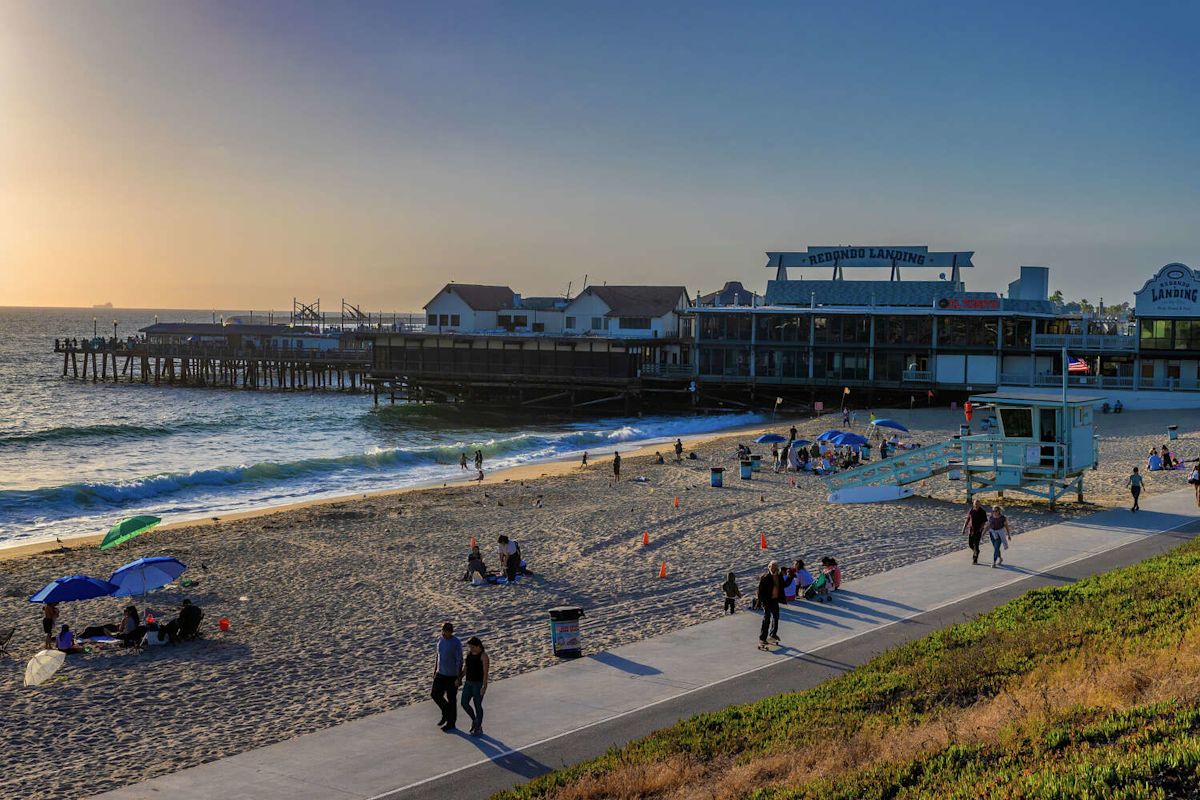
A view of Redondo Beach, Calif., from the pier, taken in August 2026. (Christine Hitt/SFGATE)
From surfing to lifesaving
Freeth arrived in Southern California in 1907 to give surfing demonstrations, first drawing crowds at Venice Beach. Later, he was hired by businessman Henry Huntington to surf and work as a lifeguard in Redondo Beach. But Freeth didn’t simply demonstrate the sport. He stayed for several years, giving surf lessons and training others who would go on to teach more Californians to surf.
“He was the engine behind surfing. So not only putting on exhibitions himself, but training lifeguards. He started a surf club, he gave lessons to people on the beach,” Moser said. “He really was the catalyst for the popularity of surfing in California.”

A black-and-white photograph shows surfing legend George Freeth and two other surfers riding a wave in Hawaii, circa 1907. (Jim Heimann Collection/Getty Images)
Freeth also taught people to swim and dive, changing the way lifesaving was practiced on the coast. He first volunteered as a lifeguard at Venice Beach and later worked in Redondo Beach, guarding both the beach and its plunge, a large swimming pool that was a popular attraction at the time.
In December 1908, Freeth singlehandedly rescued seven fishermen at Venice, diving off the pier three separate times into cold, stormy surf to reach them, according to Moser’s book. He later received a Gold Life-Saving Medal from the U.S. Treasury for the rescue.
“He was really the first one to professionalize the lifeguarding service,” Moser said, adding that up until Freeth, the lifeguards were often untrained seasonal volunteers who were good swimmers. “They had these boats that they would row out, but a lot of times, by the time you got into the boat and rowed out, you know, the person was dead or they disappeared,” Moser said.
So Freeth began training life savers, as they were called, to surf, read ocean conditions, swim through storm surf and become stronger all-around watermen. Around 1912, he also experimented with new lifesaving equipment.
“He was the first one to use a three-wheeled motorcycle on the beach,” Moser said. It was designed to quickly carry rescuers and equipment along the beach, instead of forcing life savers to run long distances and tire themselves out before swimming into the surf. Freeth also invented a torpedo-shaped rescue buoy, and Freeth demonstrated its use in a 1913 silent short film at Redondo.

FILE: A bronze bust of surfing pioneer George Freeth at the Redondo Beach Pier in Redondo Beach, Calif., with a photo of Freeth standing behind the unveiled bust, which is covered in flower leis. (Scott Varley/MediaNews Group via Getty Images)
His lasting legacy
Freeth’s relationship with the ocean began in Hawaii. Born in 1883 to a family of English and Native Hawaiian ancestry, he grew up during the reign of King Kalakaua, who encouraged a revival of Hawaiian cultural traditions, including surfing. The sport had declined after Western contact – Hawaii’s population plummeted due to introduced diseases, and missionaries discouraged cultural practices.
Freeth, who became an accomplished swimmer, diver and surfer in Hawaii, helped renew interest in surfing in Waikiki at the turn of the century.

The exterior of the California Surf Museum in Oceanside, Calif. (Christine Hitt/SFGATE)

An exhibit on pioneer surfer George Freeth at the California Surf Museum in Oceanside, Calif. (Christine Hitt/SFGATE)
In Oceanside, the California Surf Museum‘s exhibit “Surfriding: Hawaiian Royalty’s Gift to the World” features George Freeth among other figures who took surfing beyond the islands, including Duke Kahanamoku and Princess Kaiulani.
Standing among that history, Freeth’s role becomes clearer. He was not the first Hawaiian to surf in California. Three Hawaiian princes had ridden waves in Santa Cruz in 1885, and a plaque there commemorates that feat. But unlike others who surfed on these shores before him, Freeth stayed, taught others and spent years working directly with Californians.
Jim Kempton, executive director of the California Surf Museum, said that distinction is key. “He really embedded surfing into California’s consciousness,” Kempton said.
Freeth was 7 years older than Kahanamoku and was already an established waterman when Kahanamoku rose to international fame after breaking records and winning Olympic gold.
“I think his legacy of influence was probably larger than Duke’s in that sense,” Kempton said. Duke’s fame and celebrity status, however, did bolster the sport even more.
Kahanamoku and Freeth were friends, Kempton said. Freeth later coached Kahanamoku at the Los Angeles Athletic Club, helping him improve his swimming technique. Freeth had Olympic ambitions but because he was a paid lifeguard and instructor, he was considered a professional and ineligible to compete at the Olympics himself.
“Now it’s just all pros, you know, there’s just no line at all,” Kempton continued. “And here a guy who wasn’t even doing it in a sport, it was an ocean activity, and he was unable to join the Olympics because he wasn’t an amateur.”

A view of Redondo Beach, Calif., from the pier, taken in August 2026. (Christine Hitt/SFGATE)

Redondo Beach Mayor Jim Light at the first George Freeth Open Water Polo Tournament, which took place in Redondo Beach, Calif., in September 2025. (Jim Light)
Freeth died in San Diego in 1919 at age 35 from the influenza epidemic. Moser said he found no evidence that Freeth had married or had kids, but disputes portrayals of him as a lonely figure who died far from home. “He had community wherever he went,” Moser said. “He built community.”
More than a century later, Light, Redondo Beach’s mayor, is among those trying to keep Freeth’s name alive. When local water polo players proposed holding an open-water tournament in the harbor, Light had one request: that it be named for Freeth, who also helped introduce the sport to the West Coast. The George Freeth Open Water Polo Tournament in 2025 became the annual George Freeth Memorial Cup.
“I think it’s a shame that George Freeth isn’t better known when you look at his accomplishments,” Light said. But while his name may not be widely known, the surfing and beach culture he helped start in Southern California is still everywhere.
More Hawaii News
– A new type of Hawaii visitor is emerging
– Fight brews as an iconic Hawaii beach disappears
– Why Lahaina remains largely untouched nearly 3 years after the fire
– Hawaii visitors are getting stranded on Maui’s forbidden back roads
We have a newsletter all about Hawaii, with news, tips and in-depth features from the Aloha state. Sign up here.
This article originally published at George Freeth, the Hawaiian man who changed California’s beaches forever.