
Here are the morning’s top stories on Monday, September 7, 2026
“You Dance For Your Loved Ones. You Dance For Someone Who Can’t Dance.“
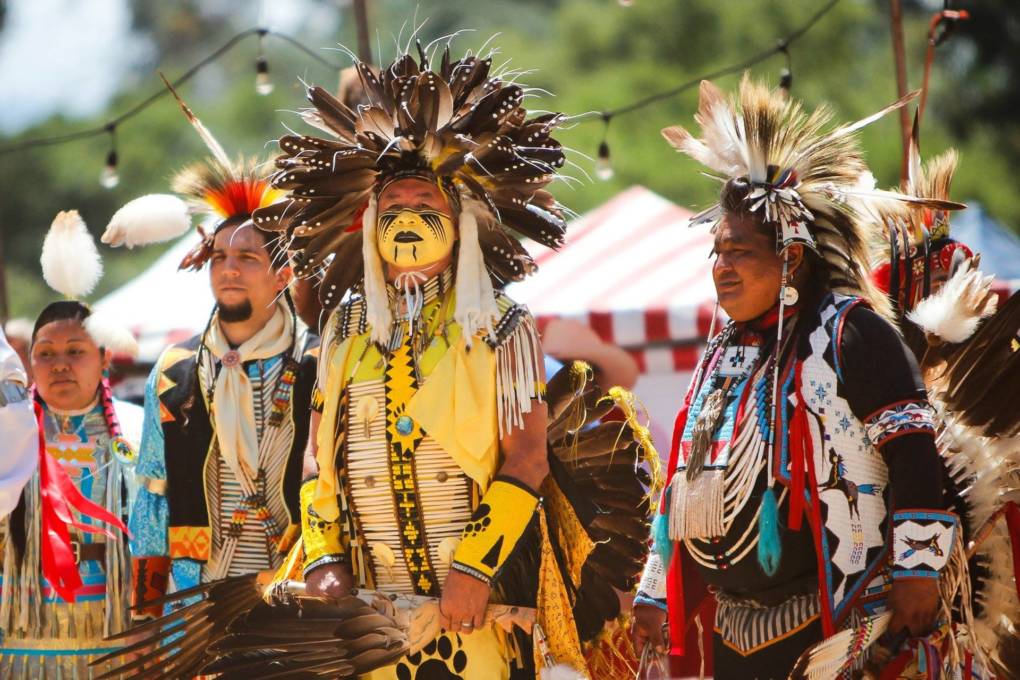
It’s a Saturday evening, and a steady drum is beating as dozens of people representing many Native American tribes circle a large patch of grass. Small kids dance alongside adults, each in their own tribal colors and with their own rhythm. Dozens more watch intently from the sidelines.
The grassy area is known as an “arena,” and it’s tucked into a golden hillside in eastern Fresno County. This is a social gathering known as a “powwow.”
Although Native tribes have held ceremonial gatherings for centuries, powwows are a 19th century tradition, and late summer is California’s busy season. These gatherings are formal ways of exchanging culture, but what tribes really come here to do is dance – what they consider as “spreading medicine.”
Waylon Burrough organized this celebration. He’s a member of the Chukchansi Indians.
“Dancing is healing,” he says. “You dance for your loved ones. You dance for someone who can’t dance.”
He says at powwows, everyone brings something special.
“Each different regalia has a different meaning. And each dance has a different story behind it.”
Tribal members come from all over. There’s Choctaw, Mono Indians, Seminole, Lakota, and Navajo, but Burrough says where they come from isn’t the story – it’s what happens when they get here.
“We dance in a circular motion. And clockwise motion. And to the beat of the drum. So it’s like dancing with time.”
Everyone moves to the same beat, like a heartbeat.
Twirling in the arena is Murphy Bear-McCloud. He’s 17 years old, and belongs to the Dunlap Band of Mono Indians as well as a tribe in Oklahoma. He’s wearing yellow and orange – with two fans of feathers called bustles that look like fireworks on his back.
“The bustles used to be flat, not big. And they used to be a lot smaller but now they just got bigger because everyone wanted a flare,” says Bear-McCloud.
He shares more with me after his dance… once he catches his breath.
“I do this powwow for a living. I’ve been dancing since I was real young, when I could walk. It’s just been sticking with me my whole life.”
This time of the year is his busiest.
“Usually I do it like weekend after weekend after weekend. Like usually I’m never home for weeks. So I’m not going to be home until November.”
One of his fans interrupts our interview.
“This guy’s going to be a superstar in life right here. You know why? Because he’s guided by the best and he’s got the best. And this is his uncle Craig Hackett speaking. And if anybody’s got anything to say to this boy, you can find me. Just say ‘whats up.’”
That’s what you call a proud uncle.
By nightfall, it’s time to compete for prize money.
Lilliane Shakespeare Largo is waiting for her turn.
“I’m from the Diné Nation, which is Navajo, and I’m also part of Northern Arapahoe and Mescalero Apache,” says Shakespeare Largo.
She’s 25 and came in from New Mexico.
“We drove all night, it was about a 10 hour drive.”
She’s performing the “Women’s Northern Buckskin” dance. A large feather points up from her head and curtains of white buckskin fringe hang from her brightly colored shawl.
“My favorite color is blue. So I made my whole bead work blue. And then they’re family designs,” she says.
In the arena, Largo and the other women take one step. And then another. Their buckskin sways in the wind – almost in slow motion. Then, time is up.
The winner? Largo – she’s taking home 1,000 dollars. This is a special win for her.
“I’m five months postpartum. So it’s a lot harder for me. But I feel happy when I do perform well.”
Her dad is holding her five month old baby as they celebrate. Here, three generations point to the spirit of these powwows. Tribal members don’t just come to dance for themselves. But also for their ancestors, and the next generation, who will one day learn to dance to their own beat.
The Marine Mammal Center in Sausalito is fielding up to 600 calls a day about sea lions that appear confused, lethargic, and, in some cases, dead. The center has treated more than 100 sea lions — above the yearly average of 75 to 90 — with the majority of these cases occurring since the start of July.
An algal bloom is poisoning mammals with a toxin called domoic acid, which can cause seizures and heart failure. The animals ingest the naturally occurring neurotoxin by eating fish or shellfish.
Giancarlo Rulli is a spokesperson for the center.
“We’ve seen a major flare-up in Monterey and Santa Cruz counties,” Rulli said. “This is highly emotional, and it can be very disturbing to see an animal that’s not in control of itself out on the beach.”
Additional rescues have taken place in San Mateo, San Francisco, Marin and Sonoma counties. The center has also treated a handful of northern fur seals. Treating a single mammal can require up to six trained responders and may involve repeated doses of anti-seizure medication.
“It’s brutal on the animals,” Rulli said. “We are seeing animals die out on the beaches. There are a fair amount of carcasses out there. We’re seeing animals pass away in transport being brought back to the hospital.”
Rulli said the cases are a sign that the toxin has worked its way through the food chain in “a short-term burst,” but said the center is also seeing chronic cases where sea lions have “brain lesions and permanent heart damage.”
Along the northern California coast, marine algal blooms are primarily caused by natural factors such as ocean upwelling of nutrient-rich water and warm ocean temperatures.
Polluted runoff from agriculture and other human activities also feed blooms, a factor projected to become more frequent and severe due to human-caused climate change.
Rulli says that already warmer-than-normal sea surface temperatures, and further warming from the climate pattern El Niño, could exponentially increase the number of affected mammals.
Local officials expect that security plans for the 2028 Olympics will require unhoused people to vacate areas around competition venues, but exactly how many people is unclear.
The new report from academics at USC and UCLA indicates that potentially close to 6,000 people could be displaced. That figure is more than three times higher than an estimate the L.A. County Department of Housing and Homelessness gave LAist earlier this year.
“That just seemed obviously low,” said Randall Kuhn, a UCLA professor and demographer who co-runs a monthly survey of unhoused people in L.A. In total, there are around 49,000 unsheltered people countywide, according to the 2026 point-in-time homeless count.
Kuhn and his colleagues came up with their higher estimate using numbers from that count, which estimates the number of unhoused people by census tract. They then adjusted those figures based on how much each tract overlapped with a potential Olympic security perimeter and the length of walkable and major streets where unhoused people were likely to be located.
”The numbers just give us a good starting point, right? What really matters is the people in those buffers.”