
Adolph Sutro was a unique millionaire. A German Jewish immigrant who arrived in the United States in 1850, he amassed his fortune in Virginia City, Nevada, at the Comstock Lode – not directly via mining but thanks to his engineering brilliance. The Comstock silver mines were deep and prone to flooding, and they trapped noxious gasses, all factors detrimental to unearthing the valuable ore.
Sutro invented a solution: a nearly 4-mile-long drainage tunnel to clear water and fumes from the mine shaft. He charged mining companies a fee to utilize this game-changing creation and eventually sold his stake in it, making millions.
He came to San Francisco with the money. Instead of hoarding his wealth, Sutro built beautiful buildings and facilities, which he opened up to the public.

Aerial view of the Cliff House and Sutro Heights in San Francisco. (Golden Gate NRA Park Archives)
Though he’s best known for his eponymous baths and perhaps resurrecting the Cliff House, Sutro offered another gift to San Francisco residents: sprawling, manicured gardens just steps away from his long-gone Sutro Heights mansion.
Sutro Heights
Side and front view of the Sutro residence in San Francisco. (Golden Gate NRA Park Archives)
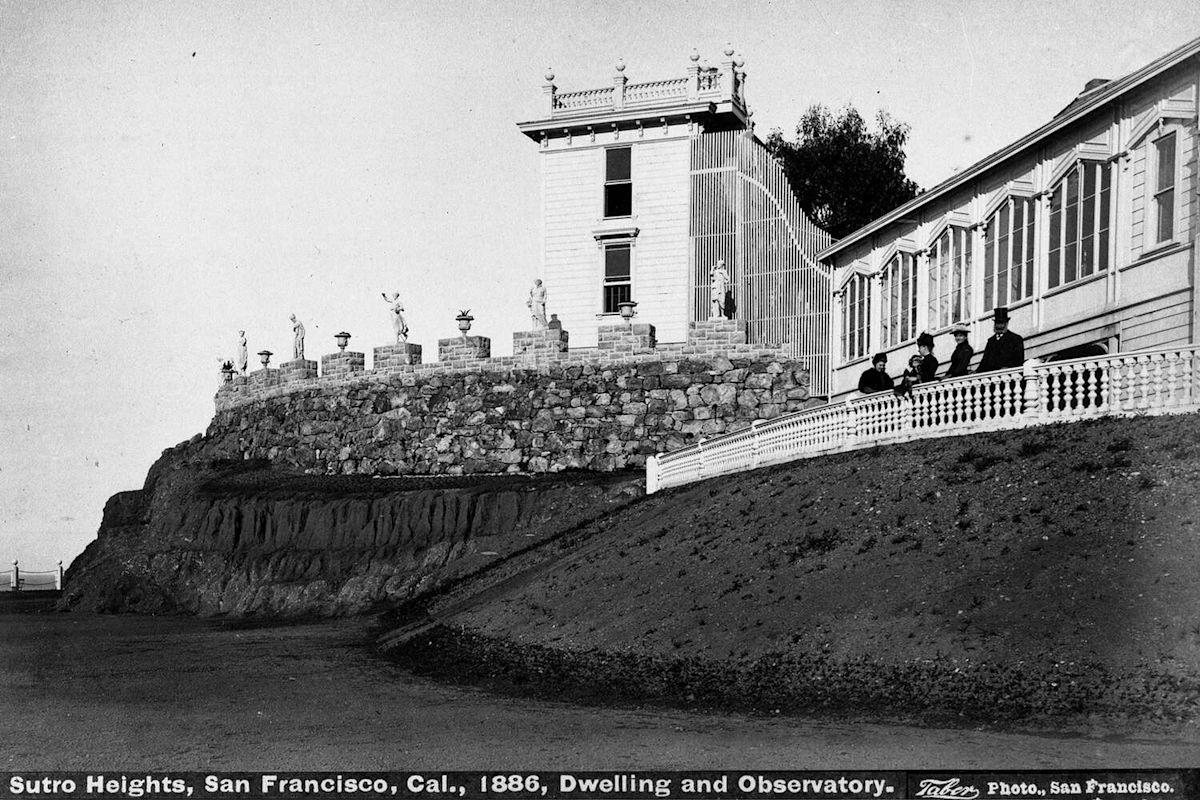
In 1881, when the baths were a distant dream, Sutro purchased 22 acres of land at the westernmost edge of San Francisco for $15,000, about $500,000 today. Over the years, he built a conservatory, an observatory and a water tower, and he established expansive gardens dotted with statues on the grounds. He also customized a home for himself and his family.
The residence was initially erected by the first owner of the Cliff House, James Butler, in the 1860s. Sutro took over ownership from the next owner, Samuel Tetlow, and made a few additions, including a side room, a terrace and statues placed around the exterior wall of the oceanfront residence.

Adolph Sutro’s residence and observatory, San Francisco, in 1886. (Golden Gate NRA Park Archives)
The Italianate-style mansion overlooking Sutro’s prized creations featured dozens of large windows to soak in the light and scenery, horizontal wood siding, and an ornamental porch with a distinct wooden parapet. The intricate railings ringing the house were an Eastlake element, which was popular at the time, according to NoeHill.
Over the decades, he hosted some of the most important figures of the time, including President Benjamin Harrison, Oscar Wilde and Andrew Carnegie. But that wasn’t the full picture. Despite owning around a tenth of San Francisco at one point, Sutro opened his marvelous gardens to the public.

The photo gallery at Sutro Heights in San Francisco, circa 1894-1900s. (Golden Gate NRA Park Archives)
Visitors were met with a towering gate flanked by two lions before entering Palm Avenue. Once inside, they entered another world with over 200 European-style statues and numerous fountains. A sign posted at the entrance laid out the simple rules: People could stroll around free of charge by picking up an admission card at the Cliff House but were prohibited from bringing one item. “Positively no lunch baskets allowed in these grounds,” the notice read. Sutro didn’t want his visitors to get too comfortable.

Lion at main gate in Sutro Heights, San Francisco, in 1886. (Golden Gate NRA Park Archives)
The stately statues on the grounds also held a secret in plain sight: Many of them were likely purchased from a catalog. While their appearance gave them the aura of rare, hand-carved antiques, National Park Service research indicates that many came from a London manufacturing company named F. Rosher and Co. Chances are that Sutro ordered these Greco-Roman replicas in bulk to fill out his estate.
Decline
Maintaining a home and vast oceanfront garden filled with plaster artwork proved to be difficult, even for a family as well-resourced as the Sutros. Decades of relentless battering by the Pacific Ocean’s salty air and winds took a toll on the grounds, especially the statues. As they cracked and deteriorated, park workers took a low-lift approach to the problem: Damaged figures were either hauled away or buried, leaving a hidden layer of history under the soil.

Adolph Sutro’s house and parapet surrounding the residence in San Francisco. (Golden Gate NRA Park Archives)
Adolph Sutro died in August 1898. His daughter, Emma Sutro Merritt, moved into the mansion and took over the management of the grounds. Committed to her father’s vision, Emma kept the gardens open but reduced the grounds staff, which at one point spanned 17 employees. She spent four decades living on the property, watching the once-lustrous surroundings take on an apocalyptic feel.
The Sutro family had given the land to the city in 1920 so it could be “forever held and maintained as a free public resort or park under the name of Sutro Heights.” But after Emma’s death in 1938, the Works Progress Administration took stock of the timeworn structures and began tearing them down. The mansion was demolished the following year.

A segment of the wooden parapet that surrounded the home is now stored at the National Park Service archives in the Presidio, offering a rare glimpse into the past alongside century-old photographs. (Charles Russo/SFGATE)
While the residence has vanished, bits of it survived the wrecking crew and remain to this day. A segment of the wooden parapet that surrounded the home is now stored at the National Park Service archives in the Presidio, offering a rare glimpse into the past alongside century-old photographs.
If you walk around Sutro Heights today, signs of the grandeur remain. Near the cliff’s edge, at the end of what was once Palm Avenue, the original tiled floor of the conservatory is still visible, sitting out in the open air.
More Local
– The rent gap between SF and LA is ‘kind of nuts’
– An army of stylists is helping San Francisco tech workers dress for dates
– Bay Area town moves to ban all tobacco and nicotine sales
– ‘I’d love to shake his hand’: Anonymous donor saves a piece of SF Chinatown history
Get SFGATE’s top stories sent to your inbox by signing up for The Daily newsletter here.
This article originally published at Adolph Sutro’s forgotten SF mansion with a graveyard of crumbling statues.