
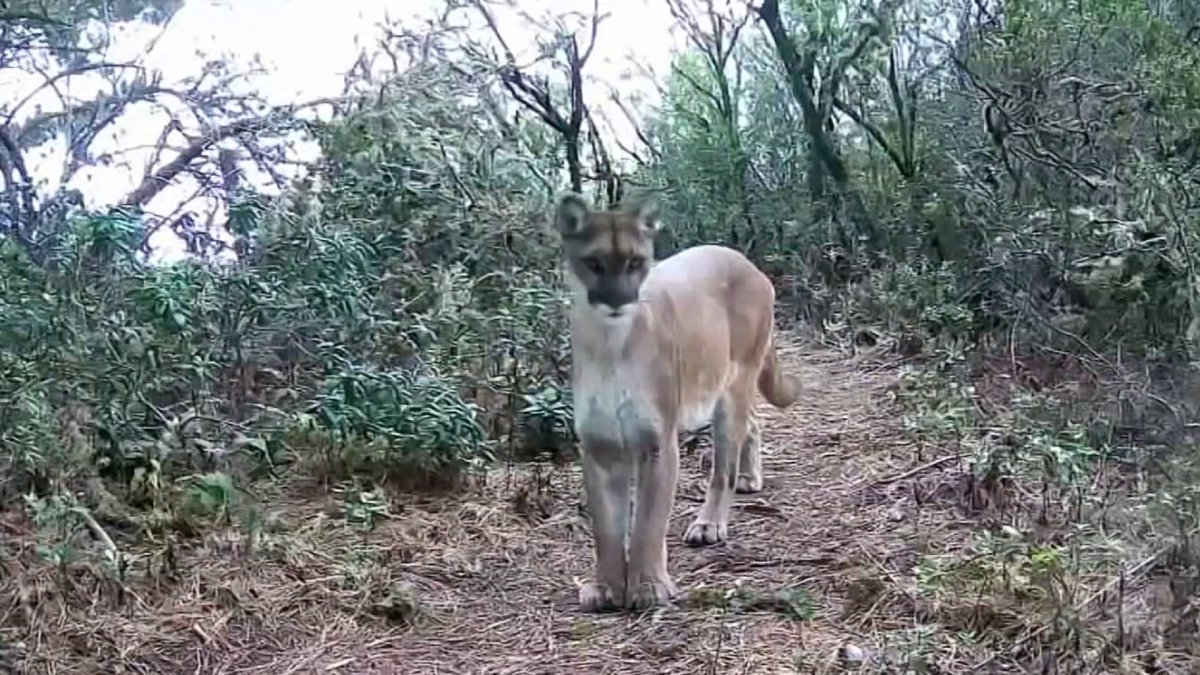
Before hikers even hit the trail at the Sierra Vista Open Space Preserve in San Jose, they are met with a warning: a mountain lion was reported in the area of the Calaveras Fault Trail.
Signs spell out what to do if visitors come face-to-face with one of the big cats. Some hikers stopped to read the warnings, including Will, who recently moved to San Jose from Tennessee.
“Second thought was dang … I’m already up here so might as well hike anyway,” Will said, adding, “Hopefully we don’t see any.”
The advisory comes just days after a hiker on a nearby trail reported encountering a mountain lion and had to be airlifted to safety. She was not hurt. Experts said that encounter was not considered aggressive behavior, but it serves as a reminder that these trails are active mountain lion habitats.
“If it’s evening, it’s better not to hike alone. That just decreases the risk of interaction,” said Zara McDonald, a biologist with the Bay Area Puma Project. “And if you are on trails that are known areas where mountain lions move, you probably shouldn’t be out there at night.”
While seeing a mountain lion on a trail is expected, seeing one in the middle of San Francisco is a different story.
Over the weekend, a mountain lion was spotted in a tree near Fell and Baker streets in the Panhandle neighborhood. A park ranger confirmed seeing the animal, triggering a joint response from police, animal control, and wildlife officials. By Sunday, authorities said the lion had left the area on its own.
Experts note that kind of urban sighting is rare, but not unheard of. McDonald, who directs the Bay Area Puma Project to help humans and wildlife coexist, said mountain lions from the Santa Cruz Mountains sometimes make their way into the city.
In January, another mountain lion wandered through San Francisco’s Pacific Heights neighborhood before it was captured and returned to the wild.
“As habitat becomes more fragmented around the Bay Area and California, cats are forced to come through urban areas to pass through and sometimes they get stuck,” McDonald said.
When they do end up in residential neighborhoods, McDonald said the best thing people can do is give them an escape route. She advises people not to approach, run, or turn their backs.
“If for some reason it comes toward you, you act big, you make noise, you do not turn your back and run away,” McDonald said. “If you have small children, pick them up.”
Wildlife experts stress that mountain lions generally want nothing to do with people, but whether walking on a foothill trail or through a San Francisco neighborhood, the best defense is simply knowing they may be out there.