
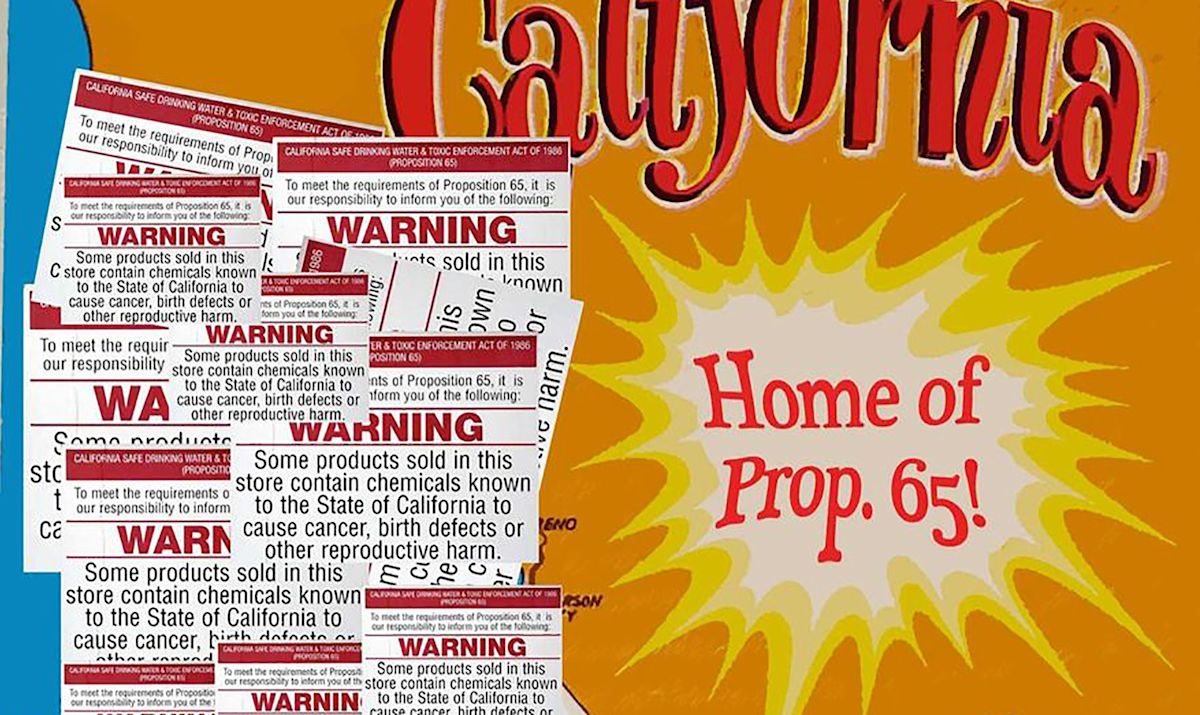
Lots of shoppers have poked fun at the excessive use of the labels plastered on assorted objects and items saying, “Warning: This item contains chemicals known to the State of California to cause cancer and/or birth defects or other reproductive harm.” That’s because this label doesn’t actually measure the risk to humans, only that a product is hazardous in some circumstances — like how wood dust is carcinogen, so things made of wood need this label. Or how alcohol has this label. It’s well-known that alcohol has lots of downsides, but having one drink will not give you cancer.
There’s a lot that common sense can help you sort out in situations like this.
But the reason that items have the disclaimer on them is because of California’s Proposition 65, which became law in 1986. Prop 65’s official name is the Safe Drinking Water and Toxic Enforcement Act of 1986. The State of California’s Office of Environmental Health Hazard Assessment (OEHHA) administers the Proposition 65 program and the California Environmental Protection Agency (CalEPA) determines whether chemicals meet the requirements to be placed on the Prop 65 list.

California’s Prop 65 even warns people about walking through parking garages. (Image by ZikG, Shutterstock)
According to the OEHHA, the goal of Prop 65 is to “provide warnings to Californians about significant exposures to chemicals that cause cancer, birth defects or other reproductive harm.” By requiring that this information be provided, they say that Proposition 65 enables Californians to make informed decisions about their exposures to these chemicals. Proposition 65 also prohibits California businesses from “knowingly discharging significant amounts of listed chemicals into sources of drinking water.”
What’s so interesting about Prop 65 is that the list contains hundreds of chemicals, some of which are even naturally occurring. But this list doesn’t ban anything. Instead, the goal is to inform consumers about potential hazards to their health.
While there might be some great benefits of this law, like how some manufacturers have changed what products they use to make items explicitly to avoid having to put the label on. That means people are exposed to less potential carcinogens. There are also lots of downsides, like how people can be desensitized to seeing the label and how some items that haven’t been widely proven to be carcinogenic still have the label on them.
The goal is to communicate to people that a particular substance could mean a risk to their health, which makes people think that the substance is automatically dangerous. In reality, many things on the list might be a health hazard under only a narrow window of conditions, but the real-world exposure to this substance is probably far below levels of exposure that present significant risk.
The Prop 65 list is 23 pages long and as of July 31, 2026, contains 879 substances.
Considering the legal cases and public discourse around the herbicide glyphosate, it’s probably no surprise that this chemical is on California’s list. It was added in 2017.
The State of California did not do its own scientific review on glyphosate. So, I would argue that it truly isn’t “known to the State of California” that glyphosate causes harm to people. However, California law requires that chemicals be added to the Prop 65 list when the International Agency for Research on Cancer (IARC) classifies them as “carcinogenic” or “probably carcinogenic.”
In 2015, the IARC classified glyphosate as “probably carcinogenic to humans.” This is what kicked off the listing under Prop 65. The IARC does hazard identification, not risk assessment (to explain, risk is equal to hazard plus exposure). According to the IARC monographs program (which is what is used to determine if a substance is classified as carcinogenic or probably carcinogenic), the agency’s hazard identification determines whether a substance can cause cancer under some circumstances. It does not measure the probability that cancer will occur, by taking into account the level of exposure to the agent. An example would be that hazard identification shows that cigarettes cause cancer, but it doesn’t take into account that you might only smoke one cigarette (which is not very likely to cause cancer) in comparison with a lifelong smoker (who is much more likely to get cancer caused by cigarettes).

The IARC classified glyphosate as “probably carcinogenic to humans” back in 2015, and that has been debated heavily ever since. (Image by Dobrovizcki, Shutterstock)
So according to the IARC, glyphosate might cause cancer under some circumstances. Glyphosate has been repeatedly evaluated by a wide variety of organizations. The U.S. Environmental Protection Agency, which evaluates the safety of pesticides, says that glyphosate has a low toxicity for humans and is not likely to be carcinogenic to humans when used in accordance with the label. Pretty much every study other than the one completed by the IARC has found that glyphosate is not carcinogenic, especially under real-world exposure.
What makes glyphosate being on the Prop 65 list even weirder is that it has remained on the list despite a federal court blocking the state from enforcing warning labels for glyphosate. The Ninth Circuit court found that a warning label would mislead the average consumer “who would not understand that a substance is ‘known to cause cancer’ where only one health organization had found the substance in question causes cancer and virtually all other government agencies and health organizations that have reviewed studies on the chemical had found there was no evidence it caused cancer.”
The situation between glyphosate and Prop 65 shows the controversy of Prop 65. The measure can mislead consumers into thinking that things pose a bigger risk than they actually do, and it can cause warning fatigue. Warning fatigue is when people see so many warning labels that they become dismissive of them and ignore even ones that actually matter.
Warning labels such as Prop 65 don’t show the whole picture about the product in question: They don’t tell you how much exposure to a chemical is needed to cause harm or whether scientific agencies even agree about the ability of a substance to cause harm. Listing glyphosate on the Prop 65 list is just wrong since there is no proof that it causes cancer. Still, that doesn’t keep California’s Prop 65 from continuing its complicated history with glyphosate.
Michelle Miller, the Farm Babe, is a former row crop and livestock farmer, keynote speaker, writer, and online influencer who advocates for agriculture while traveling the world. She is passionate about bridging the gap between farmers and consumers, by giving science a bigger voice. Find more about Michelle on her website.
The post California’s Prop 65 and glyphosate have a complicated history appeared first on AGDAILY.