
Clinically, AI will reduce the administrative burden on physicians and advanced practice providers, allowing them to see more patients. Operationally, it will function as an early warning system, aggregating and interpreting patient data in real time to flag deteriorating patient conditions before they reach a crisis. And educationally, it will be woven into training programs so that the next generation of behavioral health professionals become adept at these tools during their formative years, making adoption second nature.
“AI is a technology that can close care gaps by helping our teams find and guide patients in their time of need,” Singh said. “It’s not enough to be compassionate with the patients who show up in person — we need to direct help wherever it’s needed, even if that means proactively reaching out to patients at home. AI can help our teams meet that standard.”
Daskalakis envisions AI enabling a new frontier of real-time patient monitoring. “Think about a day when we have wearable tools that integrate seamlessly with patient care. An AI agent will be able to track that a patient is not asleep in the middle of the night because they’ve got a watch that’s showing they are agitated and fidgety, and it can provide insights in that moment and guide patient interventions, which would not otherwise be possible,” he said.
To accelerate these advances, UC San Diego Health has partnered with West Health to launch the Gary and Mary West Intelligent Care Accelerator at UC San Diego Health.This partnership will leverage innovative and advanced technology platforms to enhance care navigation at the region’s only academic medical center, creating a national model for care delivery. It has the potential to make UC San Diego the first health system to incorporate intelligent health care design and AI-enabled care targeted specifically to behavioral health patients.
A National Model in the Making
Asked whether the hub could set a regional standard, Daskalakis pushed the framing further. “We are already leaders regionally — let’s set the standard nationally. Let’s be out in front of the curve, not behind it.”
Koh envisions the hub not as an endpoint but a hub in the truest sense — with spokes extending outward. What is learned, built and modeled at the new East Campus Medical Center hub will be shared with regional and national partners to expand behavioral health efforts to other systems looking for innovative guidance.
For Koh, who has shepherded this behavioral health hub vision through years of setbacks and pivots, the arrival of the Price gift and the green light to move forward carries a weight that transcends strategy.
“There’s a tremendous sense of duty and responsibility as we work with our teams to get this hub to where it needs to go to serve one of our most vulnerable patient demographics,” Koh said.
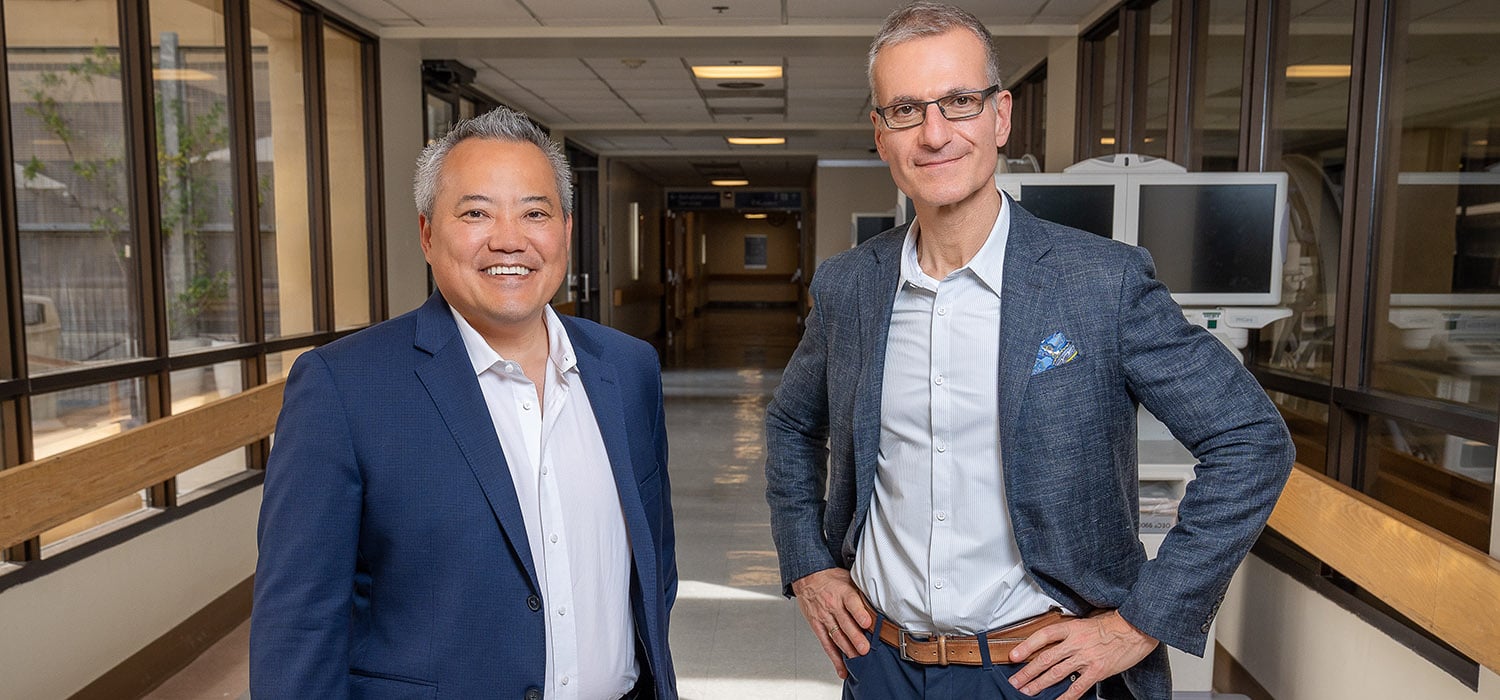
Koh and Daskalakis stand outside the doors to the west tower at East Campus Medical Center, which will become the behavioral health hub. When it opens in 2028, they imagine the help and hope it will provide to patients, such as a teenager in crisis, a family navigating a psychiatric emergency or a Medi-Cal patient reaching for a lifeline.
Those patients will find a resource that has never before existed in this region — and it won’t just be about more beds and more services but a system designed to treat the whole person, train the next generation and push the boundaries of what psychiatric research and patient care can provide to those who need it most.
“Our psychiatry department is a national leader, discovering new ways of doing things through innovative research and training,” Koh explained. “And we’ve really needed a ‘home’ for all of that. This new behavioral health hub is that promise.”