
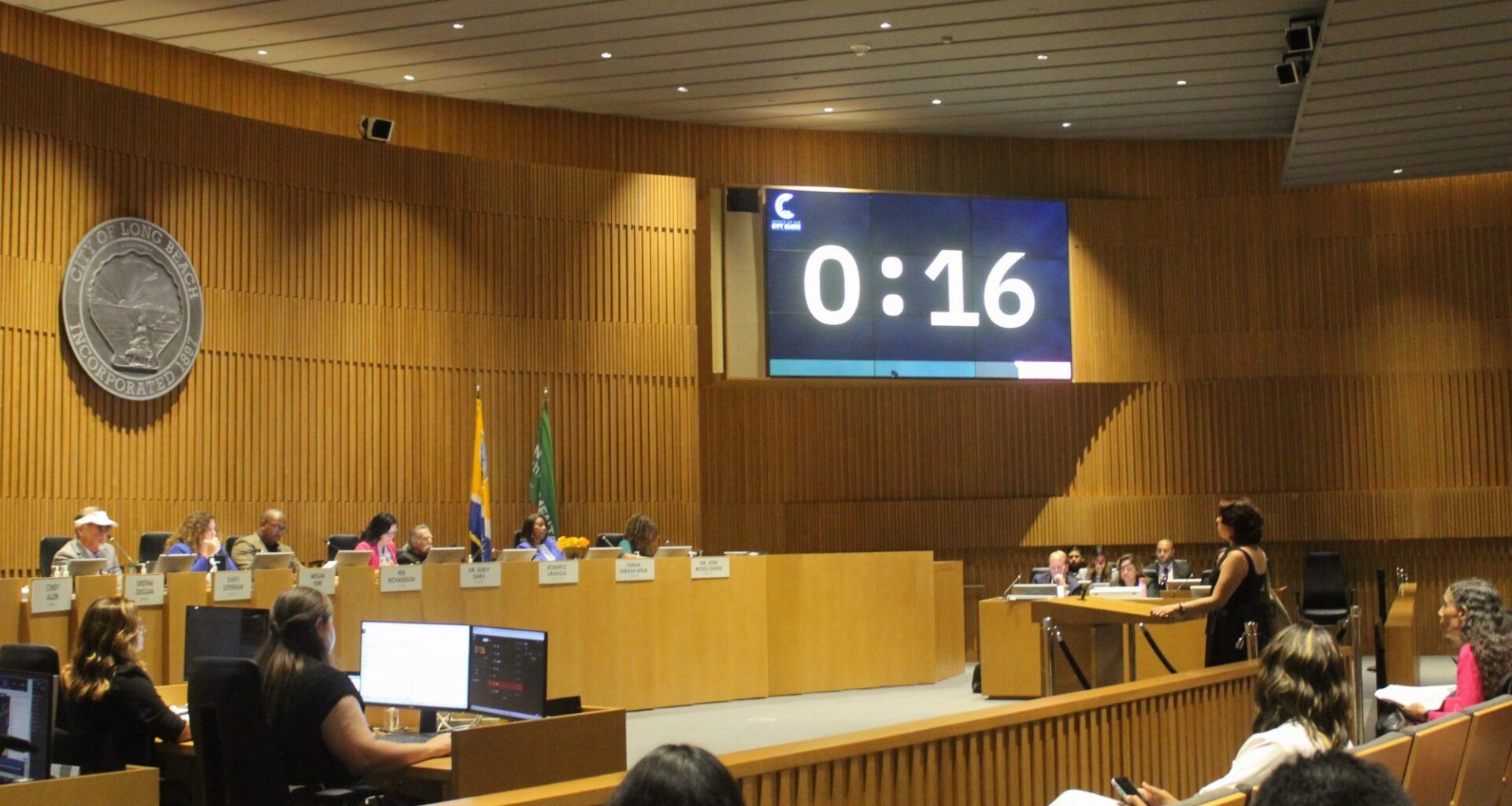
Long Beach City Council is once again discussing an ordinance that would change when residents can speak to their elected officials during meetings.
Some council members, with support of Mayor Rex Richardson, have proposed to consolidate public comment into 90 minutes at the beginning of each meeting to comply with a new state mandate but to also use the money saved to meet other community needs in the city’s 2027 fiscal year budget – which the council approved on Tuesday, Sept. 8.
In the past six months, the City Council has had several discussions about how they could reorganize meetings to make them more accessible to the public, but also accommodate state Senate Bill 707, which went into effect on July 1 and expands requirements for public participation in local government meetings. A proposed ordinance was shot down in June, which would have moved the meetings to an earlier time, moved public comments to the beginning of meetings and given people only 90 seconds to speak, among other considerations.
During last week’s meeting, Fourth District Councilmember Daryl Supernaw – with support of Vice Mayor and Seventh District Councilmember Roberto Uranga and Eighth District Councilmember Tunua Thrash-Ntuk – brought the discussion back in front of the council and Long Beach residents.
The new recommendation is to request the city attorney prepare an ordinance amending the Long Beach Municipal Code to consolidate the public comment period at council meetings into a single public comment period at the beginning of the meeting, following the call to order, roll call, pledge of allegiance, ceremonials and presentations. The public comment list would close once the last speaker is in the queue, though the mayor would have the discretion to extend the period by 30-minute increments if more speakers are still waiting at the end of the 90 minutes, according to the staff report.
The council voted 7-2 to approve the proposal, with Councilmembers Cindy Allen and Kristina Duggan voting against it. The first reading of the proposed ordinance will come back to council on Sept. 22, according to the city attorney’s office.
In a July 30 memo, the city clerk outlined the financial and operational impacts on Long Beach to comply with SB 707. SB 707 is an unfunded state mandate that requires extensive resources from the clerk’s, the Language Access Program, and the Technology and Innovation Department, according to the memo. The overall implementation cost for FY27 is estimated at nearly $487,000, leaving a net unfunded balance of about $150,000.
To align with these requirements while streamlining council meetings, city staffers recommend several municipal code amendments, including consolidating public comment into a single period at the beginning of the meeting, according to the staff report, during which each speaker has one opportunity to speak on all agenda and non-agenda items, with the total time for all public comment capped at 90 minutes.
If there are 10 speakers or fewer, people will have three minutes to speak; from 11 to 20 people, 90 seconds per speaker; and 21 or more people will have 60 seconds to speak. This is consistent with current City Council rules that allow the mayor to reduce the speaking time when there are a large number of speakers, according to the staff report.
“That 90-minute number, last time we spoke about this, was based on the average speaking time over the last three years,” said City Clerk Monique De La Garza. “In calendar years ‘23, ‘24 and ‘25, on average had anywhere from an hour and a half to an hour and 40 minutes of speaking time, and that is where we got the 90-minute proposal the last time we heard this item, so it was based on data that we gathered.”
The proposed public comment process will not apply to hearing items that would still have their own dedicated public comment period, officials said. Hearing items will be taken immediately following the public comment period.
Implementing SB 707 has required significant financial resources and staff time that could otherwise support critical city services during this challenging budget cycle, officials said. Adopting this streamlined format prior to the start of the city’s fiscal year, on Oct. 1, releases the $150,000 structural general fund allocation currently designated for SB 707 support, aligning directly with the mayor’s FY27 budget recommendations that identify this gap.
“In my budget recommendations, I outlined that there’s a financial impact to SB 707 implementation, and that those dollars could be reprogrammed if the council finds a path forward,” Richardson said. “It doesn’t necessarily need to be what was originally presented, but something that finds a more efficient way to reduce the staffing burden of the implementation of SB 707.”
Repurposing these funds will allow the city to restore community priorities, such as quality of life officers and expanded library services.
Additionally, since the July 1 implementation of SB 707, the city has not experienced significant increases in virtual public participation at council meetings, according to the staff report. To optimize resources without compromising access, city officials said, Long Beach should maintain established time limits on speakers while consolidating all public comment into a single session at the beginning of the meetings.
But not all council members agreed with these changes. Allen shared her concerns about limiting residents to only a single public comment period at the beginning of the meeting, and said it would be a significant change from how meetings are currently conducted and that it’s part of the council’s job to listen to residents’ comments.
“I do appreciate my colleagues’ efforts to streamline our public comment process, but I just can’t support this,” Allen said. “I do believe what’s being presented here today is very similar to the proposal that the majority of us had concerns (about) before the city’s legislative recess.
“I think that eliminating public comment on individual agenda items means that residents will not be able to speak specifically on the items of their choice, and they’re not able to elaborate on their choice,” Allen added. “I also think that this is going to put a lot more stress on our council offices because the public wants their issues to be heard.”
During public comment at the Sept. 1 meeting, the majority of speakers opposed the proposed ordinance or shared their concerns with the changes. Some residents said it was not fair to tie together funds for libraries with cutting down their time to speak with their elected officials.
“It is indeed a cheap shot to use the libraries as a bargaining chip,” said Long Beach resident Meg Crabtree. “The idea that if we cut our public commenting short, maybe you’ll keep our local branch open an extra day of the week – that’s, that’s low. It’s ironic too that your response to the public outcry over library services being threatened is to limit that kind of public engagement in the future.”
Former Councilmember Rae Gabelich agreed. During her time in office, Gabelich said, the city had a $130 million deficit and a three-year recovery plan but without better accountability, budget issues will continue.
“I sat where you sit,” Gabelich said. “I know how hard it can be to follow whatever that agenda item is, and the idea that you’re going to remember what the public has said to you three or four hours later is absurd.”
Despite residents asking not to approve the proposed ordinance, the majority of council members decided to move forward and supported city staff’s recommendation. Sixth District Councilmember Suely Saro, for example, said that moving the public comment period to the beginning of the meeting would allow residents, including working families, youth and labor organizations, to have a set time when their voices could be heard.
“I appreciate my colleagues trying to figure out how to make it work to accommodate everybody’s ability to comment, and I take it very seriously,” Saro said. “When I made it a decision last time to vote yes on modifying this, it’s because I want to make sure there are guaranteed times not only for young people but for working people who are working with labor organizations who are trying to make sure their voices are heard multilingually.
“You may see it as a violation of your First Amendment but I think that every opportunity you have to speak and communicate with us may not be in the way that you want to have it done,” Saro added, “but at the same time, I think that you’re able to provide that information in the beginning and that’s where I also want to make sure that when I have residents come and speak, that they’re able to comment at a time that’s certain.”