
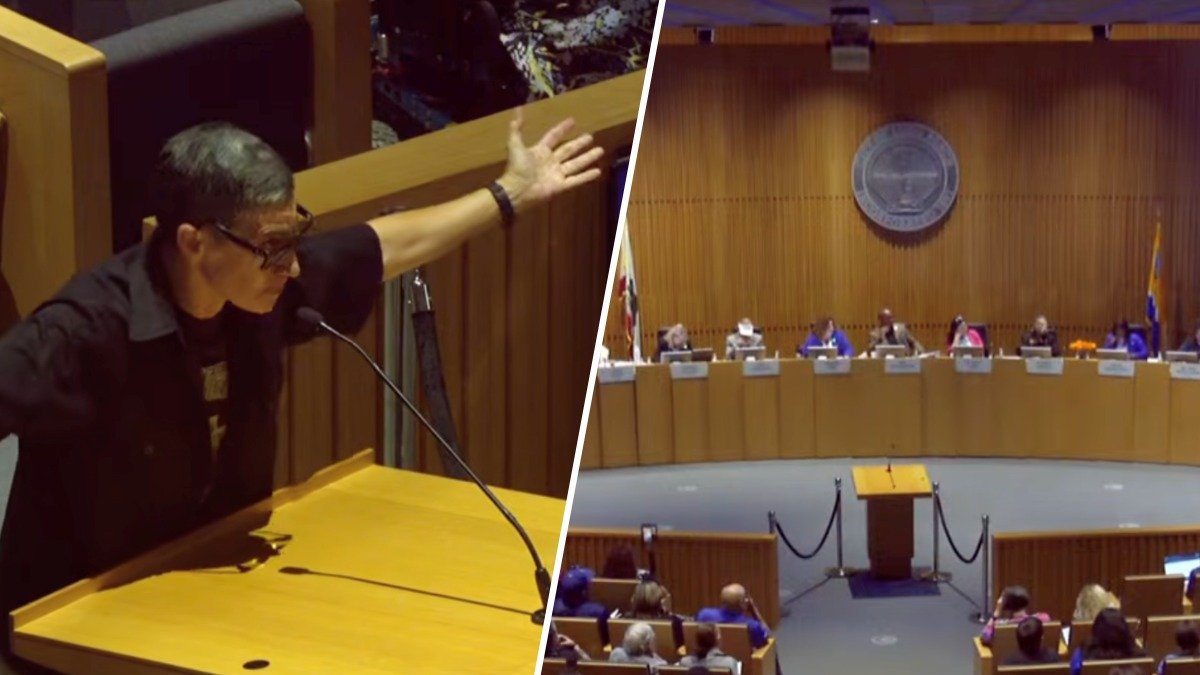
“Five months from getting the pension, you’re gonna make me lose my job?”
Giovanna Ferrero stood before the Long Beach City Council Tuesday night with a deeply personal appeal as councilmembers prepared to approve a budget that will eliminate city jobs and reduce services.
Ferrero told councilmembers she has lived in Long Beach for 20 years, once owned a business in the city and now works in homeless services. She said COVID cost her business and that she rebuilt her life by going to work for the city — work she said was personal because her father died homeless.
Now, Ferrero said she is five months away from qualifying for her pension and fears the budget will cost her job.
“I work for you. I work in homeless services,” Ferrero told the council. “Five months from getting the pension, you’re gonna make me lose my job?”
Councilmembers ultimately moved forward.
Key pieces of Long Beach’s roughly $4 billion FY27 budget passed 7-2, with Councilmembers Cindy Allen and Kristina Duggan voting no.
The city entered the budget process facing a $58.2 million structural General Fund deficit. The original proposal contemplated eliminating approximately 483 positions, 220 vacant and 263 filled, although subsequent recommendations restored some positions and services before Tuesday’s final votes.
Among the victories: Monday library hours were saved, and four threatened police Quality of Life officer positions were restored.
But substantial reductions remain. The city’s original reduction plan reached across police and fire response, homelessness services, parks and recreation, Public Works and other departments. And one of the most visible remaining cuts is Fire Engine 14.
Engine 14 wasn’t saved
Despite pleas from Councilmember Kristina Duggan and residents, and warnings of slower emergency response times, Long Beach’s final budget still eliminates Fire Engine 14.
Duggan, whose district includes Station 14, had pushed to preserve the engine as the city weighed millions of dollars in Fire Department reductions. She ultimately voted against key portions of the final budget.
Her opposition Tuesday also centered on how quickly councilmembers were being asked to make decisions about cuts that could directly affect their constituents.
“The full council has only part of a day to review significant changes before being asked to adopt the budget tonight,” Duggan said.
Duggan said the compressed timeline left her without an opportunity to bring some of those proposals back to residents before casting her vote.
“This also means that I haven’t had the opportunity to share some of these proposals with my residents and hear their feedback before voting on them,” Duggan said. “I don’t think that is a good way to make significant policy decisions.”
The elimination of Engine 14 has implications beyond East Long Beach.
Fire officials have previously warned that removing the engine would require units from surrounding stations to cover its calls, potentially increasing response times and reducing available resources elsewhere in the city.
The final budget does provide money to upgrade three surrounding fire engines to PAU capability, increasing their capacity to respond to medical emergencies. City leaders also say they will begin looking for a longer-term, financially sustainable solution to emergency response.
But for now, Engine 14 is still being eliminated.
‘Minutes to review’ a $4 billion budget
Allen and Duggan’s objections went beyond individual cuts.
Both argued that councilmembers were being asked to make consequential decisions about jobs, services and new fees without adequate time to understand the final recommendations.
Allen, who sits on the Budget Oversight Committee, said some of the recommendations weren’t provided to her until shortly before Tuesday’s committee meeting.
“I’m definitely not gonna rubber stamp a $4 billion budget, when I’ve only had minutes to review,” Allen said.
She called the process “11th hour” and warned her colleagues about approving a spending plan containing significant service reductions without more discussion.
“This budget is going to cut jobs,” Allen said. “Cut people’s livelihood.”
Duggan echoed Allen’s concerns, saying the Budget Oversight Committee received significant recommendations only minutes before its meeting and the full council then had only part of the day to examine the changes.
But Budget Oversight Committee Chair Ricks-Oddie pushed back, saying councilmembers themselves had continued submitting budget requests late in the process.
“A lot of the recommendations that I got, I received at the second to last meeting,” she said, adding that left her and city staff about a week to work through them.
She then directly challenged Allen, noting that Allen herself was proposing additional changes on the day of the final budget vote.
“Councilwoman Allen, you tried to bring recommendations today for consideration,” Ricks-Oddie said. “So you’re asking me to make recommendations last week when you weren’t adhering to the policies and processes yourself.”
Ricks-Oddie defended the process as an effort to give councilmembers and the public as much opportunity as possible to submit suggestions while still meeting the city’s deadline.
“I’m working to make a transparent process that community can engage in,” she said. But, she added, “there has to be a limit to that” for the committee to have time to evaluate the proposals.
Some parking tickets will climb to $100
One late proposal became a flashpoint: raising several parking citations to $100 to generate additional city revenue.
Allen said she learned about the proposal Tuesday.
“Under no circumstance can I support a new proposal that raises parking tickets to $100,” she said. “This new fee proposed is without public input. We never heard about this in the BOC.”
Allen called it a “predatory fee” that would hurt working-class families struggling with rent, groceries and gasoline.
Duggan focused on renters.
“Renters are more likely to depend on street parking, while homeowners have access to garages and driveways, in many cases,” Duggan said.
She also challenged the idea of using citations as a way to finance unrelated city services.
“The purpose of a citation … should be to change behavior,” Duggan said. “It shouldn’t be just to generate revenue.”
Duggan said some citations would increase by roughly 30%. The proposal also increases a street-sweeping citation from $75 to $80, which she said is projected to generate another $700,000 annually.
Which neighborhoods get the most tickets?
Public Works Director Josh Hickman then gave councilmembers numbers that help show where residents could feel those increases most.
The city issued approximately 200,000 street-sweeping citations in FY25, according to Hickman.
The largest share was in Council District 2, with 21% — roughly 42,000 tickets if applied to the citywide total.
District 1 accounted for 16%, or roughly 32,000; District 3 accounted for 15%, or about 30,000; and District 6 accounted for 12%, or about 24,000.
The remaining districts each accounted for roughly 7% to 8%, according to the figures Hickman presented.
The disparity becomes even more pronounced with other parking-enforcement citations.
Hickman said Long Beach issued just over 100,000 of those citations in FY25, with 36% issued in District 1 alone.
District 2 accounted for another 16%, District 6 for 12% and District 3 for 11%.
That means residents parking in Districts 1 and 2 in particular are already receiving a disproportionate share of the city’s parking citations — and could therefore experience more of the financial impact as some fines rise.
Richardson: It’s time to ‘land this plane’
Mayor Rex Richardson took a different view of the moment.
As Allen and Duggan pushed for more time to consider the budget and its last-minute changes, Richardson made clear he believed the council needed to finish the job.
“Lets land this plane,” Richardson said as the council approached its votes.
Richardson acknowledged there wasn’t enough money to preserve every city priority, but emphasized what councilmembers had managed to save.
“You are protecting a number of jobs that otherwise would have been cut,” Richardson said. “You are preserving critical services and resources.”
He pointed to restored library hours, new positions focused on Vision Zero traffic safety and other resources preserved through the final negotiations.
Richardson also argued there was a human cost to delaying the decision. The City Charter sets deadlines for adopting the budget, he said, and the city needs to begin notifying employees whose positions are being eliminated and give them as much time as possible to find another position or prepare for what comes next.
The mayor framed the cuts as necessary to address a much larger financial problem. Richardson said Long Beach had been facing a projected $91 million structural deficit over five years.
“If we follow through with this plan, we’re not passing deficits and debt onto future generations,” Richardson said.
But the city’s financial problems aren’t over. Richardson acknowledged Long Beach is still projected to face a deficit next year, although he said it will be significantly smaller. City projections then show structural surpluses over the following four years if the budget plan holds.
For workers like Ferrero, however, the effort to fix Long Beach’s long-term finances comes with a much more immediate cost.