
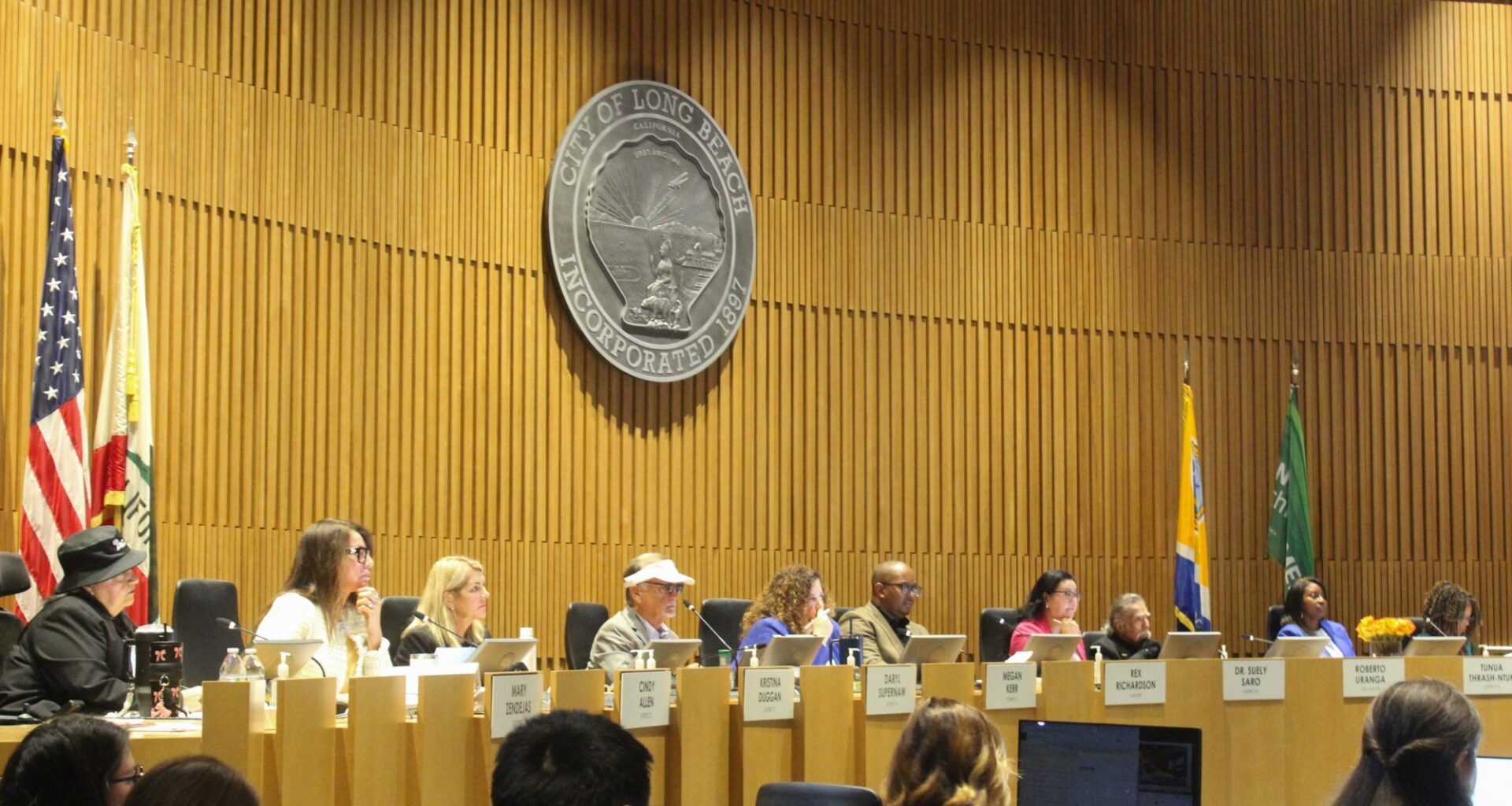
Despite facing fiscal challenges, resulting in several programming and staffing cuts across city departments, the Long Beach City Council approved a balanced $4 billion budget on Tuesday, Sept. 8, with the 2026-27 fiscal year spending plan also making investments in public safety, traffic safety and restoring library services, among other priorities.
The investments made in this year’s budget reflect the Long Beach community’s values, city leaders said – striving for a safer, more affordable and vibrant city supported by “strong social infrastructure and fiscal responsibility.”
The budget for the 2027 fiscal year received the council’s approval after several weeks of community meetings and citywide departmental public hearings. Long Beach’s new fiscal year begins on Oct. 1.
“We don’t want to go back on our progress; we have one more budget to get through before we have sustained structural surpluses,” Mayor Rex Richardson said after the council approved the budget.
“Next year will not be as challenging as this year,” he added, “(but) if we continue with this discipline, we’ll deliver again our first structural surplus since pre-pandemic.”
The city had projected a $61.3 million deficit in the 2026-27 budget’s general fund. But because of critical needs set-asides having been removed and lower-than-anticipated allocations from Internal Services Funds, that shortfall decreased. The shortfall is $58.2 million in the 2027 fiscal year budget, said City Manager Tom Modica.
For the past couple of years, Long Beach has been anticipating a general fund deficit, as economic uncertainty across the country grows, federal funding cuts continue, the city’s oil revenue keeps decreasing, revenue growth has been slow, labor costs have increased, and the state faces its own budget challenges.
During this current fiscal year, the city was facing a $60.5 million general fund deficit through FY 2031. But the projection for the general fund, city officials said, has decreased, with a shortfall of $27.3 million for FY28 — and a $2.4 million surplus by FY32.
This year’s budget was initially presented on July 30 with cuts to programming and staffing to remain fiscally responsible, city officials said. Some priorities for the budget include leveraging diverse funding sources to invest in infrastructure; ensuring economic vitality and future revenue-generating opportunities; navigating challenges while laying the foundation for a stronger and more sustainable future for the city; and having the budget reflect the values of the community.
The mayor’s recommendations, meanwhile, had four priorities, including protecting jobs and essential public safety services, preserving public health in the face of federal cuts, advancing mobility and safety for road users, and investing in neighborhoods.
Recommendations from the Budget Oversight Committee were also added and balanced into the budget to meet community needs, such as restoring funding for library services – which received strong support from residents – and quality of life officers.
“Investing in our community means a lot of things,” said Ninth District Councilmember Joni Ricks-Oddie, who is the chair of the Budget Oversight Committee. “It means looking at funding sources that we may not have considered before, it means prioritizing investing in spaces like our libraries and parks to make them safe places for our community, it means prioritizing violence prevention, particularly for our young people and our most vulnerable communities, and it means investing in public safety in all its forms, as well as being forward thinking to prepare ourselves for the city that we are becoming.
“While I know that we were not able to include every request in these recommendations, that is certainly not a reflection on their importance or their merit,” Ricks-Oddie added. “The items we could not fund are acknowledged in the recommendations for consideration, if and when funds become available in fiscal year ’27. As we often say, and I think some of the folks in public comment said, budgets are a reflection of values.”
The BOC made 28 recommendations – which were accepted by the council with a 7-2 vote – including revenue-generating ideas, such as:
Increasing the tax rate for cannabis adult-use retailers from 7% to 8% and setting the rate for cannabis cultivators at $15 per square foot under cultivation, estimated to bring $1.1 million in general fund revenue.
Increasing specific parking citations to $100, including fines such as parking in bike lanes, red curbs, fire hydrants and no parking zones, estimated to generate $1.5 million in general fund revenue.
Increasing street sweeping parking citations rates from $75 to $80, estimated to generate $700,000 in general fund revenue.
Other recommendations included using money saved from changes made to City Council public comment period required by state Senate Bill 707; adding structural funds for the Fire Department to convert Engine 22 to a Paramedic Assessment Unit; adding funds for the Health and Human Services, Library, Arts and Culture, and Parks, Recreation and Marine departments; establishing and leading a dedicated human trafficking and sexual exploitation focus area; and directing funds from the county’s Measure A to support the Community Land Trust.
Some community priorities that the mayor and Budget Oversight Committee were not able to restore, however, include restoring Fire Engine 14, giving additional structural funding to the Long Beach Justice Fund, adding funding toward the Youth Participatory Budgeting, and restoring weekend homeless outreach, among others.
The FY27 budget was approved with a 7-2 vote, with Second District Councilmember Cindy Allen and Third District Councilmember Kristina Duggan voting against it.
Those council members said they had concerns with the budget, including the revenue-generating recommendations from the BOC, which would hurt many of their residents in parking-impacted areas of the city.
“Under no circumstances can I support a new proposal that raises parking tickets to $100; this new fee proposed is without public input,” Allen said. “We never heard about this in the BOC. I’ve never got a presentation on this; it just was dropped on me. I think when people are struggling to afford rent, groceries and gas, this is a predatory fee that will hurt working class families across Long Beach and especially in my district.”
The mayor and other councilmembers, however, added that in this difficult budget year, there needed to be ways to sustainably and equitably have sources of revenue for restorations.
“At the end of the day, we know there is not enough revenue to support everything we want to fund — there isn’t,” said Fifth District Councilmember Megan Kerr. “We hear in this room people talking about all different departments and how we want to restore this and restore that. We know it is our responsibility to create and pass a balanced budget, which means we either have to increase revenue somewhere or we have to make cuts somewhere else. It’s hard and it’s personal for everyone and it’ll be really difficult on families across this community, both those employees who are impacted and the services that they may not get moving forward.”