
When Oakland needs to pave its roads, build a park, or retrofit a public building, it hires experienced construction companies. Each year, Oakland spends hundreds of millions on these “capital improvement” projects.
And for many years, the city has built in local hiring requirements and incentives for local and small businesses to encourage a competitive environment that supports the local economy.
But the city’s contracting practices are riddled with problems, according to a recent report published in August by City Auditor Michael Houston.
Houston’s office examined how Oakland handles funds for capital improvement projects. These long-term investments include buildings, roads, sewers, and traffic lights. In the three years examined by the auditor, roughly mid-2022 through mid-2025, the city spent about $330 million on these projects.
At a high-level, the auditor found lots of problems with how Oakland manages these projects. The city struggles with staff vacancies, weak controls over payment processes, slow payments to contractors, inadequate oversight of funds raised through voter-approved bond measures, and the lack of a long-term plan for capital projects.
“In a time when the City is facing significant fiscal challenges, it is important that it manages its resources efficiently and effectively beyond the short-term,” Houston wrote in the audit. His office has established 17 recommendations to improve how the city manages its big construction ventures.
Interim City Administrator Betsy Lake largely agreed with the auditor’s recommendations, according to a response included in the report.
Staffing is a problem throughout the city, but the auditor found that vacancy rates have been “persistently high” in the divisions that handle some of the city’s biggest construction projects. Roughly half of the civil engineer positions in Oakland’s Construction Management Division have been vacant for the past three fiscal years. The Capital Contracts Division, which provides contract services for Public Works and OakDOT, has also experienced vacancies. Low-staffing has forced some city workers to take on dual roles. The auditor cautioned that these arrangements may result in less oversight, overreliance on some staff, and can create potential conflicts of interest.
The report also found that Oakland needs to strengthen controls over the payment process for capital projects. Invoices reviewed by the Auditor took an average of 47 days to process, which exceeded Oakland and California requirements. When the city is late in making a payment, it also has to pay interest, which can result in higher costs.
The auditor found that payment delays for one project resulted in Oakland forking over $66,000 in interest. Staffing vacancies, the length of time to get permission to withdraw bond-issued funds, and the current process for submitting invoices are all to blame for payment delays, the auditor found.
Oakland also lacks adequate oversight of the bond funds that are the primary way the city pays for capital projects. The auditor found instances where city staff process bond payments without proper review, and the city hasn’t conducted mandatory audits of the use of these funds for Measure KK and Measure U. In one case, the auditor found that the city incorrectly charged a transportation payment to a fund that can only be used to pay for Oakland’s sewer facilities.
Unlike some other cities, Oakland lacks a comprehensive long-term capital plan. Oakland hasn’t created one since fiscal year 2022-2023, according to the auditor. This can lead to problems down the line. For example, the auditor notes that in 2024, Oakland issued an on-call task order for a small trash capture device installation project. But bond money for the project was postponed, and the city wasn’t able to fully fund the project. The order was reduced from $1.9 million to $660,000, which resulted in fewer trash trapping devices installed around the city.
Having a long-term capital plan can improve how the city uses its funds over an extended period and avoid unexpected shortfalls, the auditor noted.
Five companies got 61% of Oakland’s capital improvement dollars
In Houston’s new audit, there’s more information about how Oakland’s contracting practices have led to a handful of companies receiving the lion’s share of funding earmarked for capital projects.
In the 2024-2025 fiscal year, six of every ten dollars spent by Oakland on capital projects went to just five companies, according to the new audit.
By contrast, 36% of neighboring San Leandro’s capital project funds went to its top contractors during that same period, and in Berkeley the number was 33%.
Despite being bigger than Berkeley or San Leandro, Oakland also hired fewer contractors. Oakland employed 109 firms for capital projects over the same span of time. Berkeley used 172, and San Leandro 131.
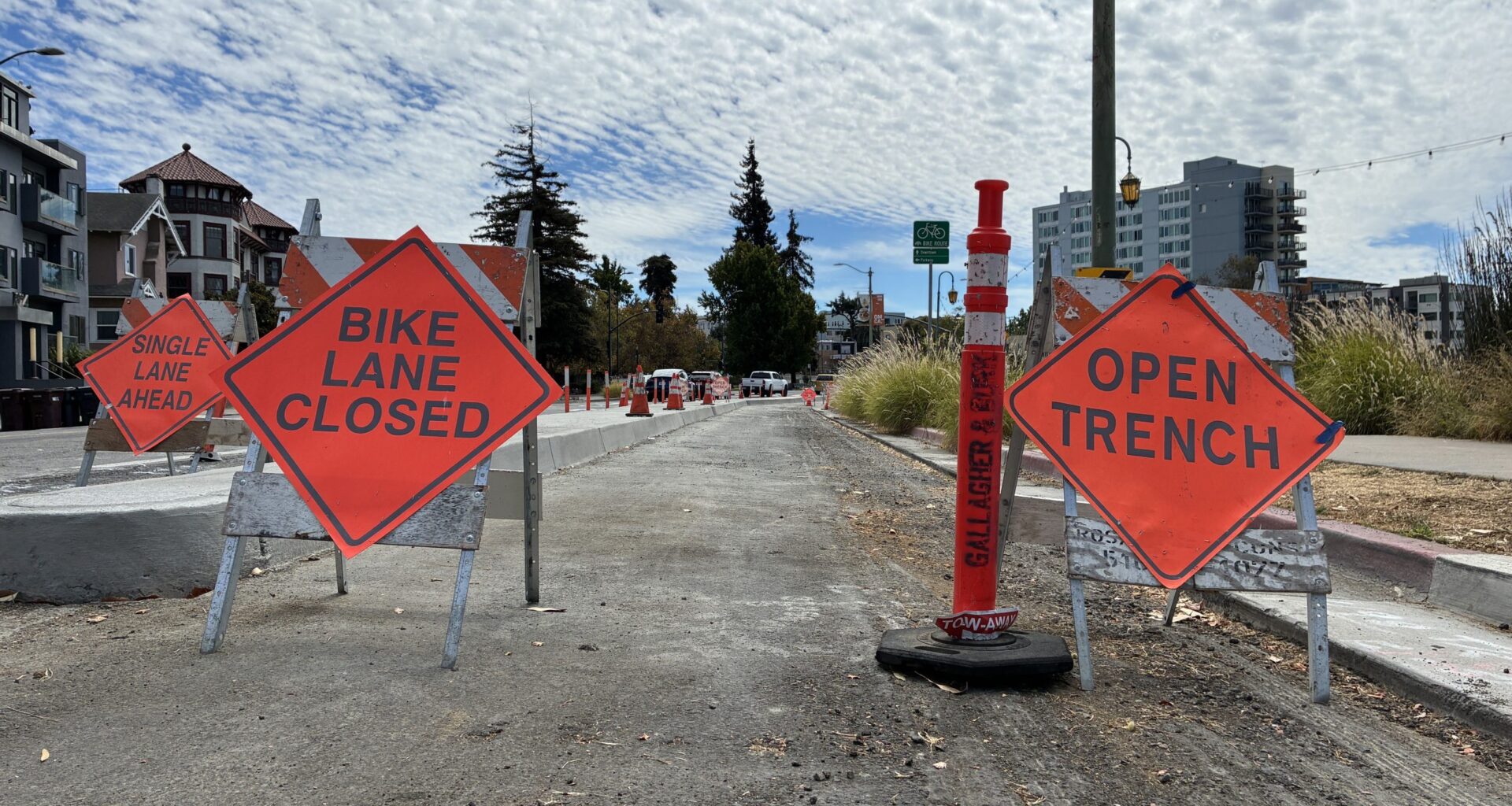
In recent years, Gallagher & Burk Inc, a paving and grading company based on High Street, has received more construction money from Oakland than any other single vendor.
The century-old firm won over $48 million from Oakland between 2022 and 2025, according to the auditor. Based on city records, Gallagher & Burk has received contracts in recent years to work on road paving projects and traffic safety improvements on Lakeside Drive.
East Oakland-based McGuire and Hester, also founded in the 1920s and employee-owned today, was close behind Gallagher, receiving more than $40 million in city contracts during the same three years, the audit found.
Paving contracts awarded last summer gave the firm around $50 million. The company has also been involved in street improvement projects on Martin Luther King Jr. Way and 14th Street, as well as pedestrian accessibility work in West Oakland.
Together, Houston wrote, Gallagher and McGuire scooped up 41% of Oakland’s construction spending between 2022 and 2025. The next highest-paid firm, Ray’s Electric, received $18.6 million. Juv Inc. and Andes Construction rounded out Oakland’s top five firms with $17.4 and $16.7 million in contracts.
The audit doesn’t focus on the concentration of city spending on a handful of firms. But Houston’s report does note: “Less competition among a small group of contractors can result in higher costs for the city.”
The audit also refers to a recent Alameda County Grand Jury report that cited an unnamed city officials who claimed Oakland could save 10-15% on its projects with more competition.
Gallagher and Burk and McGuire and Hester did not respond to emails and phone calls seeking an interview.
The city auditor’s new report cites some concerns raised in last year’s disparity study about the Local and Small Local Business Enterprise Program. This program was established in 1993 to make sure small and local businesses get included on contracts awarded by the city.
According to the auditor, the city’s implementation of this program has at times increased capital project costs and delayed contracting. But simultaneously, the disparity study found that Oakland awarded the majority of its subcontractor work to businesses that were not local or small, which the auditor took as an indication that the program may not be meeting its goals.
One example cited by the auditor involved a contract from five years ago: the city received 10 bids for multiple paving projects. None of the vendors met the program requirements. Staff recommended the City Council waive the requirement and award $59 million to three of the vendors. The council declined and requested staff return with compliant bids. A year later, the city received five compliant bids.
But because of how much time had elapsed, the bidders weren’t bound to the original prices. On top of the project being delayed a year, Oakland ended up having to pay $6 million in additional costs.
The auditor suggests that Oakland adopt a qualifications-based selection process for potential bidders. This would involve selecting vendors based on their experience and technical expertise rather than who has the lowest bid.
Oakland also maintains a relatively small list of vendors who are pre-approved to handle on-call contracts, typically emergency projects or small jobs. Of the 51 vendors in this group, just two — McGuire and Hester and Gallagher and Burk — received 51% of on-call spending from fiscal years 2022-2023 to 2023-2024, according to the auditor.
On-call contracting like this can reduce the number of bids Oakland receives for larger projects, and according to the auditor, this may contribute to higher costs.
“*” indicates required fields