
More than three years ago, nearly 1 mile underground in South Dakota, in a cryogenic cylindrical chamber roughly 100 degrees Celsius below zero, something hit an atomic nucleus.
The collision emitted a flash of light that was recorded by a detector as part of the LUX-ZEPLIN experiment, or LZ, which seeks to directly detect dark matter for the first time.
LZ’s scientists believe that today’s particles and processes might not be enough to explain the interaction. They are now cautiously optimistic that they may have finally found dark matter.
What is dark matter?
The LUX-ZEPLIN experiment is searching for dark matter, an invisible substance that makes up more than 85% of the mass of the universe but has never been directly detected.
Dark matter has been observed in the universe in various ways, according to Lawrence Berkeley National Laboratory staff scientist Aaron Manalaysay, who works on the LZ experiment. For instance, galaxies are held together by gravity, and based on the amount of matter in them, scientists can predict how fast the galaxy should rotate. But galaxies seem to be rotating faster than predicted.
A potential explanation for these anomalies, Manalaysay said, could be a gap in our understanding of the laws of physics. But since each galaxy is different, the laws of physics would have to differ slightly for every galaxy. Alternatively, if there is more matter — dark matter — that is going undetected in these galaxies, it seems plausible that the amount of dark matter can change from galaxy to galaxy.
“If I made a big batch of chocolate chip cookies, and I threw in all the ingredients and chaotically mixed them up and made blobs of chocolate chip dough and gave you a box of 100 cookies, you would not expect that every cookie would have the exact same number of chocolate chips in it,” Manalaysay said.
What is the LUX-ZEPLIN experiment?
Managed by Berkeley Lab, LUX-ZEPLIN is an international collaboration and the result of two merged dark matter experiments: Large Underground Xenon, or LUX, and ZonEd Proportional scintillation in LIquid Noble gases, or ZEPLIN.
The dark matter particle that LZ is looking for is called a WIMP: a weakly interacting massive particle. When a WIMP collides with a xenon atom’s nucleus, it will emit a flash of light that LZ’s detector can pick up.


To search for dark matter, LZ uses photomultiplier tubes to capture light from particle interactions.
Courtesy | Matthew Kapust/Sanford Underground Research Facility
The project is based in the Sanford Underground Research Facility in Lead, South Dakota, and it began collecting data in 2021. The facility, which is nearly a mile underground, consists of a cylindrical chamber that is filled with 10 tons of ultrapure liquid xenon, cooled to minus 100 degrees Celsius. Manalaysay said xenon is a good chemical element to use for dark matter detection because its large nucleus makes it a good candidate for detecting dark matter.

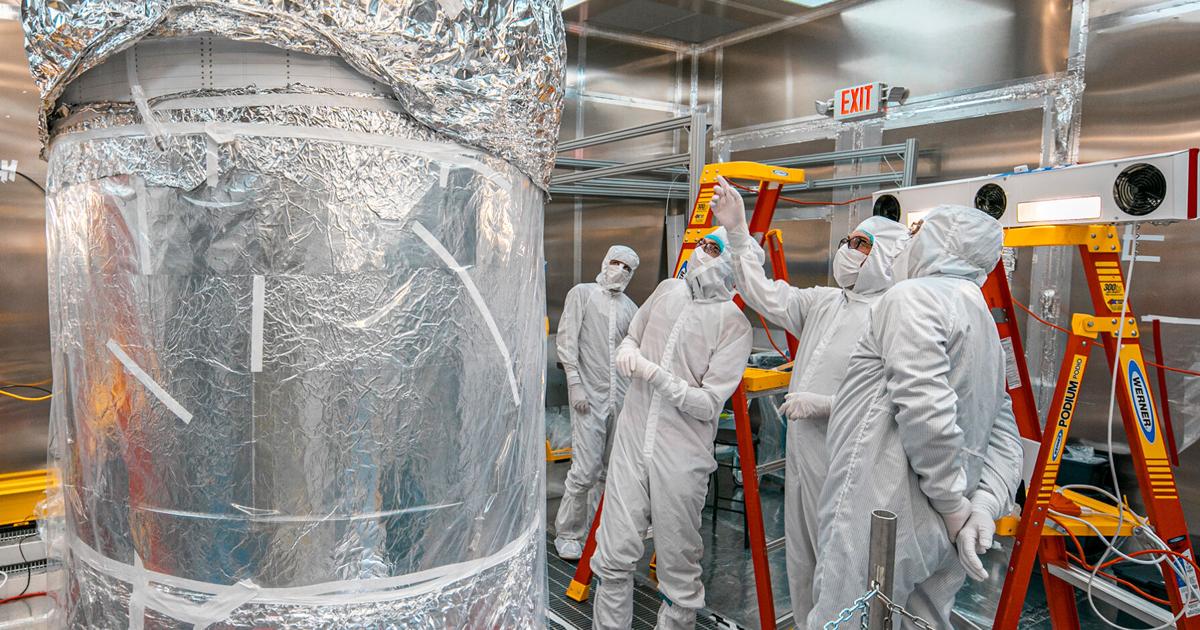
The LUX-ZEPLIN main detector in a surface lab before installation underground. The cylindrical chamber is filled with 10 tons of ultrapure liquid xenon, cooled to minus 100 degrees Celsius.
Courtesy | Matthew Kapust/Sanford Underground Research Facility
Xenon’s large nucleus provides two benefits: It gives WIMPs a higher chance to collide with it, while also creating a natural shield for the xenon in the inner areas of the chamber, blocking out background noise that could lead to particle interactions caused by normal matter. The mile of rock above the detector protects it from cosmic rays that can contaminate the data as well.

LZ’s central detector was assembled in a surface clean room and moved to the nearly mile-deep campus at the Sanford Underground Research Facility. The underground location shields the experiment from cosmic rays.
Courtesy | Matthew Kapust/Sanford Underground Research Facility
If a WIMP is directly detected, Manalaysay said, this would be the first glimpse of something beyond the standard model of physics, which explains every single currently known particle interaction in physics.
What did LZ scientists find?
The latest results analyze 220 days of data collected by the experiment between March 2023 and April 2024. It also highlights a specific event that occurred June 16, 2023, which Manalaysay described as a xenon nucleus being “kicked with some amount of energy.”
Manalaysay said the event was “very difficult” to explain without dark matter as it is not consistent with background signals from normal matter.
Though Manalaysay cautioned that it’s “hard to say a whole lot with just a single event,” he said this collision is “one of the most interesting single events” that LZ has detected.
For results to be considered a discovery in physics, they must cross a statistical significance threshold of 5 sigma, which is a measure of the discrepancy of an observation with the standard model of physics. A 5-sigma observation has a 1 in 3.5 million chance of being purely random rather than explained by some hypothesis. LZ’s observation is 2.6 sigma, or a roughly 0.5% chance that the event could be explained by known backgrounds.
The observation’s significance is not what LZ is looking for — 0.5% corresponds to a 1 in 200 chance — but Manalaysay emphasized that this is “the most significant thing we’ve seen in the dark matter search.”
How has the research community responded?
Many papers analyzing LZ’s latest results have been shared with researchers on the arXiv platform.
One such paper was submitted by UC Berkeley associate professor of physics Benjamin Safdi and his colleagues, who analyzed the results with regards to a model that involves a hypothetical dark matter particle called the higgsino, which Safdi described as a “canonical WIMP.” Safdi is not involved in the LZ collaboration.
This theoretical model extends the standard model of physics and predicts a partner particle for each existing standard model particle called a “superpartner.” The higgsino would be the superpartner of an existing particle called the Higgs boson.
Safdi said LZ’s observation, if it turns out to be dark matter, would be the first-ever direct detection of a superpartner particle and could allow physicists to “(embark) on an age of discovery where we find a whole zoo” of superpartners. Safdi himself has worked on research for another hypothetical dark matter particle called the axion, whose existence “could be tied to extra dimensions of space-time” and could be related to a universe with more than three spatial dimensions.
However, Safdi said his paper “throws a tiny bit of cold water” on LZ’s latest results.
According to Safdi, many of the most motivated dark matter models predict that, if the observed event was actually a WIMP colliding with a xenon nucleus, then other nuclei should have been detected that move with “even more energy.” But Safdi said LZ did not detect such a phenomenon, which makes the observation “hard to explain” with dark matter.
Ultimately, Safdi said he doesn’t think “there’s any hole to poke in what (LZ has) actually done.” He added that the “real peer review” will come from nature as LZ analyzes more data and compares its results with other dark matter experiments, such as China’s PandaX and Europe’s XENONnT.
What’s next for LZ?
The recent results have been presented at a conference in Japan and are being submitted to an academic journal for peer review and publication.
As for Manalaysay and his team, there’s still more to uncover. The latest paper only analyzes 220 out of the more than 700 days of data that the experiment has gathered, and he hopes other types of experiments can confirm the results.
“Xenon is almost certainly the best nucleus to discover something first, but we need to see it in other nuclei,” Manalaysay said. “There are efforts to look for dark matter with liquid argon. It’s a much smaller nucleus, but if you were to see also a signal in liquid argon by comparing what you see in both experiments, you could potentially say a lot about the properties of dark matter. … If you ever did see a hint of a signal in one detector, there’s a lot you can do with that one detector and that one experiment, but really, you need to see it in multiple experiments to really be definitive.”
UC Berkeley and Berkeley Lab have been involved in this research since the 1980s, Manalaysay said. The latest results have excited researchers: Safdi said ever since he heard the news, he has been “tremendously excited” that scientists may be “on the cusp of transformational understanding of how the universe works at a microscopic level.”
And even if this observation turns out not to be dark matter, Manalaysay and his team are ready for what’s next.
“We would love to discover dark matter, and we would love to be able to say, ‘Oh, dark matter — here are some constraints on what its properties are,’” Manalaysay said. “But really, we learn something whether we see something or not, because if we don’t see something, that also rules out a whole large number of possible explanations as well.”