
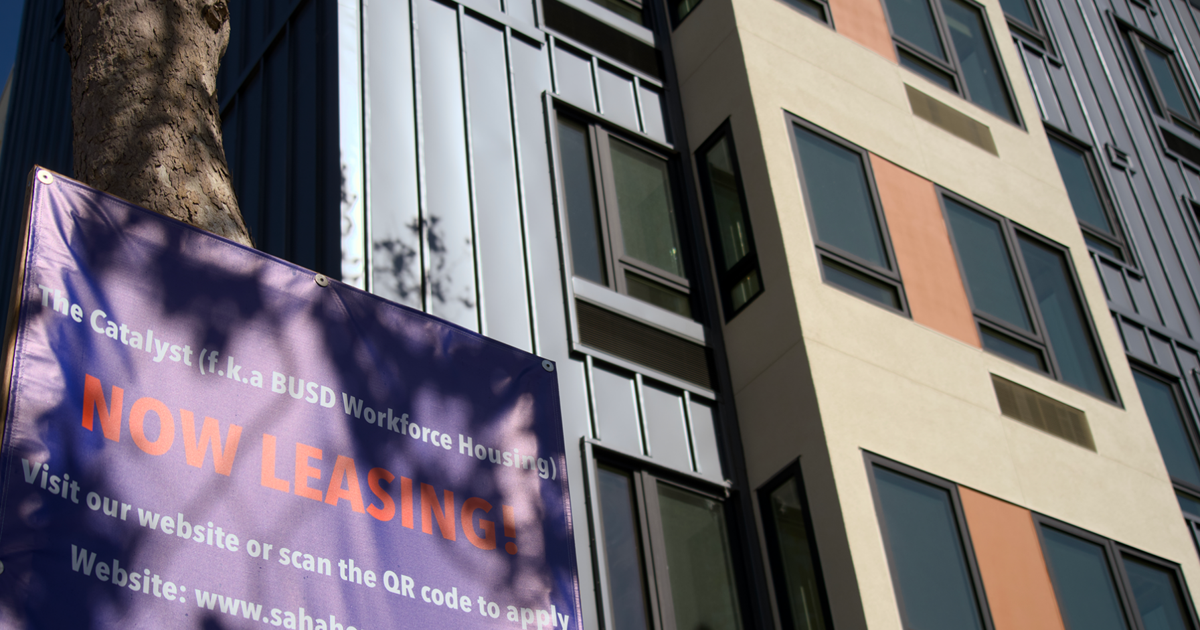
Rental applications will soon be due for apartment units at BUSD Workforce Housing, a new development which is set to offer housing with preference for Berkeley Unified School District employees. Applications opened April 15 and are due Sept. 11 at 5 p.m.
More than four years in the making, the development, also known as Catalyst, is located at 1717 San Pablo Ave. It will include approximately 110 units, with one-, two- and three-bedroom apartments available. Construction at the site is expected to conclude January 2027.
“Rising housing costs, utilities, childcare and healthcare are major factors that make it hard to establish a career in Berkeley,” said Berkeley Federation of Teachers President Matt Meyer in an email. “Our members have moved further and further away which means we spend less time with students before and after the school day. This housing project will allow some of our members to live closer to where they work with more affordable rent.”
According to Meyer, BUSD educators often struggle to find housing in the East Bay, which has negatively impacted employee retention and new educator application rates in the district.
The district began to explore the demand for employee housing with an internal survey in 2017, which received responses from more than 60% of the district’s workforce, according to a 2021 public statement from BUSD. Only 30% of surveyed BUSD employees said they lived in Berkeley. Seventy-eight percent of surveyed staff who were renters said the high cost of housing had resulted in financial pressures.
“This was never a solution to the rising cost of health care and uncompetitive salaries,” Meyer said in the email. “That being said, BUSD housing will provide stable housing and help some (of) our educators have more options to be able to remain in our district.”
All individuals whose household income is between 30% and 120% of the Area Median Income are eligible to apply.
According to Jenny Wyant, the city’s Health, Housing and Community Services program manager, BUSD employees will be preferred in the rental of all units, with first priority for district employees experiencing homelessness.
Once all applications received by the deadline have been entered into a lottery, the preferences will be considered, according to Eve Stewart, the senior vice president of real estate development for Satellite Affordable Housing Associates, one of the project’s developers.
“This is really about helping more of our employees — many of whom are from Berkeley or who spend countless hours serving Berkeley students and families — be able to live where they work,” said BUSD Board of Education President Ka’Dijah Brown in a Sept. 2 board meeting. “So we wanted to say to those members of the BUSD family: Welcome home.”
The city of Berkeley contributed $26.5 million in Measure O funds — a bond approved by Berkeley voters in 2018 to support affordable housing — to the BUSD development, according to Wyant.
Wyant also noted that the total development cost for the project is approximately $77.7 million. She said the project’s developers also leveraged funding from the California Housing Finance Agency and the Low-Income Housing Tax Credit program.
“There’s been a lot of effort by BUSD and the unions and everybody that’s been involved to make this happen,” said Frank Hernandez, president of the Berkeley Council of Classified Employees, which represents school district employees. “I would hope it’s successful. We have definitely used it as a selling point to retain members, or retain employees.”
The developers for the project, Satellite Affordable Housing Associates and Abode Communities, were chosen by BUSD in 2021. Construction began June 2025 and, according to Stewart, is now approximately 90% complete.
According to Hernandez, Berkeley Council of Classified Employees members have mostly voiced positive comments about the development, but he noted that “you’re never going to have one solution that works for everybody.”
“In general, public education in California needs to be fully funded and we need salaries that will allow us to be able to raise families near where we work,” Meyer said.