
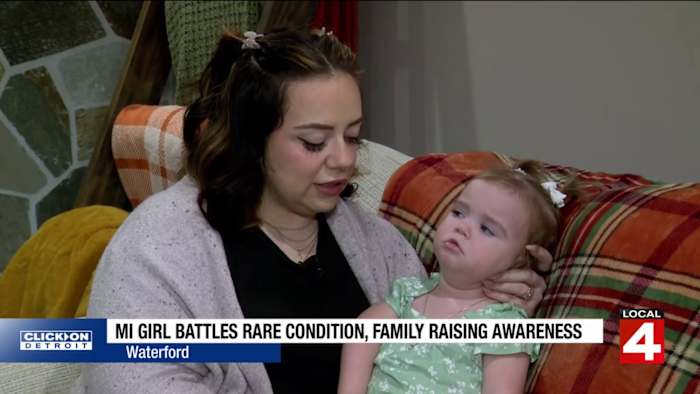
WATERFORD, Mich. – Only about 150 people in the world are living with an ultra-rare genetic disorder called CACNA1E, according to experts. A 1-year-old girl in Waterford is one of them.
Her family says a lack of awareness makes finding treatment hard. They want to change that.
In May, Local 4 reported on 1-year-old Lorelei Dunn’s story. At the time, she could have lost her shot at lifesaving treatment because her insurance coverage could have been canceled.
After the story aired, things turned around. But now, her family wants others to know why that research and treatment are so important on this CACNA1E Awareness Day.
“She gets these three twice a day, this one once a day,” Kayleigh Dunn, Lorelei’s mom, said. “These two I have to crush up and mix with water – which is a lot harder than you would think it is.”
That’s how Mom Dunn begins each day, with a careful routine centered on caring for Lorelei.
Just a few years ago, Dunn never imagined she would become an expert on one of the rarest genetic mutations in the world. That all changed when her family got the diagnosis.
Lorelei was just a few months old.
“Because of that, it causes her to have a seizure disorder,” Dunn said. “She has severe hypotonia. She cannot hold her head up. She has no trunk support. Because of some complications we’ve had with eating, she does have a feeding tube.”
There are only about 150 people in the world who are known to have CACNA1E – and Lorelei is one of only 30 with her specific mutation.
When the diagnosis came, the family was told their options were scarce and nearly nonexistent.
Then, they connected with a renowned neurologist at the University of Michigan Medicine.
The neurologist told them about a specific gene therapy that could help. Hopeful and grateful, the family wanted to get the process moving.
But in May, that possibility was nearly pulled out from under them when their insurance coverage was threatened.
“If we had lost our coverage and we were going to have to move, see a different neurologist,” Dunn said. “There was no neurologist in the state of Michigan that we found that would be willing to take this on. This is a big … to do what we want to do, they have to agree to a case study. It means long hours, extra shifts.”
Local 4 told their story, and eventually, the coverage was extended. With that came renewed hope and Lorelei’s chance at treatment.
Her family says awareness fuels research, and research can open the door to lifesaving care.
“She’s proven time and time again that she is not defined by her mutation, but it’s my life, and it’s tough. It’s tough, right,” Dunn said.
To support Lorelei and her family, click this link.
What is CACNA1E?
According to CACNA1E International, CACNA1E is an abbreviation of the gene’s full name, “CAlcium voltage-gated ChaNnel subunit Alpha 1E.”
“CACNA1E is one out of 20,000-25,000 genes in our body and plays a role in the communication between neurons in the brain. It is located on the short arm of chromosome 1 at position 25.3 and encodes the neuronal
R-Type CaV2.3 channel. This subunit helps to form the channel pore (hole) through which ions flow. A change in the gene changes the function of the channel and affects the release of neurotransmitters.
Normal calcium channels, without a mutation, open and closes regularly.
All previous studies showed that CACNA1E shows up as a “Gain of function” modification.
This means that the calcium channel opens and stays open for a long time. As a result, calcium ion influx is increased, causing too much neuron excitability.
Mutations in CACNA1E causes a number of neurological phenotypes (=observable characteristics).
Most affected individuals present in infancy with epilepsy (refractory seizures, most commonly spasms) and developmental delay or no development at all. Many patients have joint contractures (hands or feet pull to the side – google: “ulnar deviation”, clubbed feet, …) and macrocephaly (a bigger head).”
CACNA1E International
You can find more information about CACNA1E here.
Copyright 2026 by WDIV ClickOnDetroit – All rights reserved.