
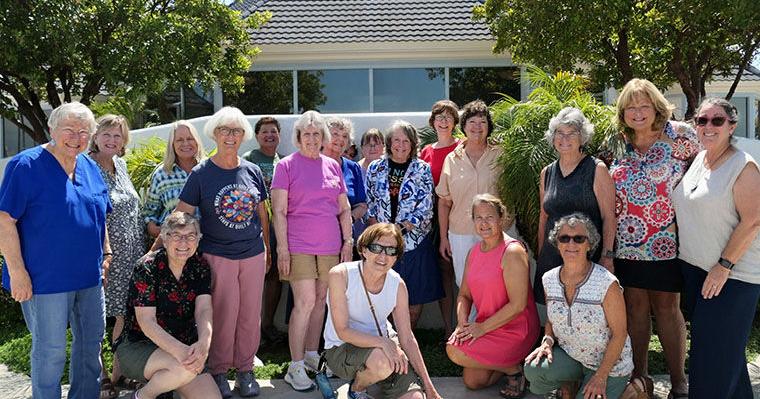
For the past four years, a group of local quilters has been gathering to share ideas, projects, expertise, and general enjoyment of the art of making pieced quilts. Affectionately dubbed the Hot Bobbins, the homegrown group is open to any locals interested in participating. They meet monthly at the Spreckels Center, volunteer to teach classes through the City of Coronado Recreation Department, and have organized several two-day sewing retreats.
At the spring retreat, one of the founding members, Sue Gillingham, shared that a San Diego nonprofit organization was looking for sewing machines. The organization, Helping Empower Community Refugees (HECR), is dedicated to supporting refugee resettlement in San Diego, helping over 1500 families start a new life with the basic items they need. Through a Facebook page, Gillingham saw the request for sewing machines. After she donated one, she asked how many people were on the waiting list. At that time, eight more families were hoping to receive one. She brought this request to the quilting group for consideration. The quilters generously donated enough funds to purchase these eight machines, plus necessary sewing notions.
At the August retreat, Gillingham invited the founder of HECR, Jill Galante, to speak to the group about its mission as well as the impact sewing machines have on the refugee families. Galante shared how she became involved in helping refugees ten years ago. The first family that she assisted had ten people in a two-bedroom apartment. They shared a single towel among them for bathing, dishes, and cleaning. She cleaned out her own linen closet to donate to the family. Over the years, as she enlisted community assistance, the organization grew, and she created a legal nonprofit charity. Donations poured in – beds, furniture, household goods, clothing, toys, bicycles, food, and toiletries. Currently, HECR offers a weekly food, toiletry, and household goods distribution at a local church. As the needs of the families change, she is always looking for ways to pivot the organization to best help them.
To help tell the story, Jill invited an Afghan refugee, Naim Azimi, who came to San Diego in 2024, to tell his family’s story. Like most of the families aided by HECR, Azimi and his wife fled their home after the Taliban took control in 2021. They were both professionals who had been assisting the U.S. Government. Because of this, they were targeted by the Taliban, and they feared for their lives. Numerous family members had been killed by the Taliban. After three years in Pakistan, they were able to obtain their visas and enter the U.S.
Azimi spoke of the many difficulties of starting over in a strange country – no belongings, not speaking the language or knowing the culture, unable to rent an apartment without credit history, and many more. He stressed, as did Jill, that sewing is a big part of the culture for Afghan women. To have a sewing machine and the ability to create items for their home and family is a huge lift to their spirits.
As difficult as the transition is for these refugee families, Jill emphasized that they are so glad to be given the opportunity to live in safety in the United States. They wish to learn the language, pursue education, work hard, and contribute to their adopted nation. They are especially impressed with the availability and quality of the public schools for their children.
The quilting group was most appreciative of Jill and Naim’s sharing of the refugee journey. It was gratifying to know that in some small way, the sewing machines they donated are aiding newcomers in beginning their lives in San Diego.
For more information about Helping Empower Community Refugees, see their website or Facebook page.
For more information about Coronado’s quilting group, contact Sue Gillingham at sdgilling@gmail.com.
VOL. 116, NO. 36 – Sept. 9, 2026