
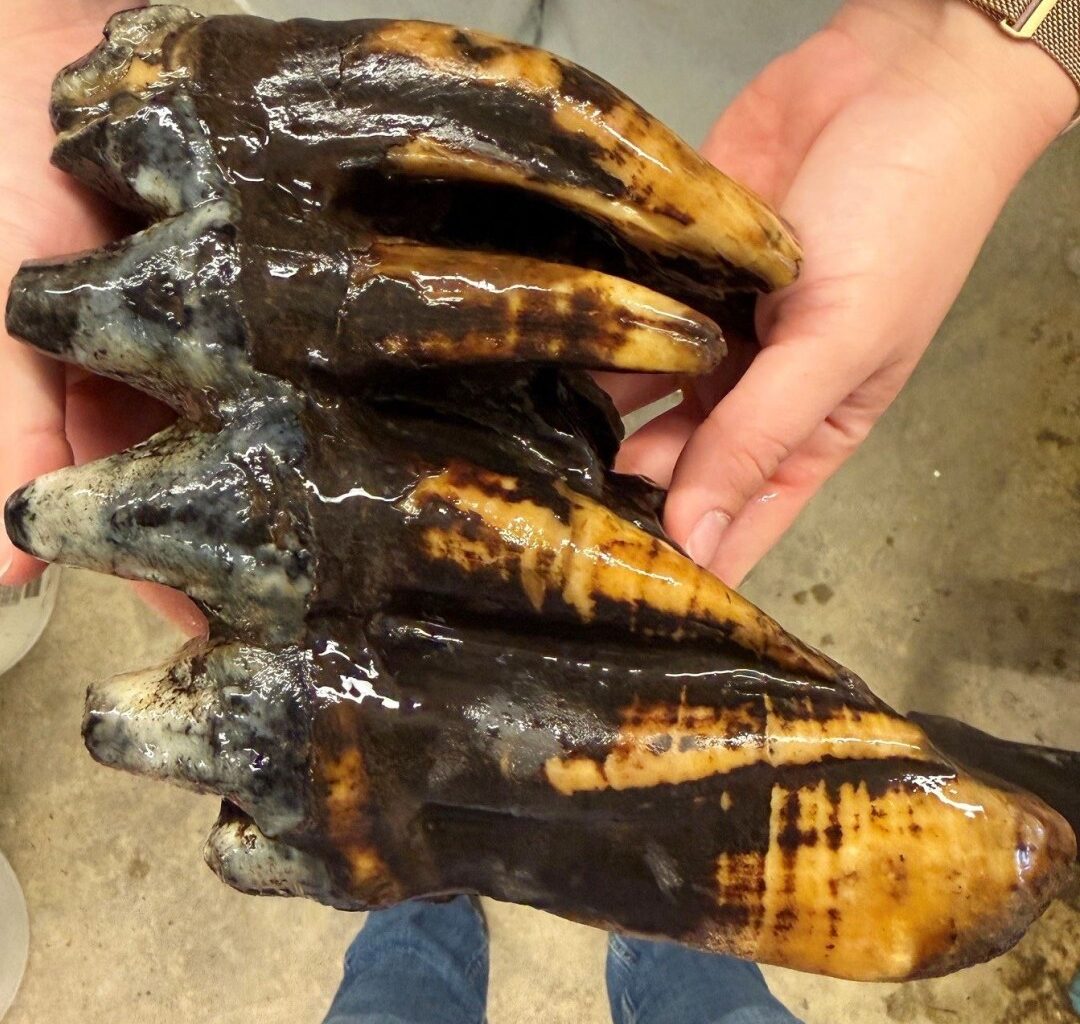
Brigid Lynch was working along a wooded creek in a mountainous part of the San Francisco Bay Area when something that didn’t look like the rocks she’d been studying caught her eye. “I keep joking it wasn’t hard to find,” Lynch, a geomorphologist at Balance Hydrologics, said Friday, per the AP. “It was just sitting there in the middle of the creek, halfway in, half out of the water.” Lynch made the discovery earlier this year while working on a habitat restoration project for the threatened California red-legged frog in a Midpeninsula Regional Open Space District preserve in San Mateo County.
The public land management agency that preserves more than 70,000 acres of land in the Santa Cruz Mountains region announced the find this week. The fossil from the Pacific mastodon, an extinct elephantlike species, has been donated to Stanford University’s Doerr School of Sustainability. “It’s in great condition,” said Chrissy Garcia, curator and manager of the school’s specimen collections. “We’ve got both the crown and the root of the fossil. … It’s exciting to have a specimen of this quality, and having it be a local find.”
Garcia said the tooth is about 9 inches long. Ron Tykoski, curator of vertebrate paleontology at the Perot Museum of Nature and Science in Dallas, said mastodon fossils “pop up with some degree of frequency, depending on where you live.” He noted there are multiple species of mastodon that roamed for a few million years in North America, up till 10,000 to 12,000 years ago. “The way this was found is actually the way a lot of specimens are found—just somebody who happened to be in the right place,” Tykoski said.
Garcia said they’ll likely try to determine the exact age of the fossil and will make a 3D copy to give to the MROSD. The district says it will use the copy for public outreach and education. Ryan McCauley, a spokesperson for the district, said the discovery on land they’re preserving helps show the value of protecting open spaces and habitats. “That this tooth, that this molar, was found in the context of trying to protect the habitat and save another species from potentially going extinct … really just drives home the point of why it’s so important to care for these open spaces and these natural lands,” he said.