
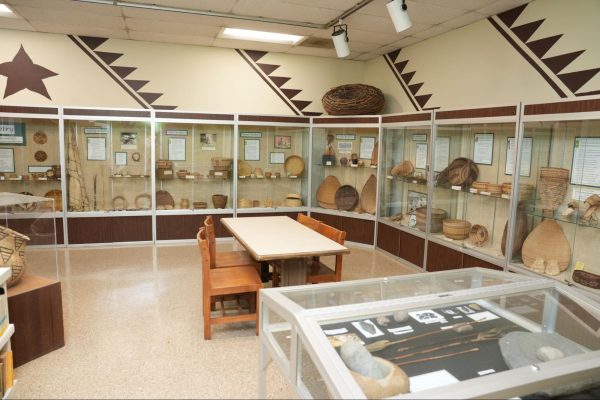
Closed since 2024, Fresno City College’s Anthropology Museum will not reopen until the Native American artifacts on display are returned to or reviewed by the respective rightful tribes.
The museum opened in the 1970s and presented exhibits about human culture through archeological collections.
Jill Minar was an original advocate for the Anthropology Museum, a professor of both archeology and anthropology until retiring when the museum began to go under review for the artifacts being held.
Minar was the primary contact for the museum’s main information when it was open. At the time, the museum provided tours and activities led by FCC students. Students also participated in the operations of the museum, learning about exhibit development and the curation of the collections.
All this information used to be posted in FCC’s catalog for the school year under “Student Activities,” though recently in 2023-2024 it only briefly mentions the museum from 2025 into the 2026-2027 catalog.
The reason for its closing and review is because it houses Indigenous artifacts that are now to follow California’s 2001 state law.
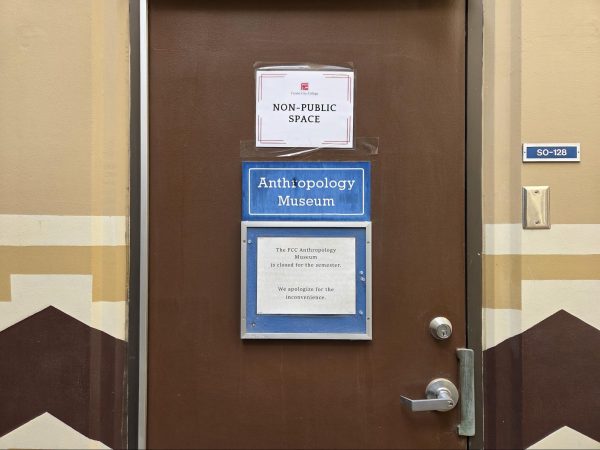 Main entrance of the Anthropology Museum with a notice of being closed for the semester on Sept. 8 (Photo by: Mikayla Portillo-Torres)
Under the California Native American Graves Protection and Repatriaction Act (CalNAGPRA), California state agencies, state-funded museums and universities are to inventory and return all Native American cultural items to their rightful tribes.
Kherstin Khan, dean of social sciences, said FCC is still in the process of consulting with tribes whose belongings remain behind museum doors.
“We also have an entire curation facility that has items well beyond what is in the museum that we also have to consult on so it’s been a really, really lengthy process,” Khan said.
The consulting process involves more than contacting tribes and checking legal boxes, according to Khan.
“We’re not just asking for permission, although that’s the bottom line, but also that we are consulting on proper display, proper ways to educate about those materials,” Khan said.“I don’t know logistically what that would look like, but maybe that would involve having certain information cards. That’s what I mean by education in the facility, and so the process of gathering that knowledge is in consultation with the tribes.”
When it comes to the museum’s future interior and exhibits, Khan said those plans will have to wait until FCC has engaged in thorough communication with the item’s rightful owners.
“To be honest, we’re not even there yet, like the planning hasn’t even reached that stage right now,” Khan said. “In full transparency, the focus is not on opening the museum. The focus is on consulting on the items to ensure we’re being ethical in navigating, and displaying these culture items.”
Khan reiterated how she used to focus on just opening the museum when first becoming dean, although now being in the dean position for a year, she realized there’s more to the process.
“It is a very, very, very time consuming process, and I know that is frustrating for folks to hear because we want the museum open, but at the same time like I said a second ago, we have to do it right,” Kahn said.
Kahn said it will likely be more than a year before the review process is complete.
“After that, I think it’s a matter of the college and the department sitting down and determining what they see as the future for the museum,” Kahn said.