
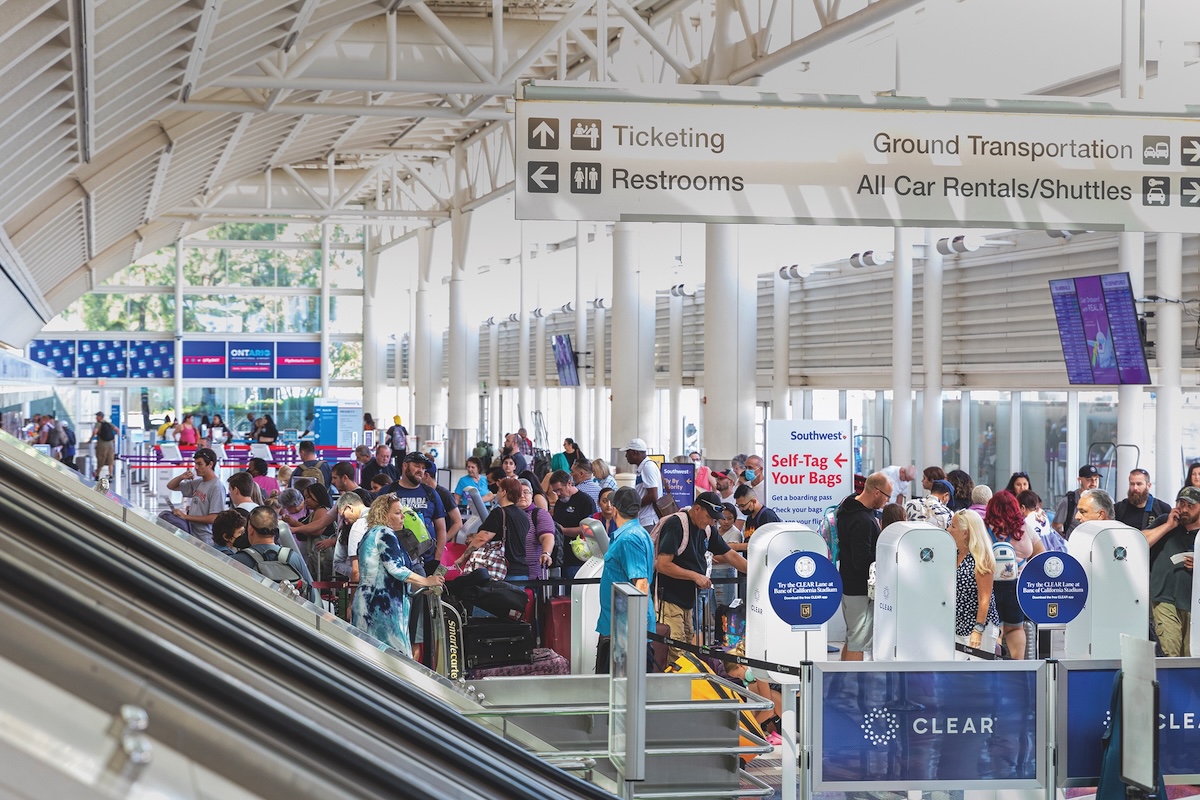
For the first time since the early months of the Covid-19 pandemic, passenger counts fell year-over-year in September at all four airports serving Los Angeles County: Los Angeles International, Ontario International, Hollywood Burbank and Long Beach.
For months, Ontario International had bucked the trend, but in September, it too succumbed with a slight drop of just over 1% compared to the same month a year ago.
Overall, nearly 7.25 million passengers went through the gates at all four airports in September, down 5.7% from the same month last year.
Due to the government shutdown, no overall totals for September were available for all the nation’s airports for comparison. But statistics from the International Air Travel Association showed a 1.7% increase in United States domestic passenger traffic in September. But the IATA uses a different metric of revenue passenger kilometers, which factors in distance traveled. This subset of IATA data also doesn’t include international travel.
LAX posted the steepest year-over-year decline among the four airports as its September tally of 5.81 million declined 6.4% from the same month last year.
As has been the case for nearly two years, domestic passenger traffic at LAX continued its slide, down 7% year-over-year versus a 5.2% drop for international traffic.
A variety of factors have been cited for the slump over the last year, including the fact that the airport doesn’t serve as a hub for any airline to consolidate routes. Ongoing construction has also prompted some local passengers to choose other airports when possible.
From March 2021 through August of this year, Ontario International recorded 54 consecutive months of year-over-year growth in passengers, an impressive streak, especially considering that during the first year of that stretch, most airports were still slammed by travel bans and other pandemic impacts.
But that streak came to an end in September as the total of 599,000 passengers that went through the gates dropped 1.1% from 606,000 passengers for the same month last year.
“Fifty-four months of consecutive growth is something few airports can claim, and it reflects the spirit of the Inland Empire,” Atif Elkadi, chief executive of the Ontario International Airport Authority, said in the announcement of the traffic statistics. “A streak may pause, but our purpose never does.”
Atif and the authority preferred to focus on the year-to-date trend compared with the same stretch last year: for the first nine months of this year, passenger traffic at Ontario declined nearly 1%.
For much of this year, Long Beach Airport has experienced substantial drops in passenger traffic – generally down around 10% year-over-year. The reason: Southwest Airlines. The Dallas-based carrier is by far the dominant airline at Long Beach, with nearly 90% of all flights and passengers. Earlier this year, Southwest faced aircraft shortages and the fallout from its decision to start charging fees for almost all checked baggage, ending a treasured passenger perk.
The statistics were also impacted by the fact that 2024 saw a record high for passengers at Long Beach.
But in September, the year-over-year decline in passengers at Long Beach began to moderate, with a drop of only 2.7% to about 315,000. Whether this was a blip or is the first sign of a recovery in passengers will be seen in coming months.
Meanwhile, at Hollywood Burbank Airport, the September passenger tally of nearly 524,000 dropped 3.7% from the same month last year.
However bleak the September passenger numbers were at the four airports serving Los Angeles County, the numbers for October and November could be even worse – thanks to the federal government shutdown and resulting staffing shortages of air traffic controllers.
In late October, there were temporary ground stops at both LAX and Burbank, while scattered flight delays hit all the airports. Another potential factor could be the impact of frozen government paychecks on the willingness of federal workers to travel.
Then last week, as the government shutdown entered record-long territory, the administration of President Donald Trump ordered a 10% cut in flights at 40 of the nation’s busiest airports – including LAX and Ontario – due to safety concerns amid escalating sick-outs from unpaid air traffic controllers. The cuts were due to go into effect after the Business Journal’s press deadline.
Assuming these flights are cut, LAX and Ontario airports are likely to experience significant drops in passengers. On the other hand, passenger counts could rise slightly at Hollywood Burbank and Long Beach airports as some airlines and passengers switch their flights to those facilities.
Air cargo handled at the four airports in September totaled nearly 253,000 metric tons, down nearly 4% from the same month last year. But two of the airports – LAX and Ontario – handle 98% of this air cargo total, and they have been moving in opposite directions for months now.
LAX, which by far handles the most air cargo, saw its tonnage fall nearly 6% to just under 184,000 tons in September. But Ontario’s tonnage eked out a slight 1% gain to more than 65,000 metric tons.
The drop in cargo handled at LAX may reflect the ongoing global trade war as the United States imposed tariffs on most of its trading partners and many of those countries retaliated.
At Ontario, meanwhile, the rise is due to a historic surge in air mail. Earlier this year, Atlanta-based United Parcel Service won a huge contract from the United States Postal Service to handle air mail at its recently expanded facilities at Ontario. A few months back, the year-over-year gains in air mail cargo topped 200%. In September, that slipped to a gain of about 38% compared to the same month last year. But that was still enough to offset a 4% drop in air freight tonnage handled at the airport in September.