
Hundreds of people packed the Oxford High School Auditorium on Thursday night to learn how the township plans to shore up zoning and ordinances for future data center projects.
The Oxford Township planning commission called the meeting to discuss the process of having rules in place once a one-year moratorium on data centers expires in February 2027.
Ordinance amendments and proposals include:
– Establish a definition of data center and provide regulation for large-scale data processing, computer server data storage, telecommunication equipment, and associated infrastructure uses.
– Modify noise and vibration standards for all uses in the township.
– Make data centers a special land use in the Data Center Overlay District according to the township zoning map applied to Light Industrial (I-1) and General Industrial (I-2) zoned parcels north of Ray Road and south of Davison Lake Road.
– Create a new section addressing required noise studies, cooling system designs, anticipated utility demand and capacity verification, traffic analysis, screening and sound barrier standards, security measures, backup power generation and fuel storage and decommissioning plans.
Matteo Passalacqua, an associate planner with township, consulting with the firm Carlisle Wortman Associates, opened the meeting by saying the process was not sparked by proposed future projects in the township.
“There have been no applications taken in by the township to develop a data center. There’s been no phone calls discussing it. There’s been no pre-application meetings,” he said. “There’s been no interest shown from the outside world on a data center being developed in Oxford Township.”
The Michigan Zoning Enabling Act prohibits a complete ban on data centers within municipalities statewide, but each are allowed to enact ordinances clarifying parameters, guidelines and regulations for proposed projects.
In Oakland Township, the planning commission will discuss proposed new amendments and language, hold public hearings and if approved, present those findings to the township board for final approval.
Passalacqua estimated the full process could take until next year, but something needs to be in place when the moratorium ends.
“If an ordinance is not adopted by the time that that moratorium ends, or if the ordinance is voted down and nothing is in place, if a data center were to submit an application, we would legally need to review it under our current standards, which we do not feel are adequate for the sequence,” he said.
Passalacqua addressed what a data center project could look like. Large data centers require four primary resources to be constructed, he said. First is large amounts of electrical capacity and infrastructure, second is large amounts of water, third is fiber-optic redundancy and fourth is large tracts of land.
Size
Projects can range in size from 15,000 square feet to a million square feet, and some data center campuses can consist of up to 10 million square feet across several buildings.
Electricity
Daily consumption can range from 480 megawatt-hours to 2,400 megawatt-hours, enough to power anywhere between 15,000 and 100,000 households. Oxford Township has about 8,200 homes.
Water
A large or hyperscale data center using evaporative cooling can consume anywhere from 1 to 5 million gallons of water per day. A closed-loop data center would use approximately 20,000 to 60,000 gallons per day, and an air-cooled system would use even less than that, however, it would use more electricity.
“These centers are the real-world infrastructure that power the internet, cloud computing, AI services, daily digital services, streaming, gaming and online transactions,” he said. “What we all found out is that the cloud is not a cloud, the cloud is a building. Users range from an individual with a phone in their hand to massive corporations and governments throughout the world.”
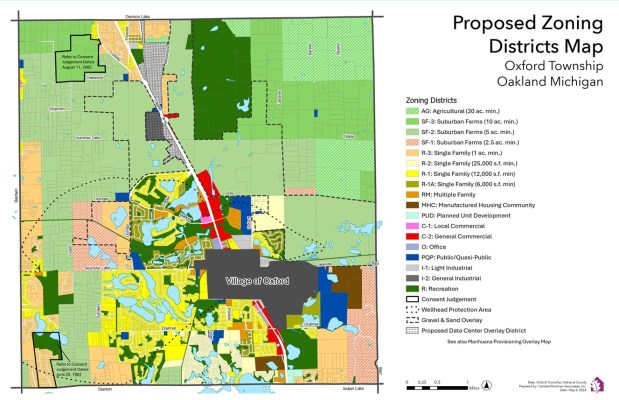 The planning commission will continue working on the township zoning map in order to designate only certain areas for any possible data center projects.
photo courtesy Matt Fahr
Sound
Any noise above 85 decibels is considered harmful to humans. Roof or ground-mounted cooling units generate anywhere from 70 to 90 decibels at the source. Diesel backup generators generate around 115 decibels at the source.
Passalacqua said a 200,000-square-foot office building would probably need two or three generators to maintain full operations in an outage. A data center of the same size would probably need somewhere between 13 and 26.
New language could allow the township to require periodic third-party audits of noise and utility usage both during and after construction and if a data center requires on- or off-site public or private infrastructure, the planning commission can require a development agreement, financial guarantees, or applicant-funded improvements, meaning that if the development needs any kind of public or private infrastructure the developers would need to pay for it.
Aesthetics
“(For) screening and landscaping, we are utilizing the current language in your ordinance for this requirement, however, we are requiring data centers to use the strictest form of landscaping and screening that is in your ordinance currently,” he said. “They can’t just be concrete concrete monolithic block.”
After Passalacqua laid out the basics of what the township needed to do and the size and scope of what a variety of projects may entail, dozens of residents spoke out against the prospect of having a data center in their backyard.
“I’m telling you that I’m going to sell my house,” said township resident Claudia Vargas. “I am sure you might earn some money and some incentives through the data center. I don’t know what the incentives are for data centers moving into towns, but I know you will lose a lot of residents, because I know I will put my house for sale.”
“I don’t see benefits addressed in the city in the city’s recent agenda document,” said Mike Ratajski. “I don’t see any, not even jobs. What other overwhelming advantages are there for the residents of Oxford? What’s the tradeoff for the potential damage a data center can inflict?”
Potential water usage was addressed by several residents.
“So, for an entity to get a tax break from the state on their equipment, they need to be tied to a municipal water system, right?,” 10-year township resident David Price asked the commission. “Our water system doesn’t go all the way through all of the industrial zones as I understand it, which means they’re going to want to drill a well, which comes back full circle because our water system runs off community wells. So I’m very concerned about the aquifer analysis?”
Residents also mentioned adding language to limit the size of any project, replacing “may” with “shall” where the public interest is concerned, require certain infrastructure protection and require periodic third-party audits and make sure any developer or company pays the entire cost on any project.
“I would like to point out that the current draft language appears to be weak, and it does not seem designed to fully protect our community’s health, sustainability, future, quality of life,” Kitty Clevenger told the commission. “And it reads like boilerplate language, rather than tailored expert advice that our township tax dollars paid for.”
She added, “Oxford and our surrounding communities are worth protecting, and we have a collective duty to safeguard our local land, water, air, and overall environment. Data centers present a malignant threat to our area, driven by greedy commercial interest rather than community well-being.”
A few members of the board addressed public comments at the end of the meeting.
“I think it’s important for us to get this ordinance on the books so that we can put some guardrails in if a data center does ever want to come here,” said Commissioner David Wagner. “All of the utility usage and all of the environmental and water and wastewater and how that’s managed and what happens when they’re expelling water from their facility. I think that’s really important.”
“We heard you guys, and we want to make sure that we address those issues that were concerns of mine when you guys spoke,” said Commissioner Ryan Austin. “There were a lot of people that were emotional in this, and I felt emotional, too, by listening. So, when somebody has lived in a house for three years, and now there’s a data center grid right behind their backyard, I’m listening.”
The commission unanimously approved a motion to send public input back to township staff and direct staff to further research and potentially revise the data center draft map and text amendments.