
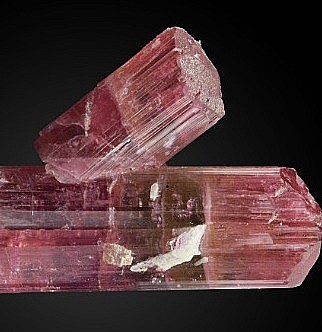


Left, Pink tourmaline from San Diego County’s historic Himalaya Mine in Mesa Grande. (Photo by Carlin J. Green, U.S. Geological Survey./Public domain.) Right, view of four men near Himalaya Mine in backcountry, c. 1905. Men are identified from left to right as Bill Nelson, Artley, Jim Kinney, and cook. (Photo and caption info courtesy of the San Diego History Center.)
Diamonds may be a girl’s best friend, but more than a century ago, pink tourmaline was the gemstone San Diego County was sending halfway around the world.
And did you know the county once supplied so much of the pink gemstone to China that 120 tons of gem-quality tourmaline were shipped overseas between 1902 and 1910?
The story begins in the rugged hills around Mesa Grande, in the Himalaya Mine, where miners discovered pockets of colorful crystals in the region’s pegmatite rock. Before long, those pink stones were attracting attention far beyond San Diego County — including at the imperial court of China.
 Mesa Grande, where Vance Angel is seen drilling at the Himalaya Mine c. 1901. (Photo and caption info courtesy of the San Diego History Center.)
The discovery came at a fortunate time. China’s Empress Dowager Cixi, who ruled during the final decades of the Qing dynasty, had a particular fondness for pink tourmaline. The demand for the rosy-colored gemstone helped turn San Diego County into an important source for the Chinese market. Cixi died in 1908, and the Qing dynasty was overthrown in 1912.
 China’s Empress Dowager Cixi, 1904. (Photo courtesy of Wikipedia/Pubic domain.)
The San Diego Natural History Museum says that between 1902 and 1910, San Diego County supplied imperial China with 120 tons of gem-quality pink tourmaline. The Himalaya Mine in the Mesa Grande district became one of the region’s major producers.
The trade involved a familiar name in the American jewelry business: Tiffany & Co.
 Stanley R. Davis with back to camera, sitting on a large rock and holding a gun. Rock formations of Mesa Grande in the background. (Photo and caption info courtesy of the San Diego History Center.)
According to the museum, the imperial court placed orders for the stone, and Tiffany gemologist J.L. Tannenbaum commissioned Southern California miners to find and ship the requested material. The process helped connect the mines of San Diego County with the imperial court thousands of miles away.
The gemstone was not being mined from a traditional hard-rock gold vein. Instead, miners worked pegmatites, unusual igneous rock formations created as magma cooled. These formations can contain pockets filled with large, well-formed crystals.
San Diego County became known for its pegmatite mines, particularly in the Pala and Mesa Grande areas. The pockets could produce tourmaline in vivid shades, including the pink and reddish material that became especially desirable.
 The rosy stone put San Diego County’s mines on the map. Pink tourmaline was discovered in local pegmatite mines late in the 19th century. It was a lucky find. (Photo and caption info courtesy of the San Diego Natural History Museum.)
The demand was substantial. Much of the pink and red tourmaline from San Diego County was shipped to China, where craftsmen carved the material into objects such as snuff bottles and used it in jewelry.
The Empress Dowager’s interest helped create an international market for a mineral that otherwise might have remained a regional curiosity.
And the story did not end with the early 20th-century mining boom. Southern California remains internationally known for its gem-bearing pegmatites. The Pala area has continued to produce tourmaline and other collectible minerals.
In 1969, the Pala Stewart Mine hit another tourmaline pocket that produced about a ton of hot-pink tourmaline, according to the Natural History Museum.
 Left, John Reed, superintendent, standing outside the mouth of a mine with a pickaxe at his feet. He holds a candle in a candlestick holder in his left hand at the “Lithia mine,” or more commonly known as the Stewart Lithia mine at Pala. In the middle and to the right, he is seen inside the mine. (Photo and caption info courtesy of the San Diego History Center.)
Today, collectors and mineral enthusiasts prize San Diego County tourmaline for its color and crystal quality.
It is easy to think of San Diego County’s mining history as a story about gold.
But the county had another treasure — one that traveled far beyond California and ended up in the hands of royalty.
San Diego County wasn’t just mining gemstones. It was mining a stone that became an international obsession.
Read more history stories here. Do you have a story to tell? Send an email to DebbieSklar@cox.net
Sources:
San Diego Natural History Museum, All That Glitters.
Gemological Institute of America, October Birthstones: Opal & Tourmaline.
Gemological Institute of America, Tourmaline History and Lore.
U.S. Geological Survey, Elbaite. Sample from the Himalaya Mine, California; photo by Carlin J. Green.
George F. Kunz, Gems, Jewelers’ Materials, and Ornamental Stones of California, California State Mining Bureau Bulletin 37, 1905.