
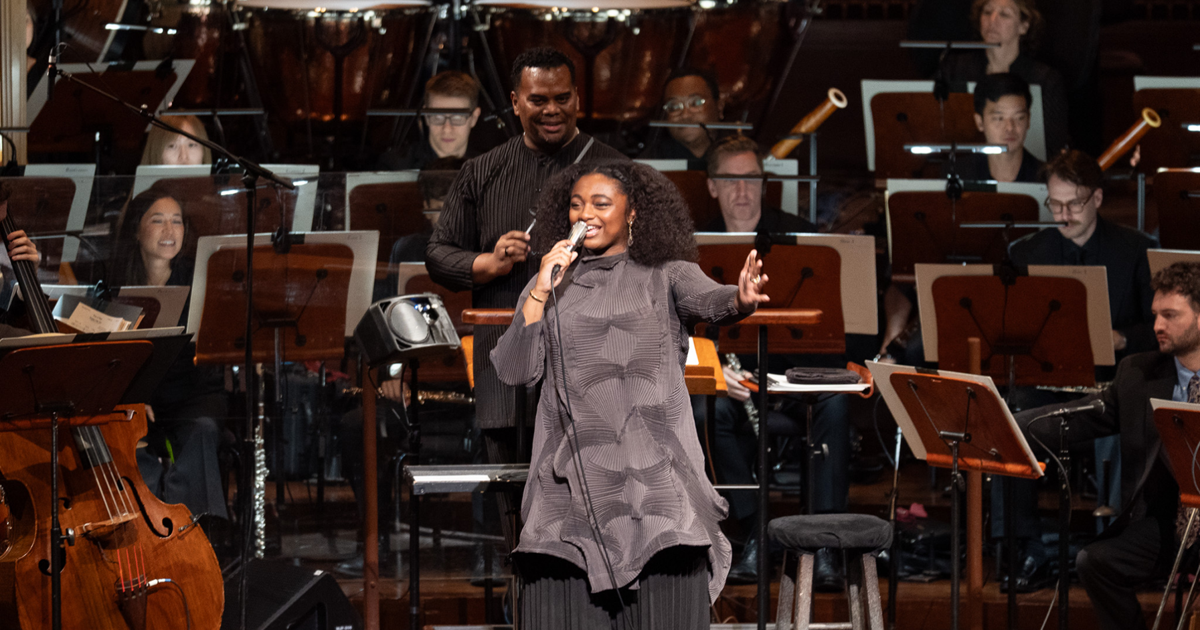
On the evening of September 8, jazz’s shiniest young star Samara Joy made her San Francisco Symphony debut at Louise M. Davies Symphony Hall. The night sought to celebrate a blend of jazz and classical music with a full orchestra surrounding Joy’s touring band, playing custom renditions of its compositions.
Even if you have not deep dived into the world of jazz, Joy is one of the more likely jazz stars you may have come across in recent years. With a voice that makes you pause in surprise with its richness, formally categorized as a rare contralto, Joy has risen in popularity on social media platforms through her soulful approach in introducing jazz classics to younger listeners. At only 26, her legacy already runs deep: Joy has six Grammy Awards to her name, including 2023’s Best New Artist, and has won various jazz contests, including the Sarah Vaughn International Jazz Competition in 2019.
Joy’s program selections paid tribute to celebrated jazz legends’ classics while embracing some more obscure picks. She began with her original composition, “Peace of Mind/Dreams Come True,” originally released in 2024. The hall’s acoustics reverberated with the oboe’s eerie melody that followed Joy’s confident, velvet voice.
“Tonight is proof that dreams really do come true,” Joy proclaimed following the song’s flourishing end, before continuing with her relaxed single “Stardust.” The compositions incorporated every instrument’s effort, including a generous use of a bar chime. The tone of the performance took on a dreamy, almost Disney-like atmosphere — a unique departure from jazz’s usual intimate and nonperformative nature.
Joy continued with a cover of Betty Carter’s “Beware My Heart.” Just as the song began, she playfully asserted that “developing a crush is simply a lack of information,” earning a laugh from the audience.
“Reality eludes you just for a second … This song is like a stop sign,” Joy said, interrupting the flow of the concert for a reality check. She introduced the song by singing the title, a playful expression on her face. “Beware my heart / You’re getting in too deep.”
Altogether, Joy and the orchestra’s control over dynamics was stellar and felt less calculated than it likely was. As Joy’s voice lowered near the end after a high note, the symphony softened in accord.
Incorporating lesser known gems, Joy introduced the first movement of a suite Duke Ellington wrote for the queen in 1958 that wasn’t allowed to be released until after he passed away 16 years later, “Sunset And The Mockingbird.” The song allowed the oboe’s dragging melody and the flute’s romantic trill to shine through a long intro before Joy joined in her signature deep register.
Joy entered the stage after intermission, changed into a flowy, electric pink shawl to sing Djavan’s “Flor de Lis” in Portuguese, a cover of which she released last year, offering a soothing and unexpected shift in the program.
The program continued to Billy Strayhorn’s “Lush Life,” earning a cheer of excitement from the audience in recognition of the beloved classic. “Life is lonely again,” she sang darkly, complimenting the lonely nature of the song.
Joy’s rendition of Billie Holiday and Mal Waldron’s 1959 song “Left Alone” was the gem of the night among a beautifully executed set. Joy prefaced that Holiday inspired her to grasp a deeper emotional depth in her singing, an anecdote that proved to be stunningly true. Jason Charos’s trumpet started, like an anticipatory call before the piano chimed in.
The song’s opening notes — an octave jump into descending harmonic riffs — dragged the audience into a slow, sultry yet lonely melody, one Joy embraced completely, soulfully. The symphony’s restraint allowed the haunting silence to seep in, allowing its flares to hit harder just a moment afterwards. A lingering trombone note prefaced Joy’s first line: “Where’s the love that’s made to fill my heart?”
Following the performance of “Left Alone,” Joy received the first of her several standing ovations of the night. The single grounded a night otherwise filled with exploration of genre and composition in a true display of her artistry, showing much promise for Joy’s contributions to the future of jazz.