
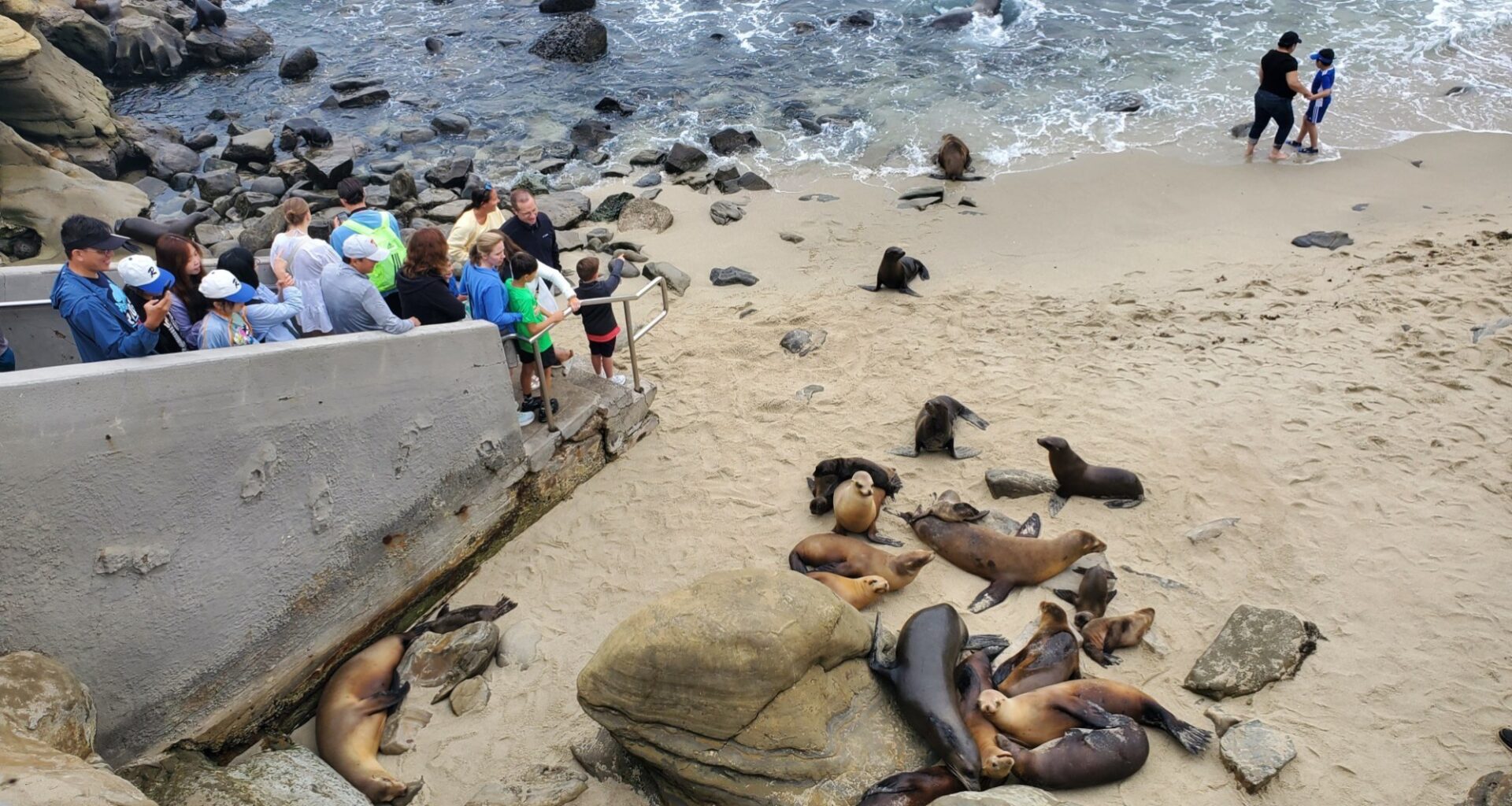
Local leaders are continuing to mull over the future of La Jolla Cove access.
Although no concrete action has been taken to this point, discussions have made their way to city and state agencies.
While San Diego City Council President Joe LaCava said the intent is to “preserve the public’s access to the iconic La Jolla Cove” that effort is becoming “increasingly challenging” in light of recent events and heated public discussions. Thus, city of San Diego representatives said have they entered into discussion with the California Coastal Commission as to how to proceed.
Local discussions surrounding keeping sea lions and humans apart have been underway for years, but on July 22, a video surfaced online appearing to show a person chasing and kicking at a sea lion near La Jolla Cove, bringing new intensity to the conversation.
In the widely circulated video, the sea lion appears to have been sitting atop a low wall that separates the colony at La Jolla Cove and Point La Jolla from a public walkway. The video shows a young man taunt and then kick at the sea lion before chasing the animal as it tries to escape along the wall.
Tyler Muehl, an 18-year-old La Jolla resident, admitted to attacking the animal, according to a plea agreement he signed in August. He pleaded guilty to a misdemeanor violation of the Marine Mammal Protection Act, which makes it illegal to harass, harm, pursue, feed, capture, injure, restrain or kill the animals.
Soon after the incident, San Diego Mayor Todd Gloria and LaCava spoke out in a joint statement, describing it as “disturbing” and “unacceptable.”
In the same statement, they wrote: “The actions of a few individuals should not undermine the work to balance wildlife protection with responsible public access to one of San Diego’s most treasured natural places. Responsible public access means respecting wildlife, following the rules, and recognizing that we are visitors in their habitat. We can, and must, continue to do both.”
Then, during the Aug. 14 California Coastal Commission meeting, board members wondered if a temporary closure of La Jolla Cove would be beneficial as the city formalizes its plans to keep people and sea lions apart.
“I’m at the point where I believe a partial closure is the only way to deal with this issue until the city gets their program implementation figured out and investigates what is going on here,” said Commissioner Matt O’Malley. “I’m sorry to have to be an advocate for that at this point.”
Commissioner Jose Preciado added that he, too, questioned whether the city “needs some sort of reboot in the sense that maybe preserving the environment completely … while everyone gets policies and practices squared away.”
Ten days later, during an unusually crowded La Jolla Parks & Beaches meeting at the La Jolla/Riford Library, a contentious conversation took place that culminated in the board issuing a recommendation of reduced access to The Cove.
During the meeting, 37 people signed up to speak during public comment, with 15 selected to address the board. The discussion frequently became contentious, with competing groups arguing over whether The Cove should be closed or remain accessible. This included incidents of cross-talk and even shouting among attendees.
The LJP&B board weighed in on possible next steps by voting to submit a proposal that would keep La Jolla Cove open while limiting access to only allow swimmers, snorkelers and divers — and prohibit other forms of access and beach recreation there — during the sea lion pupping season of June 1 to Sept. 15 annually.
“The stairs by the lifeguard station would remain open, with signage indicating (water access) only,” the resolution states. “No animal viewing from the beach would be permitted.” The western stairs would be closed during this time under the LJP&B proposal.
The resolution was presented by LJP&B members Chas. Dye and Kurt Hoffman, who said a limited-access approach could reduce conflicts while preserving recreational use of The Cove.
“The threat is imminent of completely closing (The Cove), and some action needs to be taken,” Dye said. “Given the choice of closing The Cove or this, I would take this.”
The limited-access resolution next goes to the city of San Diego Parks & Recreation department for consideration.
Following the meeting, LaCava said in a Sept. 9 statement to the La Jolla Light, “I thank La Jolla Parks and Beaches for their discussions on this issue. I encourage all La Jolla community groups to share their opinions with my office.”
LaCava also told the Light that he and his staff remain in active discussions with the California Coastal Commission “to protect marine mammals and preserve the public’s access to the iconic La Jolla Cove.” But it isn’t without its challenges.
“Given recent high-profile harassment of sea lions and tourist traffic unwilling to follow simple rules, keeping The Cove open is becoming increasingly challenging,” LaCava said.
In a separate social media post, Gloria explained how the city is handling things in the meantime.
“We are using every tool available to protect La Jolla’s sea lions while keeping this coastline safe and accessible for the public,” he said. “That means having our park rangers on the ground, educating visitors and working closely with our state and federal partners to respond when people put themselves or these animals at risk.”
The post also states that the city intends to continue working with state, federal and community partners to strengthen protections at La Jolla Cove, including evaluating Ranger coverage, signage, crowd-management measures and public education efforts.
Gloria’s office declined to offer further comment or concrete next steps.
— La Jolla Light freelance reporter Noah Perkins contributed to this report.