

As we have seen in recent weeks with players like Zeev Buium, Fraser Minten, and Braeden Bowman, teams are trying to get ahead of their RFAs by signing them to long-term extensions a bit early (also because of the new 7-year limit which kicks in this week), which is what the Buffalo Sabres did with Noah Ostlund. The 22-year-old forward signed an eight-year deal for $6.6-million per season. The contract kicks in next season, and goes nicely with the extensions for young players like Josh Doan, Zach Benson, and Owen Power.
*
The Columbus Blue Jackets signed veteran goalie Cam Talbot to a one-year deal. He is coming off a poor season in Detroit but had generally been pretty steady for several years before that. He will be the backup to Jet Greaves, and that makes it seem like Elvis Merzlikins won’t be returning anytime soon from his shoulder surgery.
*
Over the last couple of weeks, my Ramblings have covered my personal projections and the best fantasy draft values. These projections are my own, but anyone looking for Dobber’s projections, draft list, and draft guide, head on to the Dobber Shop to pick up your copies! The Fantasy Guide has a slew of articles to give you the edge for your fantasy drafts, and a purchase includes a Draft List, which has Dobber’s projections for skaters and goalie. Help support what we do year-round and grab the Fantasy Guide!
With that brief preamble out of the way, these are the draft value discussions my recent Ramblings have included:
Shallow League Forward Draft Values (link)
Deeper League Forward Draft Values (link)
Shallow League Defence Draft Values (link)
Deeper League Defence Draft Values (link)
Rookie Draft Values (link)
Today, we’ll look at individual NHL team fantasy values to see where we should, or should not, stack some players from the same franchise. My projections use Z-Score values, which determines how far a player’s projection in each category is above/below a replacement level player. So, if a replacement level forward in a 12-team league averages 20 goals, and I have Matt Boldy for 41 goals, the ‘Z-Score’ gives him a value based on the difference. We do that for within each position for each player in each stat. The fantasy stats used are goals, assists, shots, blocks, hits, and power-play points.
Data for my projections come from Evolving Hockey, Natural Stat Trick, All Three Zones, and Frozen Tools with ADP data from Fantrax. I am focusing on the skaters and goalies with the 250 highest Z-Score totals, which is roughly the number of players drafted in a 12-team league.
To start with, let’s look at the teams that stood out. These are the teams whose total fantasy value is above the middle of the league and whose combined projection rank is higher than their combined ADP rank at each position. For example, I have Sam Reinhart as the 18th overall fantasy forward this season and his Fantrax ADP rank among forwards is 30th. It gives him a +12 positional rank. I do that for each player and then add up each team’s total. Using those parameters, here are the seven teams that stood out for stacking purposes:
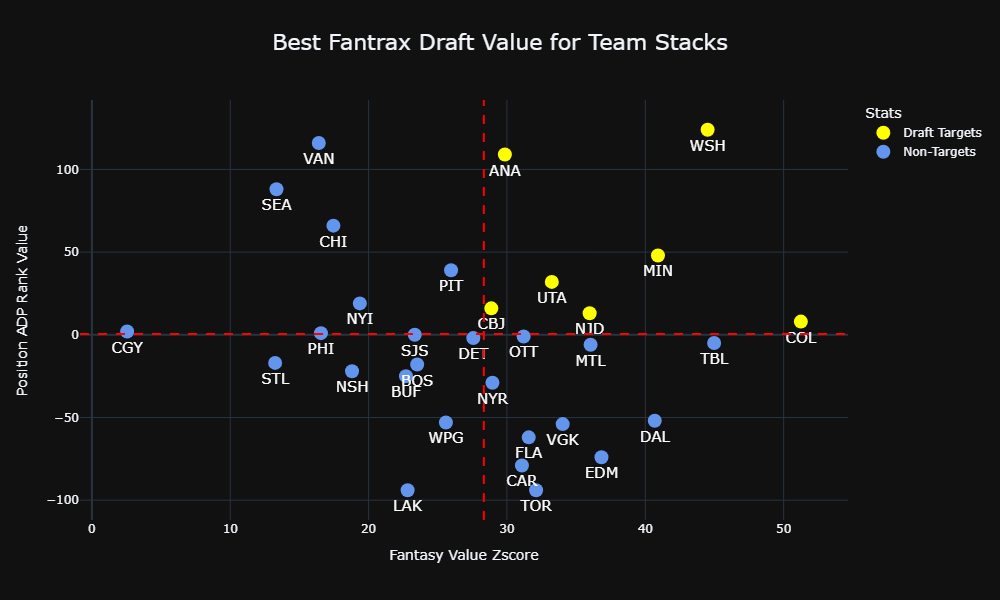
We won’t cover them all, but first up is the team that made a lot of key offseason changes.
Washington Capitals
The Capitals have the highest Position ADP Rank, which means their skaters and goalies have combined for the best draft value. They also have the fifth-highest Fantasy Z-Score Value, which means they not only provide draft value, but also have a lot of fantasy impact. There are players who provide good draft value based on their ADP but won’t bring great stats; that is not the case with the Caps:
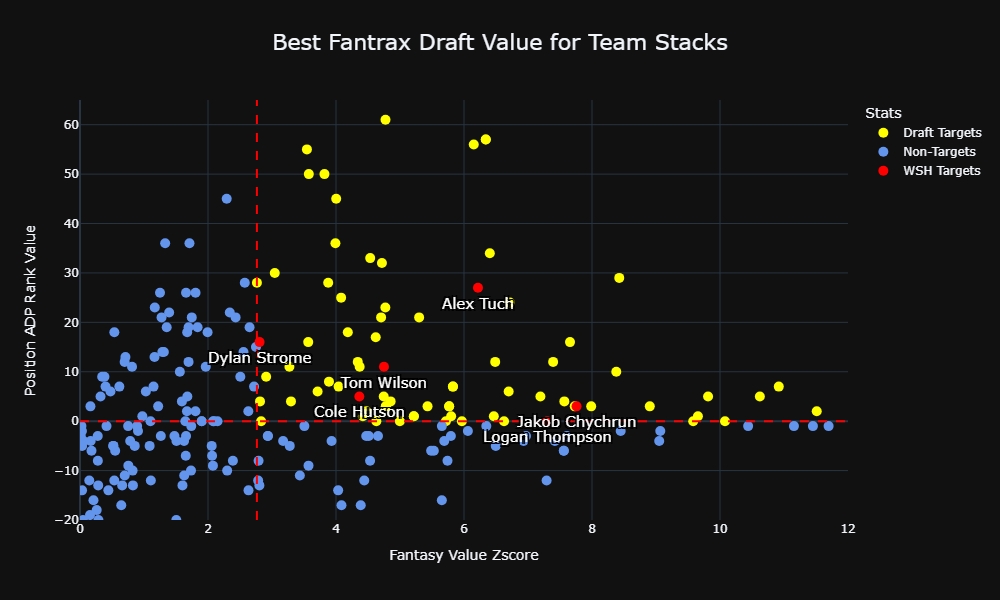
Among their forwards, three names stood out:
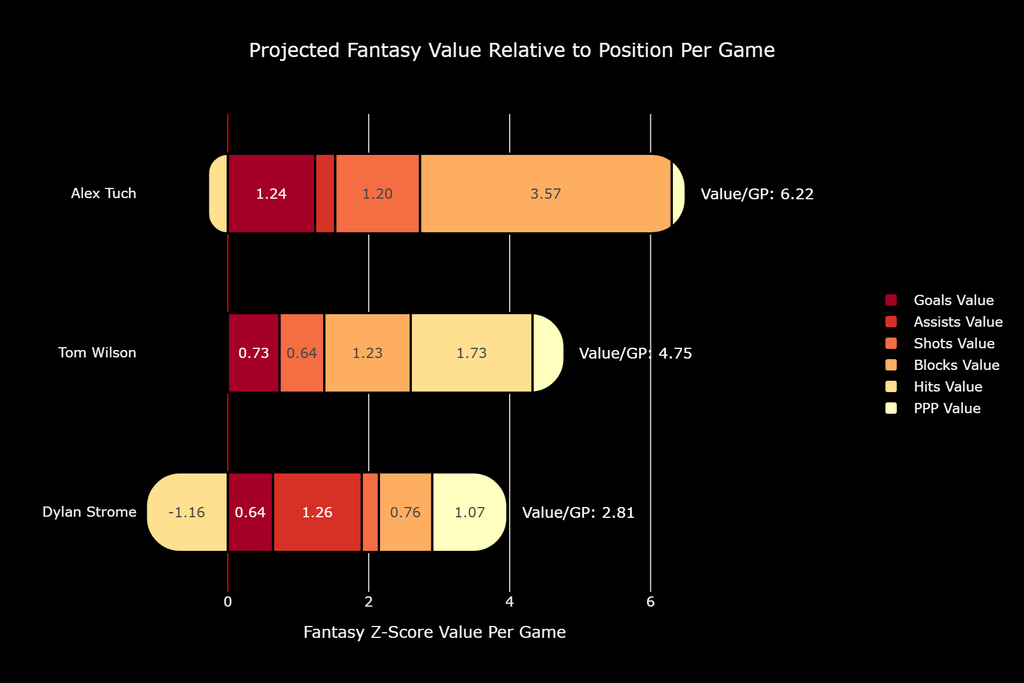
Alex Tuch joined the Caps in the offseason and is a prime example of contributing across the board as he’s averaged 35 goals, 32 assists, 196 shots, 78 hits, 102 blocks, and 10 power-play points per season over the last two years. A huge chunk of his value comes from blocks, but even if we cut his block projection by 30%, he still comes out as a positive draft value. On Fantrax and Yahoo, he’s being drafted somewhere between the 80th and 100th pick; my projections have him around the top 50. In multi-cat leagues, Tuch looks like a great option.
With the influx of so many good forwards, my projections assume Tom Wilson‘s ice time will fall, and with it his production. He should still be a 25/25 player with roughly 2 shots, 0.75 blocks, and 2.5 hits per game, and that kind of across-the-board coverage still makes him valuable. His draft value is not in Tuch’s tier, but still good.
Finally, Dylan Strome fell to 59 points in 2025-26 following his point-per-game 2024-25 campaign. That is depressing his ADP and giving him good draft value. He probably loses a bit of ice time if Pierre-Luc Dubois and Boone Jenner stay healthy, not to mention if Ilya Protas establishes himself, but Strome’s point-per-game season came with 17:23 per game. He is still the Caps’ best playmaker and their top centre. If the team is as good as they look on paper, Strome is in for a big rebound.
It isn’t just the forwards giving good value, though. Both Jakob Chychrun and Cole Hutson are solid draft values from the blue line:
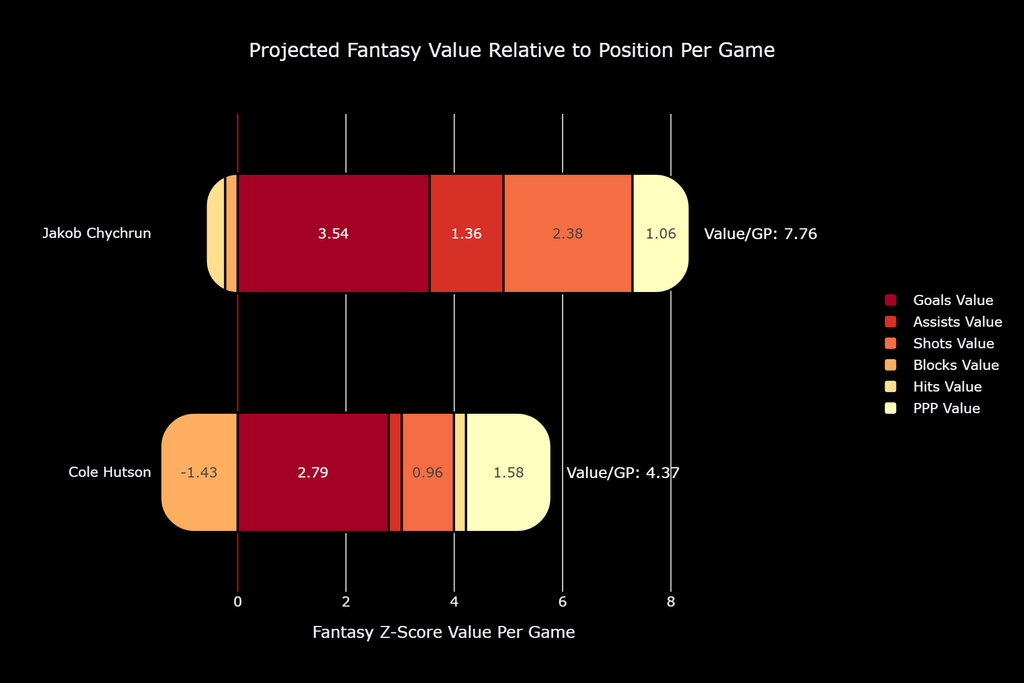
Neither is providing immense value like Tuch, but both have positive draft values. There is (and should be) concern about which defenceman takes top PP minutes, but the Capitals haven’t been shy about splitting PP time somewhat evenly among both blue liners, and my projections assume both skate between 40-60% of the team’s PPTOI. Fantasy managers might not want to pick one or the other, so I say: Why not both?
As a quick note, goalie Logan Thompson comes out as a break-even draft value. He is fine to target as part of a stack, but not someone I would reach for. If managers aren’t comfortable taking him as a top 5 goalie, then it’s fine to pass on him.
Anaheim Ducks
Unlike the Caps, the Ducks aren’t providing a massive amount of fantasy impact. However, they are providing a massive amount of draft value and that does matter:
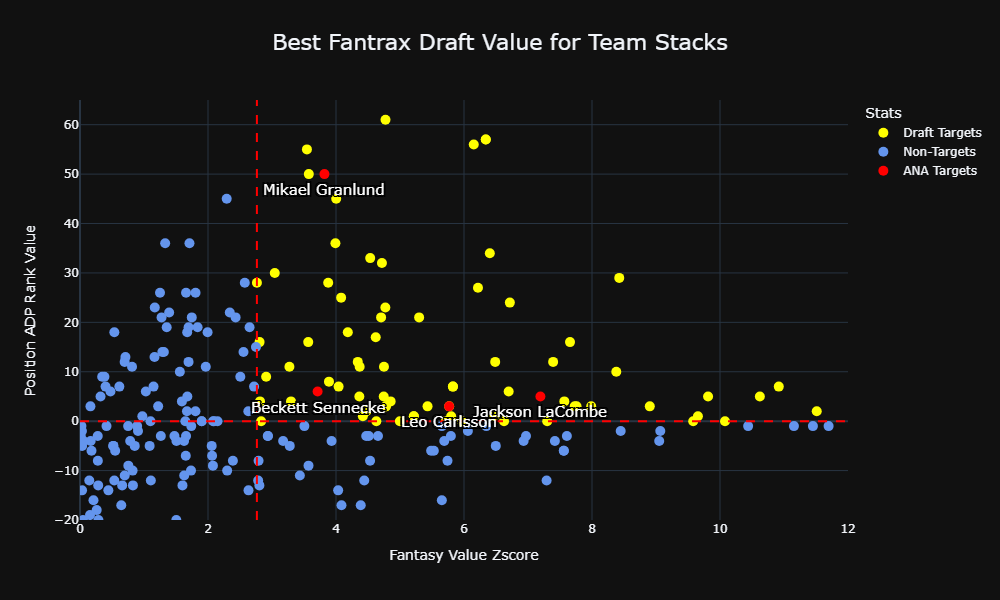
As with the Caps, there are three forwards whose fantasy value sticks out here:
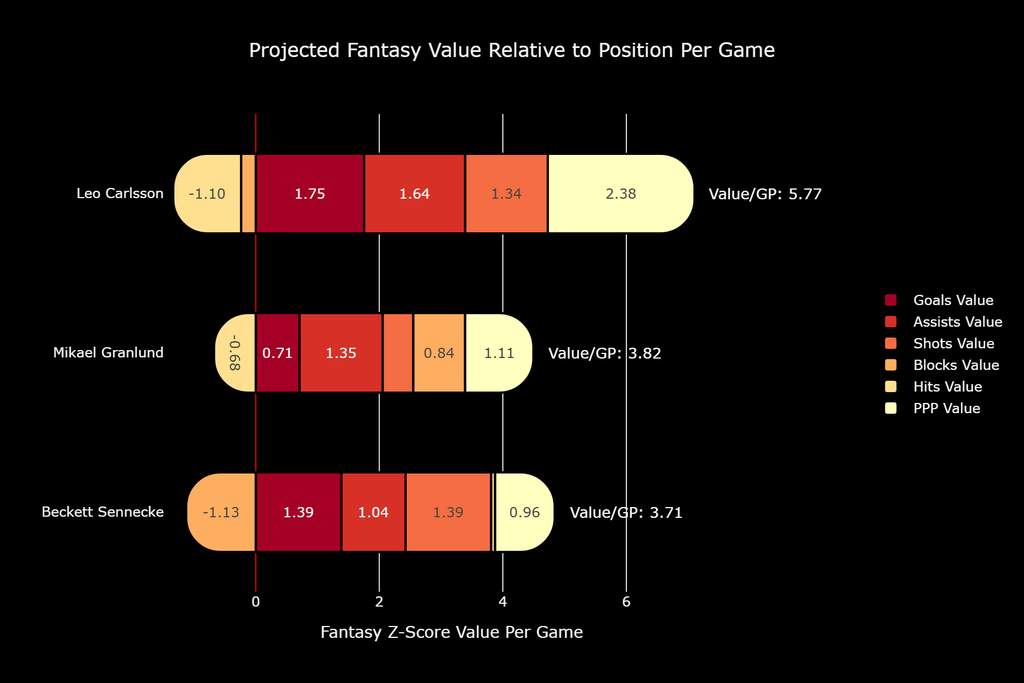
The name that might surprise some is Mikael Granlund, and I get it because he’s a veteran forward who is well-known and hasn’t had hugely productive seasons. All the same, his 82-game paces over the last three years are for 20 goals, 44 assists, 164 shots, 61 blocks, 59 hits, and 21 power-play points. That is pretty good category coverage and he’s not being drafted inside the top 200 picks on either Fantrax or Yahoo. With the trade of Mason McTavish, release of Chris Kreider, and injury to Troy Terry, Granlund will be a fixture of both the top 6 and the top PP unit, likely topping 19 minutes a game again. Volume matters, he’s a very talented playmaker, and the top of the Ducks’ roster is highly skilled. How many forwards with ADPs outside the top 200 can we reasonably expect 20 goals, 40 assists, 20 power-play points, 50 blocks, 50 hits, and 2 shots per game? He may not give eye-popping stats, but eye-popping stats aren’t required to bring good draft value.
The duo of Leo Carlsson and Beckett Sennecke make an appearance here. They aren’t tremendous draft values like Granlund, but good ones, and as with Granlund, the bevy of changes up front without similar replacements coming in means they should be heavily relied upon in all key offensive situations. Carlsson is primed for a point-per-game season and Sennecke is projected for 70 points. Fantasy managers targeting Ducks skaters should have their names circled.
I will quickly touch on Jackson LaCombe. He is on the chart above as a good draft value and I have him ranked as the 10th fantasy defenceman in this format. That is still 40% less productive than the elite names like Cale Makar or Zach Werenski, but he’s going somewhere around the 15th defenceman off the board, and that makes him a good draft value.
Minnesota Wild
This one kind of surprised me because it isn’t as if the top Wild skaters should be over-looked; names like Kirill Kaprizov, Matt Boldy, and Quinn Hughes are among the top options at their position. The thing is that only Boldy came out as a good draft value among those names. There are others on the board:
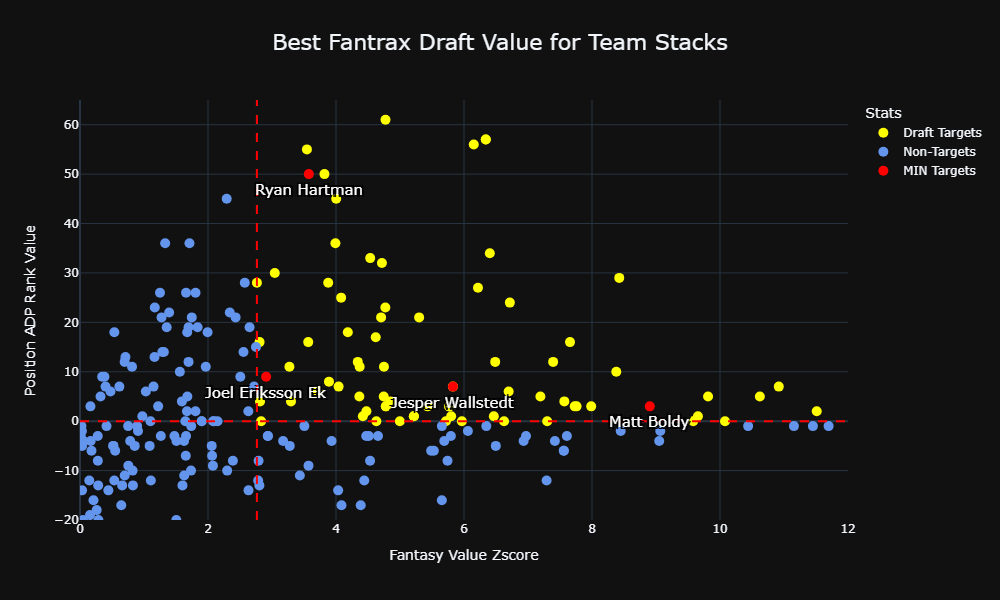
Ryan Hartman is the shocking name here, and it’s one I’m not sold on. His 2025-26 season saw him manage 95 blocks in 76 games. That is 30 more blocks than his prior career-best mark (65) set back in 2023-24, and the difference in blocks per game is 42%. My projections heavily weight recent performance, so he’s projected for nearly a block per game, which is a lot for a forward, and is providing over 70% of his fantasy value:
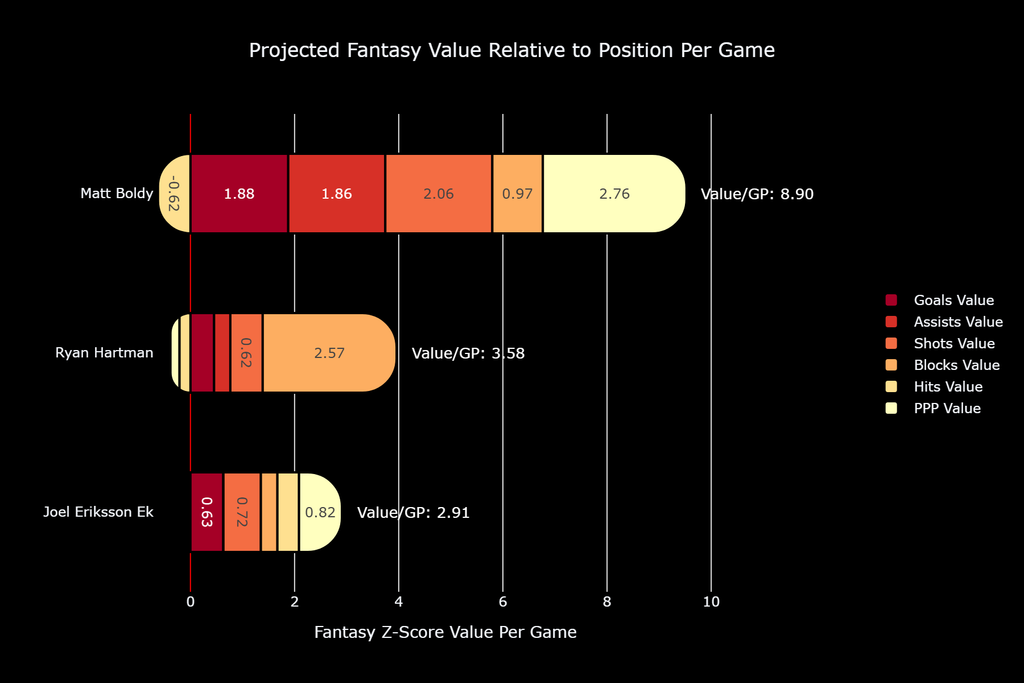
If Hartman’s block rate is half of what I project, which is what it was back in 2024-25, he drops from a top 70 forward to top 130. All his fantasy value is riding on something he’s only done once, which is what makes me nervous about drafting him. The good news is his ADP is well outside the top 200 picks, so fantasy managers don’t need to draft him as a top 70 forward; his Fantrax position rank is closer to 135, which is where his fantasy value lands if his block rate crashes.
Jesper Wallstedt is an interesting name because the injury to Filip Gustavsson should mean a lot of Wallstedt early in the season, and if Gustavsson can’t catch up when he returns, Wallstedt is in line for many more starts than the 33 he made last year. Minnesota should easily be a playoff team and Wallstedt could fly past 50 starts. Fantasy managers who don’t like to draft goalies early will want to target him in the 11-20 range.
Utah Mammoth
The last team I’ll mention is Utah. Unlike others on the list like Minnesota, the New Jersey Devils, Columbus Blue Jackets, and Colorado Avalanche, there are no Mammoth players who’ll be among the top 25 selected. That means fantasy managers wanting to stack them can go get elite options from other teams with their first couple of draft picks and then focus on the Mammoth. They might not have elite options, but they have a few good ones:
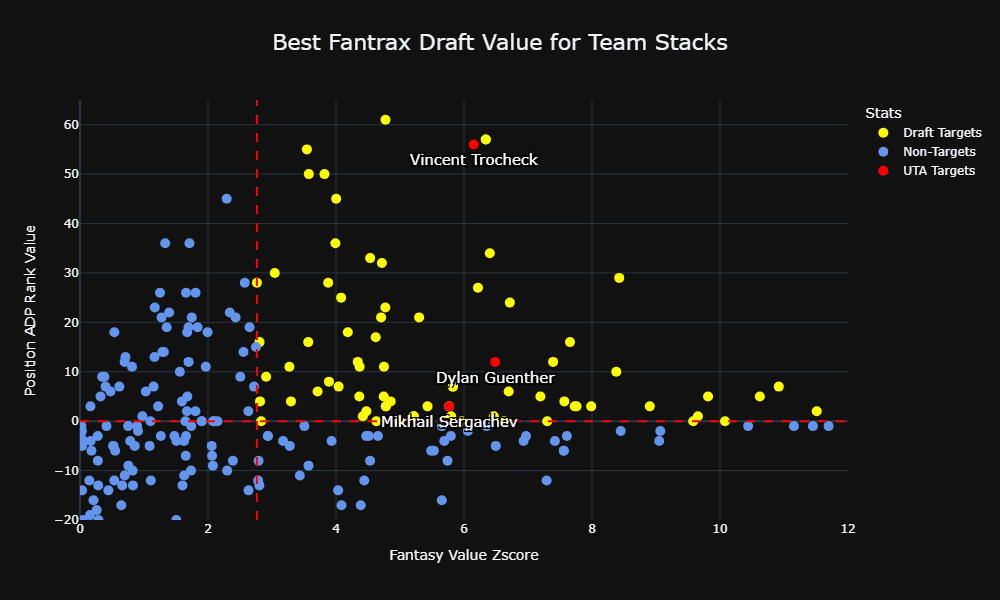
Vincent Trocheck was covered in the Ramblings covering shallower league targets linked earlier, so we won’t go long on him here. He is a guy expected to provide positive value contributions across the board, so even if he’s not great in any one area, he should be good in all of them, and that matters.
Aside from Trocheck, there is a young Mammoth forward on the board:
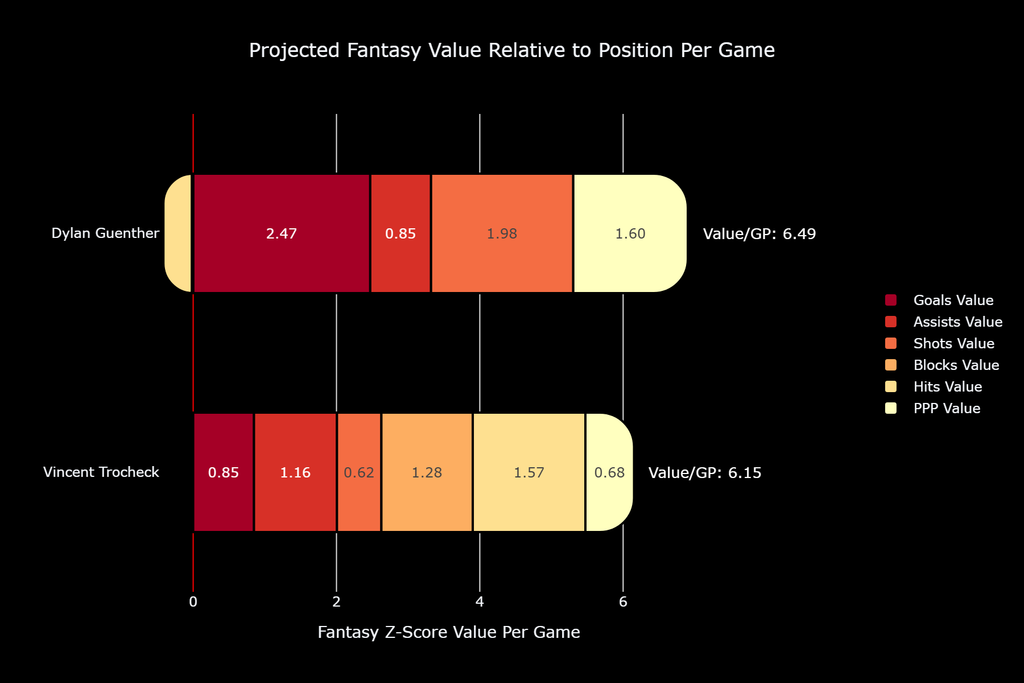
Using Stathead, if we adjust for the higher scoring environment of the last five years and go back to 2013, here is the list of players who played at least 200 games through their age-22 season and averaged at least 32 goals, 32 assists, and 2.5 shots per game:
Three of those names are first-round fantasy picks and Aho has averaged a point-per-game pace over the last five years. Those are the names Guenther aligns with to this point of his career. I have him projected for 39 goals and 38 assists; maybe that’s a little light.
Mikhail Sergachev rounds out our list. He isn’t a great draft value, but he’s the top defenceman, and top power-play defenceman, for a playoff team on the rise. Lock and load.