
San Diego County’s real estate value stands at $845 billion, the fifth largest of any county in the country.
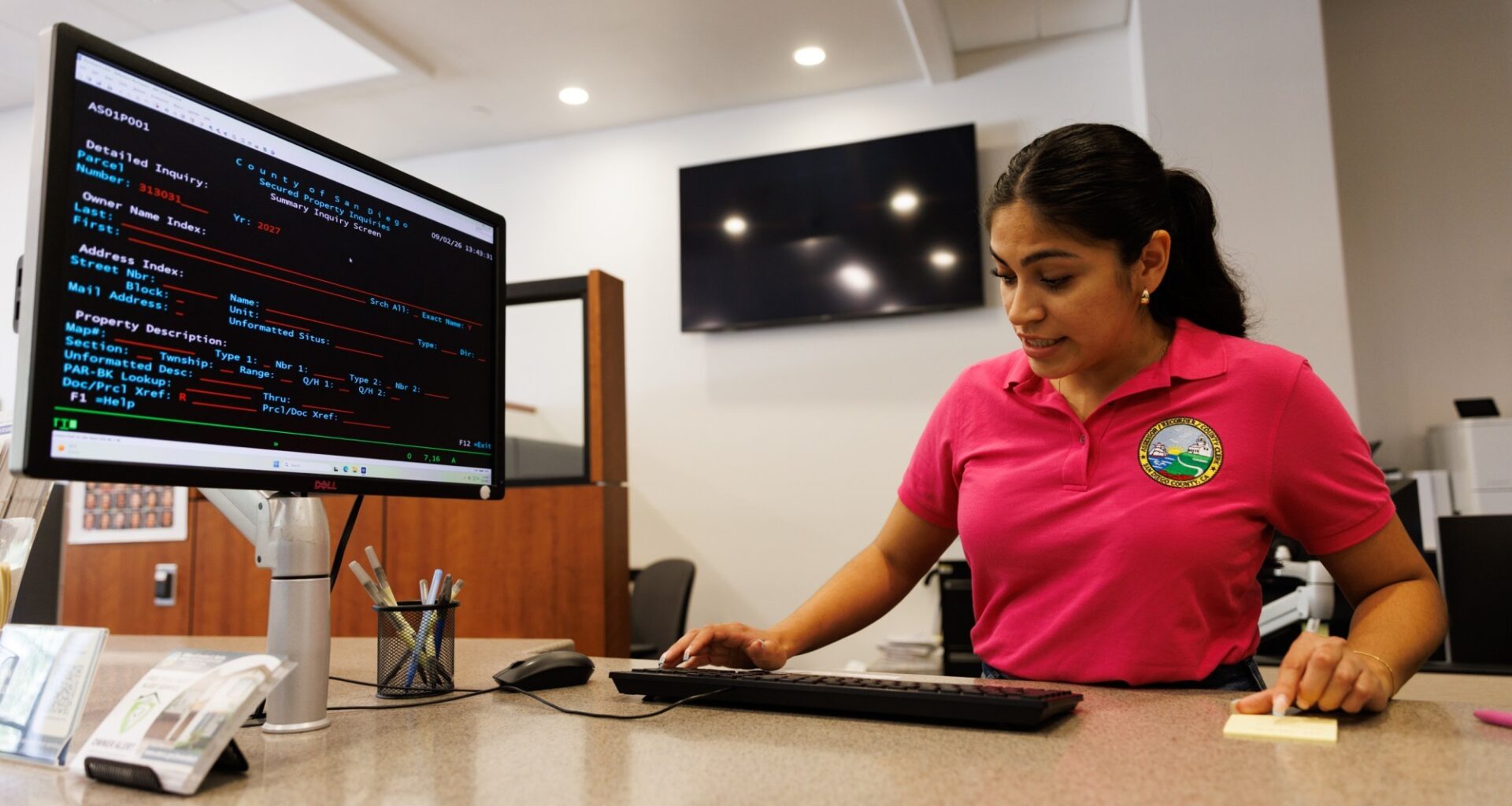
But tracking that assessment value relies on technology older than the floppy disk, MTV and the presidency of John F. Kennedy.
County Assessor Jordan Marks has plans for the county to undertake a $57 million replacement of the legacy computer system used in his office, a pricey IT project fueled by concerns of the aging system costing more than an eventual replacement.
But this is not the county’s first swing at the project.
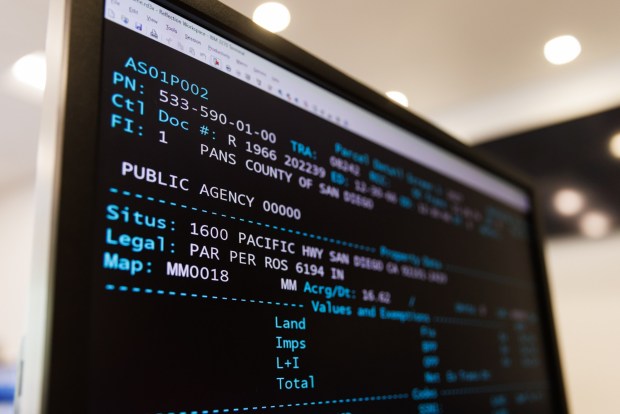 The San Diego County Assessor’s office uses an outdated system called COBOL, as shown at the County Administration Center. (Kristian Carreon / The San Diego Union-Tribune)
Since 2005, the county has twice hired contractors to develop a custom-built replacement for the aging computer system used by four county offices that have a role in the collection of property taxes.
The most recent attempt – a $66 million contract with Peraton, a massive IT company that primarily contracts with government and military agencies – partially fell through in 2024.
That year, Marks backed out of the project after the system built by Peraton wasn’t compatible with the Assessor’s Office’s operations and needs. Other county offices stayed the course with Peraton and launched the system last year.
Now going at it alone, Marks is promising to secure a computer system for his office and bring to an end a long, costly endeavor for county government.
“We’re in the golden age of technology,” Marks said in an interview. “I’m going to deliver something that’s better, cheaper and that’s going to be a much better property tax system in San Diego County.”
 Jordan Marks, San Diego County’s assessor, recorder and clerk, speaks to the crowd during a Republican election night watch party at The US Grant Hotel in June in downtown San Diego. (Luke Johnson / The San Diego Union-Tribune)
As the assessor, Marks’ office assesses the value of real estate, land and other assets like boats and aircraft. But in the Assessor’s Office, the computer system staff use to input and track property value relies on a computer language called COBOL.
COBOL stands for Common Business-Oriented Language. It was first commissioned by the Pentagon in 1959, as military leaders looked for a uniform computer language to use across their systems.
Today, COBOL continues to be used by financial institutions and government agencies around the world. But reliance on something so dated is getting costly.
“It’s gotten to a point where the old technology is more costly than the new technology,” Marks said.
Every employee in the Assessor’s Office who knew how to use COBOL has retired, and in their place, the office has grown increasingly reliant on expensive contractors, who themselves sometimes struggle with the computer language, Marks said.
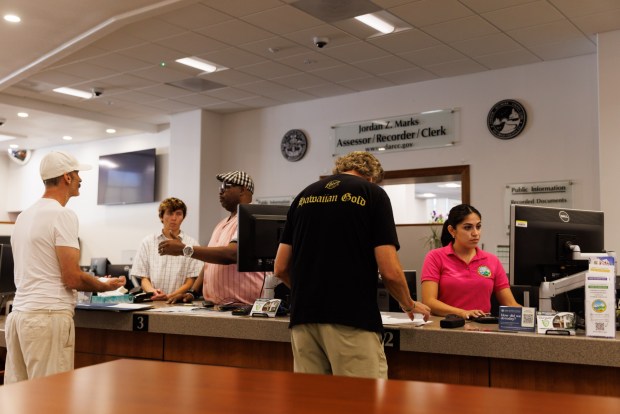 Rosa Garay Benavides, senior assessment clerk, right, helps a member of the public inside the Assessor’s Office at the County Administration Center. The COBOL system is displayed on the monitor beside her. (Kristian Carreon / The San Diego Union-Tribune)
“It’s not whether they can fix it; it’s how long they can take to fix it,” Marks added. “The people who knew how to kick it in the right spot have all retired.”
If COBOL doesn’t get replaced, Marks estimates it would cost taxpayers $80 million over the next decade to maintain it.
Once the new system eventually comes online, Marks expects it to cost the county about $4 million a year.
Last month, the Board of Supervisors unanimously backed Marks’ plan to finance the replacement with about $57 million in bonds.
Unlike the computer system Peraton built for the county, Marks plans to buy an existing computer system from an IT provider.
He anticipates his office will put out a request for proposals within the next four months.
Marks’ plan is in part bolstered by advances in the technology used to track property value elsewhere in the state.
California has an exceedingly complicated property tax system. That’s prompted large counties to hire companies to build a new computer system from scratch.
The process has not been easy, said Kristen DePaul, the assessor for Modoc County who serves as the president of the California Assessor’s Association.
“It’s a big process for some bigger counties to undertake,” DePaul said.
After nearly a decade of development, Riverside County was the first in the state to launch a new property tax system in 2015.
San Francisco followed in 2020, and Los Angeles County in 2024
“I can’t imagine being a large county and trying to recreate the wheel or move such a large amount of data to a new system,” DePaul said.
But doing the same thing in San Diego County has seen headwinds.
In 2005, the county hired a company called Bearingpoint to replace the legacy computer system used by the four offices who handle property taxes: the Assessor’s Office, the Auditor and Controller, the Treasurer-Tax Collector and the Clerk of the Board of Supervisors.
But by 2008, the company had failed to deliver anything beyond documentation and filed for bankruptcy shortly thereafter.
In mediation, the county recouped the $32 million it had paid Bearingpoint.
Another effort came in 2011.
That year, the company hired HP Enterprise Solutions to build what officials called an Integrated Property Tax System. The contract was eventually switched from HP to Peraton.
Despite Marks backing out, Peraton’s new system has been used by the Treasurer-Tax Collector and Auditor and Controller for about a year. Like Marks, the Clerk of the Board of Supervisors, which oversees property assessment appeals, declined to use Peraton’s system and launched its own system earlier this month.
Use of Peraton’s system will cost the county about $6 million this year, but ongoing costs are expected to go down in the future as the new system needs less maintenance, said county spokesperson Sarah Sweeney.
For Treasurer-Tax Collector Larry Cohen, Peraton’s new system is “working fine” and regularly improving.
The decision to go with Peraton was made before county supervisors appointed Cohen to the job last year, but he added that he thinks Marks is going in the right direction by not going with a custom-built computer system, which is more expensive.
“I think that’s what the taxpayers would welcome,” Cohen said.