
Published Sep. 15, 2026at6:00am
From the rooftop of one of ArtHaus Partners’ newest apartment buildings, at 820 W. MacArthur St., the skylines of Oakland and San Francisco can be seen in one panoramic view — a perfect vantage point for CEO Riaz Taplin to observe his growing empire.
“I’ve built more workforce housing than anyone in the history of the Bay Area,” Taplin said while giving The Standard a tour of the building in mid-August.
Taplin’s claim is hard to verify, given the fluidity of the term “workforce housing,” which encompasses studios, student beds, and multi-room apartments meant for people who earn between 60% and 120% of the area’s median income. But his company, formerly Riaz Capital, has certainly built a lot.
By its own count, ArtHaus holds around $1 billion in real estate assets across 4,000 units in development or under management, spanning roughly 60 buildings. The majority of its portfolio is in Oakland, but in the past four years, it has expanded to developments in San Francisco, Berkeley, and Sacramento, while construction is underway in Santa Cruz and San Diego.
The Taplin family has been involved in real estate since 1977, when Riaz’s father, Russ, began condo conversions in San Francisco. Riaz, who has a degree in economic history from the London School of Economics, founded Riaz Capital in 2010 and began steering it toward workforce housing in 2012. He aimed to combat what he called “a profound affordable housing crisis” in California using a mix of private and institutional capital to secure investment for the company’s projects while taking advantage of Opportunity Zones and other federal and state tax incentives.
 ArtHaus has benefited from California’s Density Bonus Law, which helped the developer add 23 buildings and more than 1,900 units, including at this site in Oakland’s Jack London Square.
But this expansion has not always been smooth, and, according to some residents, has left significant collateral damage. Since 2023, around 70 tenants living in ArtHaus buildings have filed complaints or lawsuits against the landlord through Oakland’s Code Enforcement Services, the Oakland Tenants Union, and Alameda County Court. The Standard spoke with nine tenants across six ArtHaus-owned buildings about their complaints, which range from black mold and cockroach infestations to safety concerns and unexplained charges.
These issues have been compounded by ArtHaus’ introduction in November of an AI chatbot called Sophie, meant “to improve our customer service and response times for our residents,” according to a spokesperson. Tenants said management encouraged the use of the chatbot for submitting maintenance requests and communicating with property managers. However, residents said they would often go weeks or months without receiving a response to complaints. (A spokesperson said there are other ways to reach management besides the chatbot.)
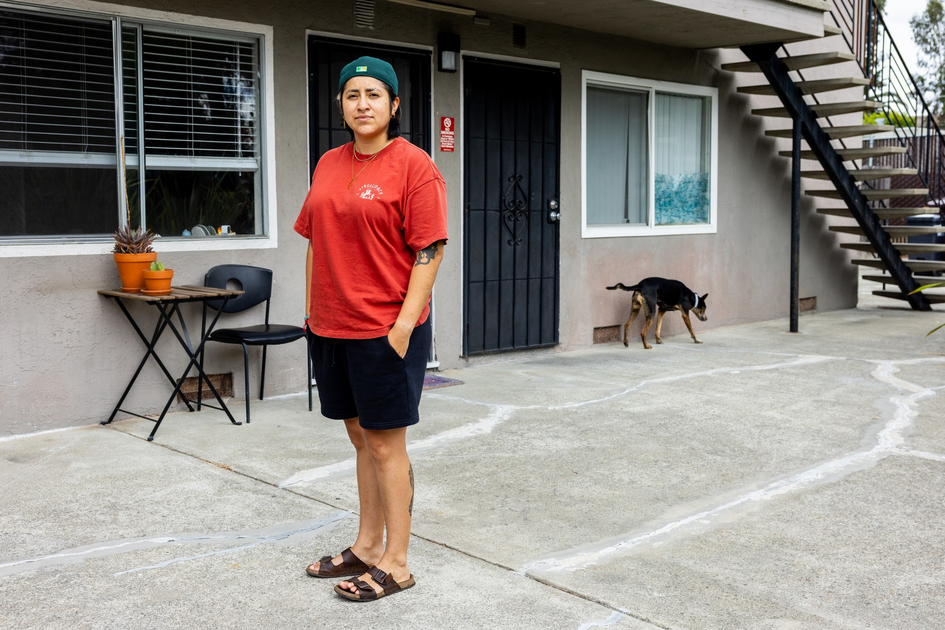
Scarlet Corona, 32, a tenant in an ArtHaus property called Diamond Haus, in the Highland Park area of East Oakland, has been living with cockroaches since the day she moved in a year and a half ago. She said she’s had it with her landlord. “They’re horrible, neglectful. I‘m so fucking tired of their bullshit,” she said.
Documents seen by The Standard show long lapses in communication between Corona and ArtHaus as she waited for a resolution to the infestation. The documents also show attempts by ArtHaus to treat Corona’s apartment; the landlord reported that the cockroaches came from a neighbor’s apartment, to which property managers were unable to gain entry. (“That resident has since vacated, and the building is now under active building-wide treatment with a vendor,” a spokesperson told The Standard.)
Corona shared images of cockroaches and gnats in the laundry room and kitchen, claiming that at least five apartments in the building had been affected. A spokesperson denied these claims: “This has never been a significant issue at this building, and we are proud of the quality of this building and the small businesses that make up its community.”
 “I’ve built more workforce housing than anyone in the history of the Bay Area,” said Arthaus CEO Riaz Taplin. | Source: Courtesy
Regardless, Corona said, she is looking for “somewhere else to live, but every other affordable property available is owned by them. Why would I move to another ArtHaus?”
Her days and nights seem to be dominated by the landlord, which also owns the building near Fruitvale, ArtHaus Works, where she works at a nonprofit.
“It’s spooky,” Corona said. “They have cockroaches there too.”
***
During the W. MacArthur building tour, Taplin explained how obsessed he’d become with the color and scent of each room. “I love the smell!” he exclaimed while taking pictures on his phone of defects he found in the apartments, including scratches on a wall and a light fixture hanging out of its brackets.
Taplin claims to have “chosen every color and planted every tree.” This attention to detail stems from his early real estate career, focused on “design-forward” projects in wealthy Bay Area locales. The CEO had a hand in all of the buildings’ decor alongside a decorator, according to Seth Lang, ArtHaus’ senior VP of development. But in 2016, Taplin decided he “didn’t want to be doing homes for rich people” anymore.
“I wanted to be something more aspirational,” he said. “I tried to find scalable ways to increase single-person housing. We can’t solve all the problems all of the time; let’s try our best to solve problems for single people in urban environments.”
ArtHaus is trying to “fill a hole in the market,” Taplin said. For his company, that means 340- to 395-square-foot units that fetch around $1,500 a month, plus utilities, communal areas with elegant furnishings, and “coliving” lifestyle perks like gyms, rooftop fire pits, barbecue areas, business centers, and theater rooms. The W. MacArthur building is restricted to tenants who earn up to 80% of the average median income in Oakland: about $95,000 a year.
 Corona said she is looking for “somewhere else to live, but every other affordable property available is owned by them. Why would I move to another ArtHaus?”
 A leaky washing machine and hole in the laundry room floor at Corona’s apartment building.
 Residue left by a former neighbor at Corona apartment in East Oakland.
Taplin says California’s housing industry is “broken,” and he is always searching for “new ways to create more affordable housing.” In Oakland, that hole in the market needs urgent attention. Between 2015 and 2023, the city’s Regional Housing Needs Allocation planned for 6,949 affordable housing units, but only a third of that total (2,476 units) were delivered, with the biggest deficit in the “moderate” income category.
Taplin placed blame for that on the city’s approach to public safety and accused it of letting crime, vandalism, and illegal trash dumping run riot during and after the pandemic years. “Businesses fled, residents fled,” he said. “They tainted the water for more institutional capital returning to Oakland.” Taplin claims he has been shot at twice while in his office, which is in the same ArtHaus Works building where his tenant Corona works. “I’m still waiting for the cops to call back,” he said.
However, ArtHaus’ tenants have had their own safety concerns, and for that, they blame not just the city but the landlord.
***
Driving southwest on the I-980 in Oakland, a quick glance to the right offers a sight of ArtHaus Jack London, one of the developer’s newest buildings, by the docks in Jack London Square. Adorned with murals by Oakland artist Fernanda Martinez (opens in new tab), the building resembles many other Arthaus properties popping up across the East Bay — beacons for a brand seeking to attract young, cash-strapped workers as tenants.
One of those tenants, Essence Smith, 33, lived in ArtHaus’ Jack London building for four years before leaving in August over mounting security concerns. Packages were being stolen from the mailroom “within 30 minutes of delivery,” Smith claimed, but when these incidents were reported through the AI chatbot, the landlord ignored them, she said.
“I had a credit card delivered to the building, which I never received. Then I started to see phantom charges on my account,” Smith said. “I only found out that it might have been stolen because I saw a Google review for the building that said someone had broken into the mailroom. They [management] never told us anything about it.”
ArtHaus denies this, saying it “sent numerous communications about package theft, as well as reminding residents not to allow unauthorized individuals to follow them into the building.”
Smith’s bike was stolen in May from a locked shed inside the building. Someone had gotten past two doors that required key passes and accessed the shed, she claimed. Where her bike used to be was a mattress, indicating that someone had been sleeping in the shed. Smith submitted a report to a property manager, who responded that he would “request the video footage and investigate the matter thoroughly.” She claimed she never heard back from the manager.
 Adorned with murals by Oakland artist Fernanda Martinez, Arthaus Jack London resembles many other of the developer’s properties popping up across the East Bay.
“Jack London has experienced an uptick in crime and break-ins, including cars and buildings, over the last few years,” an ArtHaus spokesman said. “Our property has not been exempt from that. We have communicated these concerns and issues to the city and law enforcement, have replaced doors and locks, and taken other security measures.”
According to a complaint filed with Code Enforcement Services, a tenant at an ArtHaus building on Newton Avenue reported in July that “visible drug dealing and suspected prostitution” was taking place outside the building. In January, according to another complaint, a tenant from an ArtHaus building on Magnolia Street said they were being threatened by someone inside the building and “cannot reach a live human to move units and I don’t feel safe.”
These issues were exacerbated by the introduction of the Sophie chatbot, which ArtHaus encouraged tenants to use for submitting complaints and inquiries, including repair requests, rent or charge disputes, and anything else for which they may need assistance. Every tenant The Standard spoke with mentioned frustration with the landlord’s insistence that they use the chatbot.
Smith said she had lived in the building for two years before it was taken over by ArtHaus in 2024 and when the management decided to introduce Sophie, “things got weird.”
“She’s not the smartest AI,” said Smith. “It’s sort of like talking to an AI chatbot behind a paywall.”
On a call with Sophie, a tenant is forced through a set list of options, which often end in a suggestion to email management and little recourse if there is an emergency, according to several tenants who spoke with The Standard.
“You could email them that the building is on fire and they wouldn’t do anything,” Smith added.
In response to the tenants’ safety concerns, a spokesperson said that residents can also call a phone number listed on Arhaus’ website and that if Sophie “does not ultimately meet our residents’ or our expectations, we will make a change.”
Taplin acknowledged that it may have been a “strategic mistake to introduce AI,” and is considering whether to “get rid of it completely.”
***
As rain lashed Calem Golub’s bedroom window in April, he sat on his bed and watched water drip through cracks in the wall. He said he’d been “spam-calling” his landlord, ArtHaus, and filing reports to its Sophie chatbot that had been ignored for more than a month.
Golub, 25, was one of around 265 tenants across nine buildings in the East Bay who had been living under the troubled corporate landlord Mosser Capital until ArtHaus acquired his apartment block at 350 Newton Ave. in December 2025. The relationship with his new landlord had not begun well. When ArtHaus sent someone out to inspect the water damage in Golub’s home in mid-April, the worker taped a plastic sheet around his leaky window and left.
Now, following “four months of hell,” Golub said, his home has become “uninhabitable.” He said black mold and water intruded on the two-bedroom, despite the property managers receiving a code enforcement violation warning in March that reported “evidence of water intrusion” and a “deteriorated wall in need of repair.” An independent mold inspection company recorded a level of 92% humidity in Golub’s apartment in April — the Environmental Protection Agency recommends a humidity level of 30%-50% inside a home — while the mold inspector reported having “had a hard time breathing” during the visit.
The apartment has since been gutted by ArtHaus and the drywall replaced, but the rotting timber frames remain, according to Golub, who returned to the apartment the day before the drywall was erected and took videos of the frames still in place. “There’s no way they could have replaced them in a day,” he said.
 Arthaus Terraces at 1330 Bush Street in Lower Nob Hill is the developer’s first Arthaus-branded building in San Francisco.
Golub’s apartment building, plus eight other “distressed” properties, were purchased by ArtHause from Mosser last year — a transaction the San Francisco Business Times called the Bay Area’s “housing deal of the year. (opens in new tab)” The deal was for $30 million, “a major discount that clocked in at around $105,000 per unit, less than a third of the $315,000 per unit its former owners paid for it in 2020,” the Business Times reported.
“It was one of the most challenging acquisitions,” Taplin told The Standard. Mosser, one of the Bay Area’s most active residential landlords, entered a financial tailspin after the pandemic as falling occupancy, declining rents, and rising interest and repair costs affected its debt management, according to reports.
But Arthaus’ success has not lessened the distress felt by former Mosser tenants. Fearing that the walls in his apartment could collapse, Golub has been sleeping in the room above the bike mechanic shop where he works in Richmond. He went on rent strike for the time he has been away from the apartment, leading ArtHaus to demand $7,000 in rent and issue Golub an eviction notice.
According to ArtHaus, “The resident was provided a rent credit for the duration they were unable to live in the unit. If a notice to pay rent was sent during this time period, that was an error.” Of the eviction notice, the spokesperson said it was “the formal and industry standard notice to provide to a tenant when they are late on rent. That does not mean we are pursuing an eviction,” calling that “a last resort after significant efforts to work with a resident have been made and aren’t successful.”
Golub, who has lived in the apartment for 18 years, said it’s “nearly driven me crazy having to say goodbye to that place. It’s unexplainable to have your childhood home ripped from you by a nepo baby billionaire slumlord.”
Taplin, whose personal wealth is unlikely to be in the billions, has long been faced with competing narratives about his company in the East Bay. Within the Bay Area real estate industry, Taplin is a lauded figure with a host of awards to his name. He sits on the board for several nonprofit housing organizations, and independent trade coverage has generally framed him favorably.
But another narrative promulgated by tenants rights activists has rendered him, ArtHaus, and its predecessor Riaz Capital as a mass tenant evictor. Housing organizers tied the Taplin family to at least 555 evictions across the Bay Area between 2010 and 2019.
A spokesperson disputed the accuracy and source of that figure, saying that “tallies like these … will often count any step in the legal process that was ever initiated, including routine notices that were cured or resolved and never resulted in anyone leaving their home.
“The figure does not represent households that were actually evicted, and treating it as though it does is simply wrong,” the spokesperson continued.
Asked via email for its own accounting of the number of completed evictions, the spokesperson wrote, “We don’t have an exact number on this. … An educated guess is +/-50.”
Taplin said ArtHaus was not able to inspect any of the 265 units it acquired before closing the deal with Mosser, claiming it could not gain access to the buildings until it owned them. A Mosser spokesperson later clarified that ArtHaus “did get to do limited due diligence prior to close … and were allowed access to a sample size of approximately 10% of the units.”
The Oakland Tenants Union continues to field complaints about ArtHaus, according to housing counselor Noah Kirshbaum-Ray, who reported a sharp increase in complaints about ArtHaus after it purchased the Mosser buildings and introduced the chatbot.
Kirshbaum-Ray believes many issues at ArtHaus-operated buildings are going unreported because tenants do not know where to go. “If the same issues keep coming up, it’s pretty likely that a large section of tenants there are experiencing them,” he said. “Unfortunately, most of the time tenants just accept that’s how it is.”
“Every single resident is important to us, and everything happening in every unit is incredibly important to us,” Taplin said, while admitting that “it takes months to go through 300 units.”
***
Six tenants who spoke to The Standard, echoing numerous small-claims complainants, reported that ArtHaus had issued unexplained charges on monthly invoices and refused to repay security deposits when tenants left a building. Five tenants provided evidence of charges with generic titles such as “utility bill” and no explanation.
As of June, an ArtHaus Magnolia tenant who did not wish to be named was in a lengthy battle with the landlord to remove $400 in charges for use of the building’s Wi-Fi. The tenant claims he does not use the building’s Wi-Fi, opting for another internet provider to ensure higher speeds. His attempts to have the charges removed through the chatbot have been ignored. (After The Standard inquired about the charges, the ArtHaus spokesperson said, “We believe the Wi-Fi charges were removed.”)
“The saving grace is that I did not have autopay,” said the resident. “I can’t imagine what it’s like for people with autopay. [The charge] would have been invisible.” The resident is unreserved in his contempt for ArtHaus: “They’re a parasite. They are classic slumlords in a digital era.”
Corona, from the Diamond Haus apartment, said she had “unexplained solar panel charges” added to her account and is contesting a $1,000 late fee charge for nonpayment of ArtHaus’ “damage liability” — the developer’s version of renters insurance — which she declined to pay because she has her own insurance. She claims she told the AI chatbot about the mischarges weeks ago but never heard back.
The ArtHaus spokesperson disputed the existence of a $1,000 late fee but said the charges to Corona’s unit “have been credited in full,” including the damage waiver fee and the disputed solar charges. (Corona said the resolution came only after The Standard inquired about the errant charges.)
Another tenant, Nicole Peterson, a 48-year-old substance-abuse counselor, is based in ArtHaus Mandela, one of the company’s newest constructions in Oakland. She claimed she was slapped with an eviction notice and a $6,000 rental charge when ArtHaus changed property managers midway through her lease and changed her rent due date from the 10th of the month to the 1st without informing her. The eviction notice and charge came only six days after her rent nonpayment, she said.
“My neighbor got an eviction notice too; she was crying,” Peterson said. “You don’t know what people are going through when they get these notices. Management sucks, it’s horrible.”
Peterson, a tenant in the building for two and a half years, claims her air conditioning unit has not worked for more than a year and she has received mystery electricity back charges that haven’t been explained. She, like many ArtHaus tenants, reported her issues to the chatbot but has had no response from management.
“I’ve never talked to a human since I moved in here. The only time I met a person was when they were showing me the apartment. You can’t argue with AI,” said Peterson.
 Arthaus specializes in building 340- to 395-square-foot units that fetch around $1,500 a month, like the ones currently leasing at Arthaus 820 in Oakland.
After The Standard inquired about Peterson’s claims, an ArtHaus representative said, “All of [the resident’s] concerns have been addressed and have been discussed with the management team.” The rep also stated that the eviction notice to Peterson, like the one issued to Golub, was a formality and not an overt attempt to evict the tenant.
Taplin and his business entities are facing four active lawsuits in Alameda County small claims court for alleged non-repayment of tenants’ security deposits and erroneous utility charges, with another case recently dismissed. Two habitability lawsuits against the landlord in civil court have been settled in the last two years, with one paying out more than $10,000 to a tenant who complained of rodent and insect infestations at their apartment in East Oakland, as well as a broken elevator and stove.
“Both matters involved disputed allegations and were resolved through negotiated settlements without an admission of liability,” a spokesperson said.
ArtHaus also faces a lawsuit over conditions at its East 18th Street property, where it joins Mosser as a codefendant. Disabled tenant D’Andrea Gates-Riley alleges the building, which ArtHaus purchased from Mosser, had “garbage piled up in the hallways, leading to roaches and foul odors.”
The lobby was not secured, the complaint claimed, “leading to outsiders entering the property without authorization and sleeping in common spaces.” Gates-Riley’s toilet was out of order, and the building’s elevator suffered outages for more than a week, the lawsuit claimed.
A lawyer for the plaintiffs, Ethan Silverstein of the California Center for Movement Legal Services, declined to comment on ArtHaus specifically. “Some landlords attempt to profit by making buildings unlivable in hopes of driving out the rent-controlled tenants,” he said. “Thankfully, tenants have a lot of rights in these situations, especially in the Bay Area.”
“This was a property we recently purchased and may not have been aware of all residents’ concerns,” the ArtHaus rep stated. “We take all issues like the ones named here very seriously and are actively working on improvements to this property.”
***
To build or acquire its projects, ArtHaus relies on a mixture of private funds and tax-exempt bond financing. Its acquisition of a 368-unit Sacramento complex was financed through a $100 million public bond issued by the city and county of Sacramento. Documents also show ArtHaus is set to receive a $750,000 project management fee as part of the bond for the Sacramento project.
ArtHaus has also benefited from California’s Density Bonus Law, which allows developers to increase the number of units in a building as long as they are earmarked for affordable housing. The law has helped the developer add 23 buildings and more than 1,900 units, according to its website, including the Jack London site, which increased from 105 to 130 units.
But perhaps its greatest success lies in its deployment of Opportunity Zones, a federal incentive that allows investors to reduce capital gains taxes on investments made in “economically distressed” neighborhoods. ArtHaus has used this vehicle to raise $215 million across two Opportunity Zone funds, Taplin said in a 2021 investor webinar.
The company has built 15 properties using these funds, ArtHaus portfolio documents show. These include a 64-unit development at 1705 Mandela Parkway and an eight-unit project at 2618 Martin Luther King Jr. Way, both in Opportunity Zones, while the developer has begun construction projects in zones in Santa Cruz and San Diego.
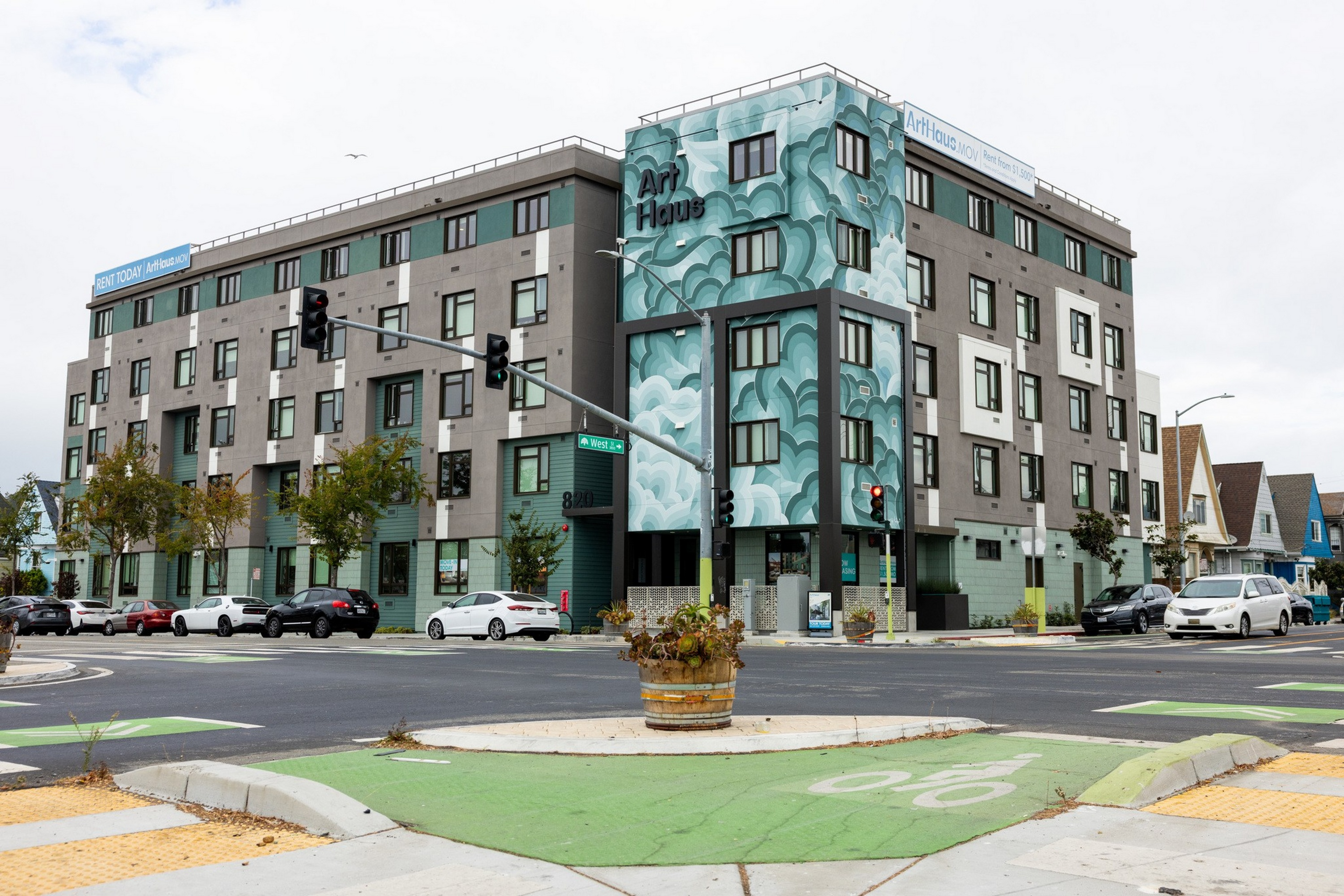 Arthaus 820 in Oakland is restricted to tenants who earn up to 80% of the average median income: about $95,000 a year.
A document that appears to be a pitch deck for the company’s latest proposed fund, accessed by The Standard through ArtHaus’ website and subsequently taken down, shows it attempted to raise $100 million for building inside Opportunity Zones. The federal government requires that at least 90% of an Opportunity Zone fund’s assets must remain inside a qualified property. However, the company’s pitch deck indicates that as much as 44% of its prospective Opportunity Zone fund would be spent purchasing property with “opportunistic returns” outside those zones.
One of the projects outside of the Opportunity Zone featured in ArtHaus’ pitch deck is in the planning stage: 2330 Prince St. in Berkeley. This townhouse development will replace a church and preschool with 23 homes that, according to the pitch deck, the landlord plans to sell for $41.31 million, or around $1.8 million per home, making $12.2 million in profit if successful. (A spokesperson said 2330 Prince St. “has not been acquired yet and will not be acquired in an Opportunity Zone fund.”)
When asked about the claims made in the pitch deck, Taplin said the document was not final and should not have been accessible on the website.
“We haven’t deployed or finalized said vehicle,” Taplin said of the fund referenced in the deck. “All our Opportunity Zone funds have been deployed with the regulations and have been compliant.”
“I feel like I’m being villanized,” he added.
He pointed to projects like Rooted, a public-private partnership with the city of Oakland that helped house 64 teachers and educators in ArtHaus properties. The company also partnered with the International Rescue Committee to house refugees and provided free office space for an educational nonprofit.
“I’ve spent my lifetime trying to do something for the community, and did I do everything right? No,” Taplin said. “But if there aren’t people like me, what does it look like?”