
Gizelle Medina is the managing editor of the Daily Titan. All opinions expressed in this article are those of the author and do not reflect the opinions of the Daily Titan as a whole.
Self-reinvention is often tempting at the start of a new semester; however, the urge to rework one’s identity for the sake of success is often rooted in post-grad anxiety tied to the current job market.
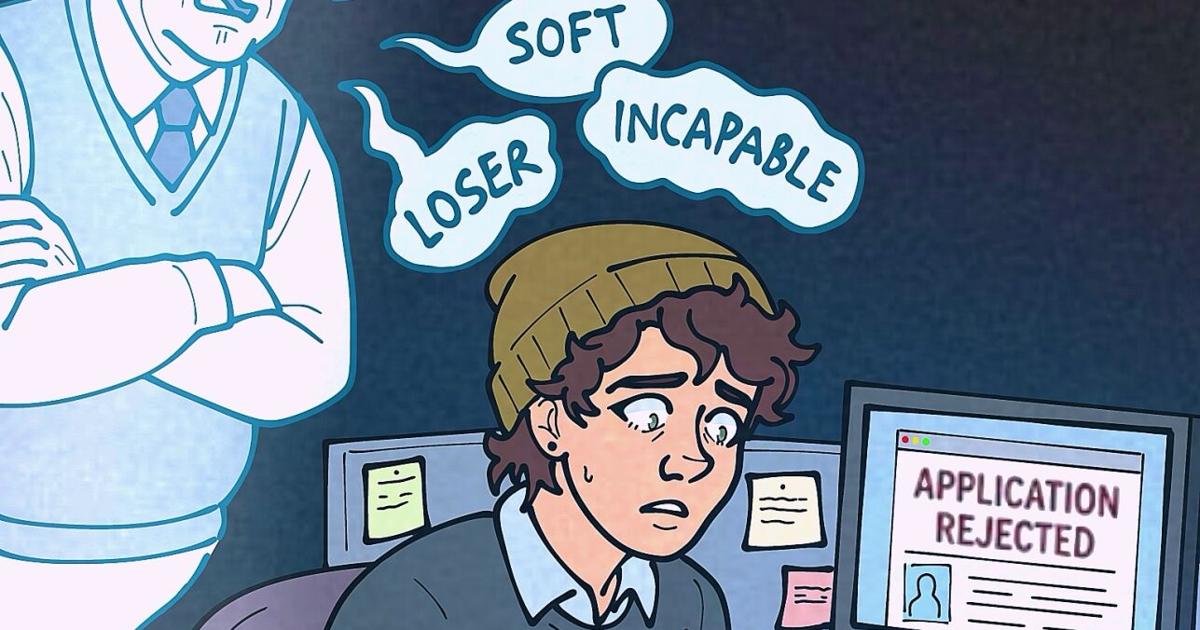
Cal State Fullerton students must now navigate a professional scene where ‘hard work’ has become a generational trigger word. As the corporate landscape shifts exponentially from the one that greeted previous generations, so must the cultural norms that new-age workers are held to.
The traditional socio-labor contract, which once promised fiscal security and professional dignity in exchange for lifelong loyalty to a single company, has crumbled. Instead of trying to fit into this decaying model, Titans must embrace this multigenerational shift in labor values as a mobilizing freedom to rediscover their own valuation of how education and employment translate into personal fulfillment, outside of rigid, inherited norms.
This shift requires a radical reevaluation of what “entering the workforce” means beyond the quantifiable differences between the economy then and the economy now. Not only is the labor landscape drastically different, but so is the relationship between a person and their personal assessment of postsecondary education.
Dr. Carrie Lane, professor and chair of American Studies at CSUF, notes that many view education as a means to an end rather than its own formative experience.
“Whatever path you choose to go down professionally, you have this core foundation. That’s not how we talk about education anymore,” Lane said. “We talk about ‘bang for your buck,’ who gets employed right out of school, and ‘What’s your major?’ and how’s it gonna buy you a job, and ‘How much money do you make with this major?’ So we’ve adopted a different language.”
For Generation Z, work-life balance, career development and a sense of purpose are prioritized criteria, whereas Baby Boomers craved more rigid paradigms related to performance, output and perceived success.
These newly embraced non-monetary incentives underscore a desire to reject wages as a sole motivator in seeking employment, calling for a new standard to replace the current faulty and arguably infantile system.
Tethering one’s journey to a single model of success suppresses the adaptability required to navigate the professional precarity of today’s economy. Success metrics must pivot from mirroring broad, fleeting socioeconomic norms to personal evaluations of purpose carved from one’s complex identity.
Rather than harping on recycled worries from the early 2000s era of mass white-collar job losses, the younger generation must find comfort in knowing that doubt regarding the linearity of how a degree translates into a job is not unique to modern circumstances.
What is due, however, is rejecting the pressure to ‘pay your dues’ in a framework that Lane argues no longer exists.
Lane notes that if employees are expected to work hard for a reward that no longer exists, abandoning that expectation is not a sign of entitlement.
“In the colonial era, American parents were saying, ‘Kids these days, they’re so lazy.’ It’s every generation that always thinks the younger one is underperforming in some way,” Lane said. “It seems super smart to me that younger people are saying, ‘I don’t want to do that, because there’s no golden ring at the end.’”
This inward reflection is Gen Z’s rational adaptation to a volatile market.
Gerard Beenen, a management professor at CSUF, suggests that the stress felt by the “anxious generation” — a title given to Gen Z by psychologist Jonathan Haidt — is amplified by “threat rigidity,” which is the tendency to view obstacles, like artificial intelligence, as a threat to be avoided rather than a challenge to be approached.
“If you view it as a threat… instead of as a challenge or an opportunity, a whole different series of chemical cascades flows through our brain and our nervous system,” Beenen said.
While older generations may view job hopping as a lack of commitment, it is often a strategic response to a world where changing companies is the only path to financial stability.
Rejecting the pressure to see oneself as a mere LinkedIn profile challenges the widely accepted norm of existing as a well-curated brand marketable to a company. Students thereby bypass the temptation to exploit or degrade their identity for the sake of professionalism, creating a unique framework for themselves instead of matching a recruiter’s buzzwords.
“I am a firm believer in ‘career is a calling,’ and I encourage people to pursue their passions,” Beenen said. “A career is different from a job. A career is a sequence of job experiences that are somehow coherently linked so that one follows after the other.”
Titans must root their value in college education beyond mere vocational training to position themselves in an ever-changing society as thoughtful, well-informed people.
A degree is not a guarantee of a job, but it provides a significant advantage over those without one. By prioritizing personal values extracted from a rich collection of experiences over the expectations of an old-fashioned corporate ladder, Titans can ensure their contribution to the world is never hollow.