
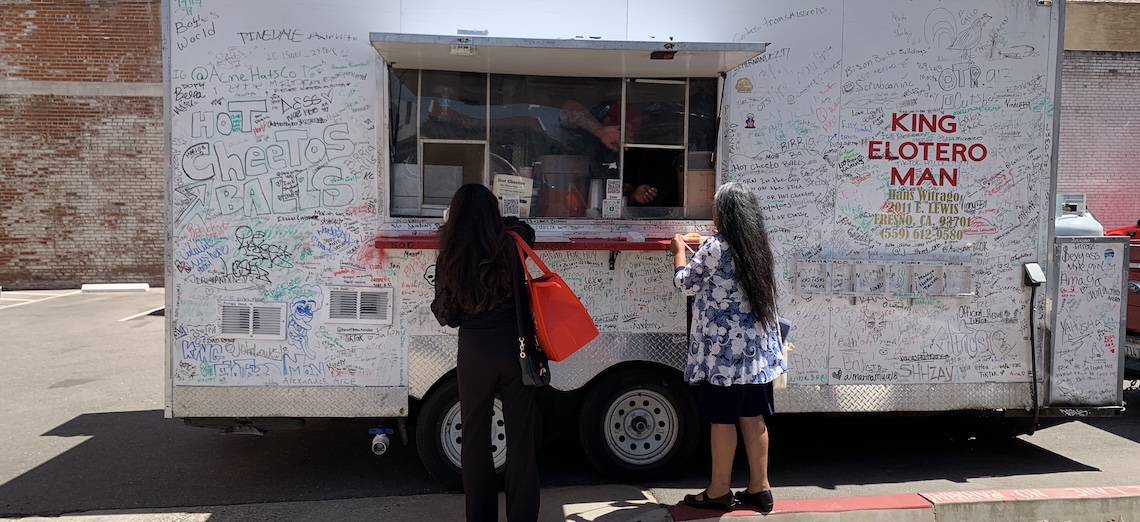
Two customers order from the King Elotero Man food truck during the Fresno Area Hispanic Foundation’s Mobile Food Vendor Grant Ceremony in Downtown Fresno on May 21, 2026. Photo by Denine Currie
Fresno ranked No. 148 among 182 U.S. cities in a WalletHub study examining conditions for Hispanic entrepreneurs.
Last month, WalletHub compared the cities across 23 metrics measuring Hispanic business-friendliness and purchasing power, scoring each on a 100-point scale before weighting the results to determine final rankings. Higher scores represent more favorable conditions for Hispanic entrepreneurs.
Fresno ranked No. 97 for Hispanic business-friendliness and No. 161 for Hispanic purchasing power, earning a total score of 42.33.
Chip Lupo, a WalletHub analyst, said in a news release that the cities at the top of the ranking tend to have large Hispanic populations as well as high rates of Hispanic entrepreneurship.
“In the top cities, Hispanic entrepreneurs can enjoy low corporate tax rates and good opportunities for growth. Plus, a large Hispanic population can be especially helpful for entrepreneurs who want to cater to that demographic,” Lupo said.
The three highest-ranked cities for Hispanic entrepreneurs were all in Florida: Pembroke Pines, Fort Lauderdale and Orlando.
Locally, organizations are working to close that gap.
Building foundations
In Fresno, organizations such as the Fresno Area Hispanic Foundation are working to provide entrepreneurs with resources to start, develop and formalize their businesses.
Founded in 2001 by local business owners, the nonprofit addresses the needs of the region’s growing Hispanic business community.
Its core services and programs include business incubation, financial assistance, bilingual support, community events and workshops.
The foundation also offers Latinapreneur/Womanpreneur programs designed to help women entrepreneurs create strategic business plans and incorporate digital platforms into their day-to-day operations to expand their online presence and sales.
‘Majority within the minority’
Nationally, Hispanics are expected to make up nearly 27% of the U.S. population by 2060, according to the WalletHub study. The study also reports that nearly one in four new businesses is Hispanic-owned.
Dora Westerlund, CEO of the Fresno Area Hispanic Foundation, said there is a significant number of Hispanic-owned businesses in the Fresno area and described the Hispanic community as a “majority within the minority.”
Westerlund said access to resources, education and funding can help entrepreneurs build sustainable businesses.
“When they are given the opportunities and the right tools and resources, they just thrive because they are resilient and willing to work really hard,” Westerlund said. “Economically, they are becoming self-sufficient and are providing generational wealth for their families and children. They are sending their kids to get educated and get better opportunities.”
It is a “win-win situation,” she added.
Latina-owned growth
Westerlund said Latina-owned businesses have been on the rise, particularly since the COVID-19 pandemic.
Nationally, Hispanic and Latina women-owned employer firms increased 37.2% between 2022 and 2025, according to the Wells Fargo Impact of Women-Owned Businesses Report.
Westerlund said there are relatively few organizations like FAHF offering programs and funding specifically designed for women and Latina entrepreneurs.
“It makes a huge difference when you have a place where an ecosystem is in place to assist small businesses and Latino-owned businesses,” Westerlund said.
Path to financial security
Westerlund said many Hispanic and Latino workers in agriculture and other industries view business ownership as a path toward greater financial security and independence.
In construction, she said, Hispanic and Latino workers — including women — are pursuing contractor licenses, permits and bonds that allow them to operate their own businesses.
She also sees entrepreneurs who have been working independently but have not formally established their businesses increasingly taking that step.
“We have seen more people formalizing their business. They want their businesses to be able to go to their kids and to their families and backed by formalization. I’ve seen it happening for some time and it’s going to continue to grow,” Westerlund said.