
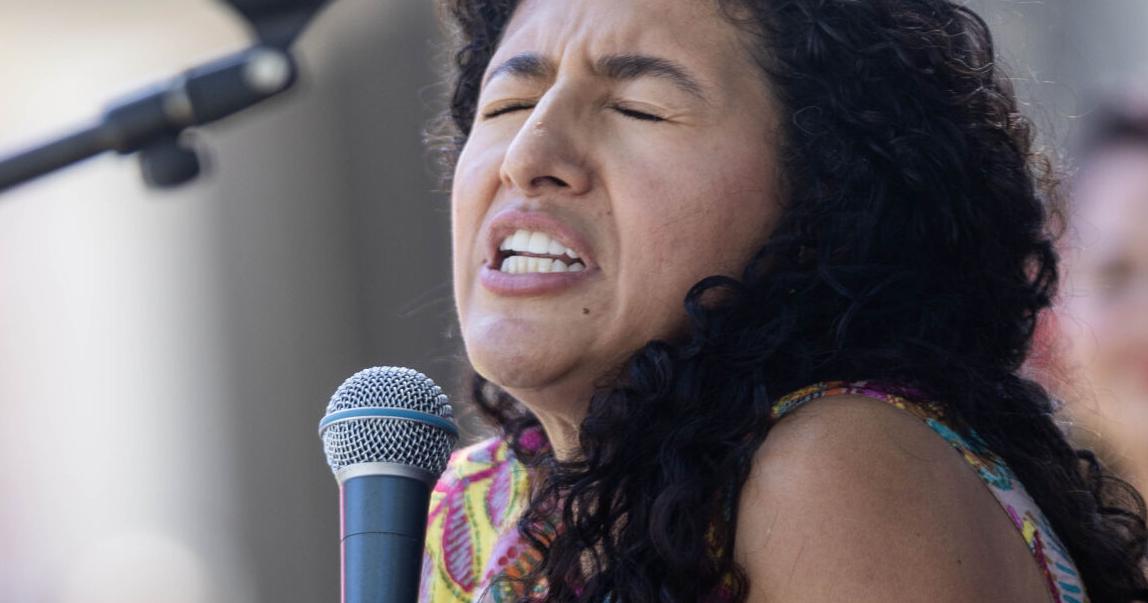
Bakersfield College kicked off its annual Hispanic Heritage Month celebration Tuesday, bringing students, staff, faculty and community members together for an afternoon of food, live music, guest speakers and cultural activities at the Panorama campus.
“Today we have food from various Latin American countries,” said Cesar Jimenez, vice president of student services. “We have a band (Velorio) playing, we have a radio station and we have featured speakers.”
And Tuesday was just the kickoff to the celebration that will be extended to five campuses this year.
“People are coming from throughout the community, students and faculty are coming from their classes,” he said.
According to Jimenez, 75% of Bakersfield College students are of Latino heritage, and most of them are women.
“We are the largest Hispanic-serving institution in the state of California, and the fifth largest in the United States,” he said. “We serve well over 46,000 students.”
The celebration took place on the Center for Student Success Lawn near the northwest corner of the campus. The event was free and open to the community.
As more students began arriving, BC President Stacy Pfluger welcomed them along with faculty and staff.
“Hispanic Heritage Month is a time to really reflect on the history and the cultures of the dominant group in this area,” Pfluger told the gathering.
“There’s a lot of history that has shaped Bakersfield and Southern California, and we’re certainly happy to be a part of that story,” she said.
But more important than the history is the path to the future, she said. And that’s what BC offers.
“We continue to build on these foundations and lead the college and the community into an even better future.”
As Kern Community College District Trustees Yovani Jimenez and Nan Gomez-Heitzeberg watched and listened, city of Arvin Mayor Olivia Calderón delivered a passionate and heartfelt keynote address.
“Today, I want to speak to you not only as the mayor of Arvin. I want to speak to you as a daughter, a sister, a wife,” Calderón said. “I want to speak to you as a Latina, a proud Latina, who believes — I believe in every fiber of my body — that education can be the trajectory of a family, a community and a life.”
Calderón said she wanted to share three key ideas with those gathered: Heritage, the power of education and community leadership.
“I want to begin somewhere very, very personal,” she said, “because sometimes history is not something you read in a book. Sometimes history is sitting at your kitchen table. It’s your grandmother. It’s your father’s hands. It’s your husband’s accent. It’s the language your parents spoke to you when you were a child. The sacrifices that made it possible for you to stand where you are today.”
Josue Valladares, 22, a sophomore nursing student at BC, attended part of Tuesday’s event. His family, he said, came to the United States from El Salvador, and they are intimately aware of the meaning and cost of sacrifice.
“We came here running away from gang violence,” he remembered.
The country was controlled by corruption, and criminal gangs.
“So my mother decided we needed to migrate to the United States to have a better opportunity in our lives, to live peaceful, you know?”
Valladares was 12 at the time.
“My mom had had enough,” he said. “This was after my father was killed. My grandfather was killed a year after.
“The 17th of this month is actually the 18th anniversary of my dad’s death. So this week, for me, is just emotional, honestly.
“Today is also Independence Day for us in El Salvador. That is one of the reasons why I’m out here.
“When it comes to our family,” he said, “what we always say is we are a family of faith, so we say the Lord brought us here and allowed us to be here in the United States.
“We came, actually, seeking asylum. So we were allowed to stay. We like to think we were allowed to be here for a reason. And one of those reasons is for us to study, learn the language, the culture, soak up the good things the United States has for us.
“One of those things is peace,” he said, just being able to enjoy a walk outside of our house without thinking we’re going to be murdered today, or we’re going to be robbed, or the children could be kidnapped or violated or raped.
“Those are some of the things that we grew up with and just being able to walk outside or just sit outside, that’s just something that we didn’t have.”