
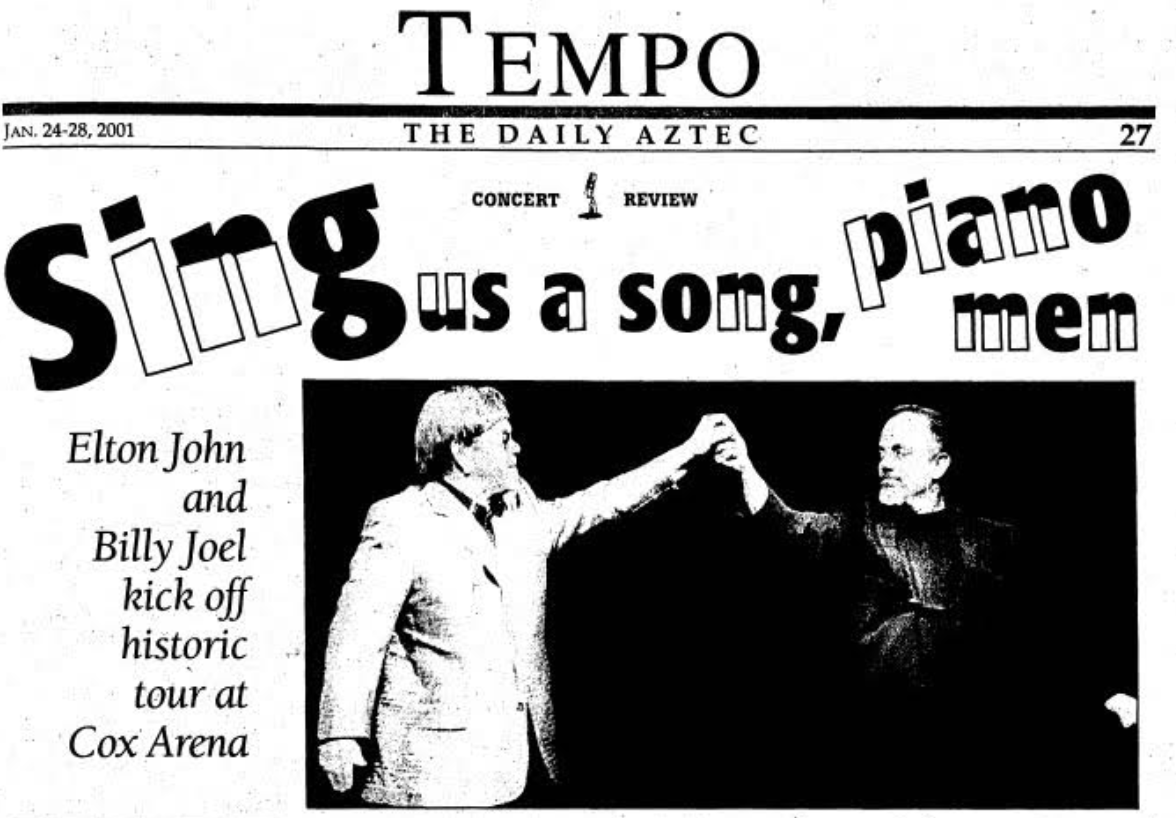
In the 1960s, an era where rock erupted as a dominant music genre, San Diego State University became a hub for best-selling artists. Iconic performances from artists such as Bob Dylan and Green Day still ring in the memories of SDSU alumni today.
SDSU anthropologists Seth Mallios and Jaime Lennox compiled every concert played at SDSU from the 1960s to the 2000s in their five-part book series, “Let It Rock!: Live From San Diego State,” published in 2015.
Students could watch up to two concerts a night for a fraction of the price they pay now, according to Mallios.
Mallios is a professor of anthropology at SDSU and the director of the university’s South Coastal Information Center, where archaeological site records are kept.
Lennox, an SDSU alum, earned her bachelor’s degree in anthropology in 2005 and her master’s degree in 2008. She is the director of the Archeology Collections Management Program and the University Native American Graves Protector and Reparations Act coordinator.
Mallios and Lennox began scratching the surface of the school’s many rock concerts, and ended up sifting through hundreds of articles from The Daily Aztec to curate their five-part book series.
According to Lennox, concerts were put on by students, including members of the KCR radio station. Today, many of the major concert venues are leased by entertainers’ management, and SDSU’s Associated Students manage the venues. Lennox reached out to the KCR Radio Alumni Association during her research for the book series.
“The campus radio station (KCR) was contacting bands and getting their music and putting it out to the students,” she said. “A lot of these concerts were put on by students for students, and so it would reflect what they liked.”
In 1964, Bob Dylan performed at Peterson Gym, and in 1969, the Grateful Dead performed at the Aztec Bowl. In 1980, Santana performed at the Open Air Theatre (now known as Cal Coast Credit Union Open Air Theatre) where lead singer Carlos Santana promoted his new album, “The Swing of Delight,” and charged $12.75 for front row tickets.
In 1983, The Police gathered massive crowds for their show at the Aztec Bowl, now the setting of Viejas Arena. The show had issues with counterfeit tickets and a ban on outside items. Audience member Elaine Rother said that all items people brought into the venue were taken away, making a mountain of abandoned coolers and water bottles in the parking lot that could not be brought inside, according to Let It Rock!
Mallios said San Diego served as a popular place for musicians to start touring. In the Southwestern-most part of the country, San Diego served as an easy starting point on a map, and a trial run for performers before heading to Los Angeles.
Musicians didn’t profit much from selling concert tickets since it was low cost. Rather, their revenue came from promoting their music on KCR, leading to college students who bought CDs or merchandise.
At SDSU, Montezuma Hall, The Backdoor Studio, Aztec Bowl, the Open Air Theatre and Peterson Gym all served as venues to host audiences of different sizes. Many of the locations have been remodeled to what we see today or entirely demolished and replaced.
The Backdoor Studio, according to Mallios, was originally meant to be a space for two spare bowling lanes and was built on the lower level of the Aztec Center, where the Conrad Prebys Aztec Student Union stands today. Instead, architects Robert Mosher and Row Drew turned it into a small venue for concerts. The studio would regularly host bands, sometimes up to twice a night. Today, those packed concert sets would not be possible because of modern building codes that limit a room’s capacity.
More popular concerts include Sade, who performed her “Love Deluxe” record at the Open Air Theatre in 1993, later spotlighted on KPBS. In the same year, The Cranberries played The Backdoor Studio, and Bon Jovi played the Open Air Theatre.
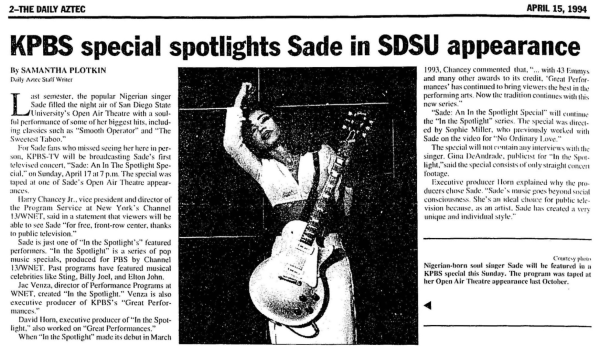 This 1994 article captured the excitement over Sade’s performance, and that students would have a chance to see her first televised concert on KPBS. Courtesy of The Daily Aztec
The Daily Aztec promoted Green Day’s show at Montezuma Hall in 1994, encouraging fans to visit their tour bus behind The Backdoor Studio after the show in the caption above the photo. Tickets for students were $9 and $10 for public entry.
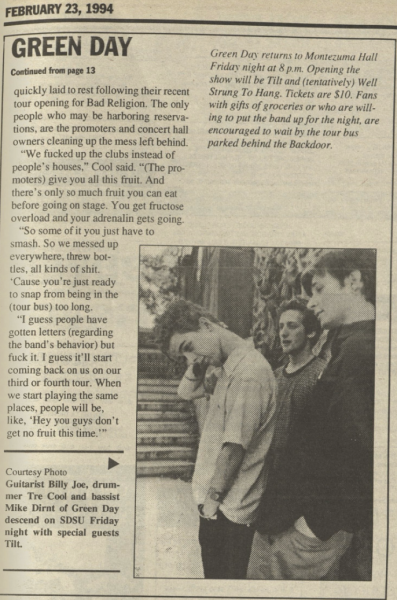 Green Day on The Daily Aztec archives. Courtesy of The Daily Aztec
SDSU’s Aztec Bowl hosted Lollapalooza in 1994. The lineup of artists was a mosaic of popular music genres of the time, including rock, pop, hip-hop, country and jazz. The festival had two stages with constantly rotating entertainment.
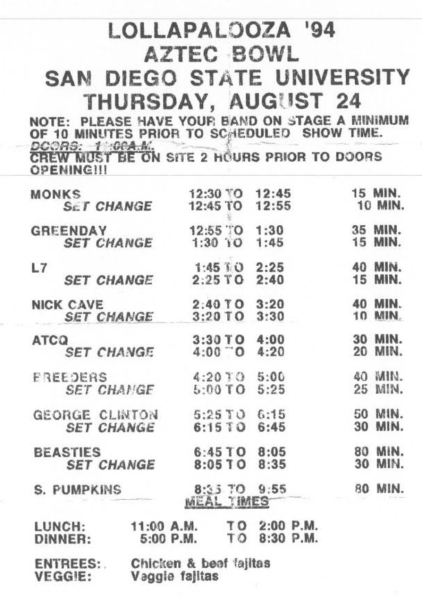 Flyer of Lollapalooza ’94 at the Aztec Bowl. Courtesy of The Daily Aztec
The Smashing Pumpkins were the main attraction for fans coming to the music festival. The band later returned to play the Open Air Theatre in 2000, but three days after the show, the band announced their disbandment.
In the transition to the 21st century, the culture of music shifted. Rock shows at SDSU became less frequent, venues that hosted them redeveloped and the once-energetic sound has been replaced by big-name pop artists performing on campus.