
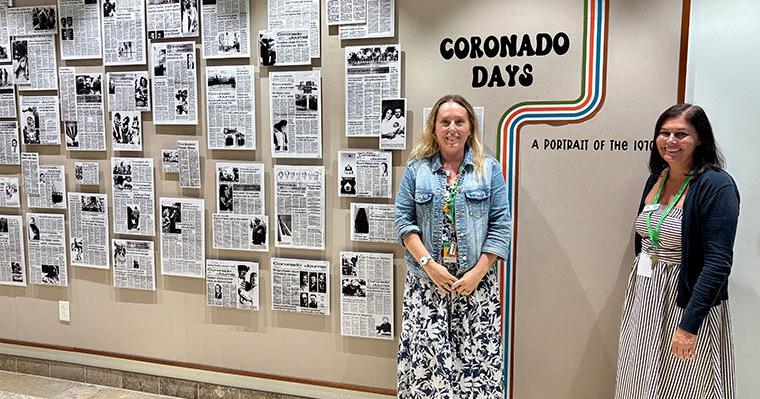
The Coronado Public Library currently has an exhibit up that takes visitors 50 years back in time. “Coronado Days: A Portrait of the 1970s” focuses on a variety of aspects of life on the island during the decade, with a particular focus on 1976 and the celebration of the nation’s bicentennial.
Special Collections Librarian Kelly Andrade and Librarian Ashley Chase curated the exhibit, having begun planning for it over a year ago as they started to consider how the library’s exhibits could tie in with the larger 250th anniversary celebration. “One of the things we needed to consider was, being in California, how does 250 relate to us? One of the ideas was to do something more localized, and working with the Coronado Historical Association (CHA) also gave us some ideas,” Andrade said of how they landed on “Coronado Days”.
The exhibit, which can be explored at the librarian through September 27, features things like the front pages of the Coronado Journal newspaper throughout 1976, a video compilation of interviews between current Coronado High School (CHS) students and CHS graduates from the Class of 1976, local yearbooks, memorabilia that showcases the island during that decade and allude to major events and decisions happening locally, “now and then” photos, and more.
“The video component is about trying to bridge the generational gaps,” Chase explained of that piece of the exhibit. “To bring teens and Gen Z into the conversation and get them excited about history and the idea that they’re making history all the time.” The library partnered with CHA last fall, giving CHA’s high school interns the opportunity to be part of creating this exhibit. “They filmed a generational conversation about what it was like growing up here and what it was like being at the high school in the 70s. They also each wrote an article to go with the video and the interview, as well.
“And I have to shout out that, even though doing the internship with teens was very out of my wheelhouse,” Chase laughed, “they were wonderful. Seeing the grads and the current high school students have that conversation was really rewarding for me, too. It was special to see them go through their pictures and yearbooks together before their interviews.”
“I grew up in a small town (only 2,500 people) and working here, I really love the small town atmosphere,” Andrade mentioned. “That and working on this exhibit brings me back to my childhood. The people I went to high school with are now running that city, and are our teachers and principals at the schools. So I liked seeing that people who graduated 50 years ago are still around Coronado. And we’ve gotten to make these great connections with them.”
When setting up their exhibits, Andrade and Chase like to ensure every element tells a story of what’s on display. “Each case has a theme; for example, one is more focused on civics, with pieces about the City – who was in charge of the City then, and there were a lot of interesting things that were happening in the 70s,” Andrade noted. “Virginia Bridge was the first woman mayor, elected in 1972. She was actually only the second person to be elected by the citizens because before that the mayors were selected by the city council.”
That case also includes pieces about some of the local organizations that have been a part of the community for many years, pieces on the big Winn Room renovation project that took place in the 70s, and even the song sheets for a musical piece that was written for Coronado that decade. “These big pamphlets [shown in the case] were annual reports that were sent out to everyone, and the community would get them in the mail,” Chase added. “I also just love seeing stuff like this,” she said, pointing out an aerial photo of Coronado. “Here you can see the Shores hadn’t been built yet, but that was another big project that happened in the 70s, along with Tidelands Park.”
Another case focuses heavily on Coronado’s local bicentennial celebrations in 1976 and the Fourth of July celebrations. Included in this section is the official transcript from a town meeting in 1976 and photos by local photographer Tommy Lark, who was responsible for many of the photos in the Coronado Journal and Bay and Bridge magazine. “This is [a look at] that whole year,” Chase said of the case. “This highlights the events that were held in 1976, but they even started getting prepared for the bicentennial in 1972,” Andrade added.
Next to the television playing the student and graduate interviews is a case dedicated to Coronado’s schools. “We have every CHS yearbook except for 1993 right now, and we wanted to highlight the seniors who graduated in 1976 so we have their senior photos,” Andrade continued. “We used to have four elementary schools until Glorietta Elementary School closed in the 70s. We even have some junior high yearbooks in here, and then because we have almost all of the Bay and Bridge magazines (which were started in the 70s by then mayor, Virginia Bridge, who was the publisher and editor) we have the Glorietta Elementary School featured in there, too.”
The final case in the collection features more of Tommy Lark’s photos and creates a visual comparison of Orange Avenue and other local spots between the 70s and the present day. “We love his images from the 70s of Coronado, and then we love a ‘now and then’ type of thing,” Andrade said of putting this case together. “We walked around [Coronado] and tried to take as close of a replica image to what Tommy was photographing at the time to see what’s changed and what’s still there. And even though we didn’t grow up in Coronado, we’re both history buffs, so looking at what Coronado used to look like and getting to go out and take these photos was really fun for us.”
Everything on display – the yearbooks, the photographs, the newspapers, etc. – has come from the library’s special collections. “We have an incredible ephemera collection, and I want to give [Andrade] huge props,” Chase said. “As our head of special collections, she’s really been bringing the whole thing up to a professional standard. Thinking about how people are going to know how to find [these collections] and how we preserve them has been a huge labor of over the past couple of years. And we want people to know it’s here, that anybody can come see our collections. They just have to make an appointment.”
Included in their collections is access to local newspapers. “We have a whole run that’s on microfilm, as well as access to the California Digital Newspaper Collection,” she added. “People don’t always know that’s here, so we want to hype that up, too. Right now you can see any Coronado paper that’s existed prior to 2022. It’s a resource for people to use and our number one suggestion when people ask questions or want to start research [on a local topic]. I love that people want to stop and check out the headlines that are displayed in this current exhibit, and we want to let them know that if they want to dive deeper and read that entire issue, they can.”
Since the exhibit has been up, both have loved seeing how library visitors have been engaging with it, especially when people recognize themselves or someone they know from a photo or the video. “We’ve really loved seeing those moments,” Andrade said. “Just watching people come up and have those very nostalgic memories.
“We do always wonder if people are really going to like each exhibit, and then we’re always pleasantly surprised when people give us feedback that they really loved it, or that they learned something new, or that it was very nostalgic for them, etc.,” she added, mentioning that comment cards are available at the library or digitally on the library’s website for anyone who would like to provide feedback on the current exhibits. “It’s a lot of research when we do these kinds of exhibits and do them ourselves, where we have to figure out what was going on [locally] in the 1970s and comb through our collections.”
“It takes longer when we’re doing fully in-house things,” Chase agreed, “but we’re so lucky that we have an abundance of content. So it was figuring out what we could narrow it down to and what kind of narrative we would be telling.”
And what’s evident throughout the exhibit is how the past is a reflection of the present. “You see things change, obviously, but you see so many things and so many of the types of concerns that kind of stay the same,” Chase noted. “Like with the creation of the Shores – is it good, is it bad, some people like it while others don’t. We’re all having the same, different experience. The 70s was also a time of great upheaval and change, but kids were still going to high school and having a great time, being silly, not knowing what the future holds, etc. Seeing that, it made me feel calmer.”
“I kind of really like that because change is inevitable, and you do need change,” Andrade agreed. “But you also love that there’s still that connection that people can have, and that hasn’t changed.”
“Coronado Days: A Portrait of the 1970s” is on display at the Coronado Public Library now through September 27.
While this exhibit was curated fully by the library and its collections, Andrade and Chase are also open to partnering with outside groups and individuals who may have access to a collection or are part of an organization celebrating a milestone, etc. They’re about a year out in planning for the next exhibits (with four planned per year), but anyone who would like to discuss the exhibits or an idea is welcome to contact them via email at kandrade@coronado.ca.us and achase@coronado.ca.us. “We’re here for the community, so what does the community want to see? It’s their exhibit space, really. We’re just the stewards of the collections and the curators of the exhibits.”
VOL. 116, NO. 36 – Sept. 9, 2026