
By Veronica Escámez
On the evening of September 15, San Francisco’s Civic Center Plaza was once again dressed in the colors of Mexico.
As it does every year, The City held its annual El Grito ceremony, marking the start of celebrations honoring Mexico’s independence and Hispanic Heritage Month.
Anthems were recited and flags honored as the consul of Mexico and the mayor of San Francisco recalled that “scream” in 1810 that ignited the desire for freedom of an entire people.
It was a night of tradition, pride and identity. However, this year something different occupied the center of the square.
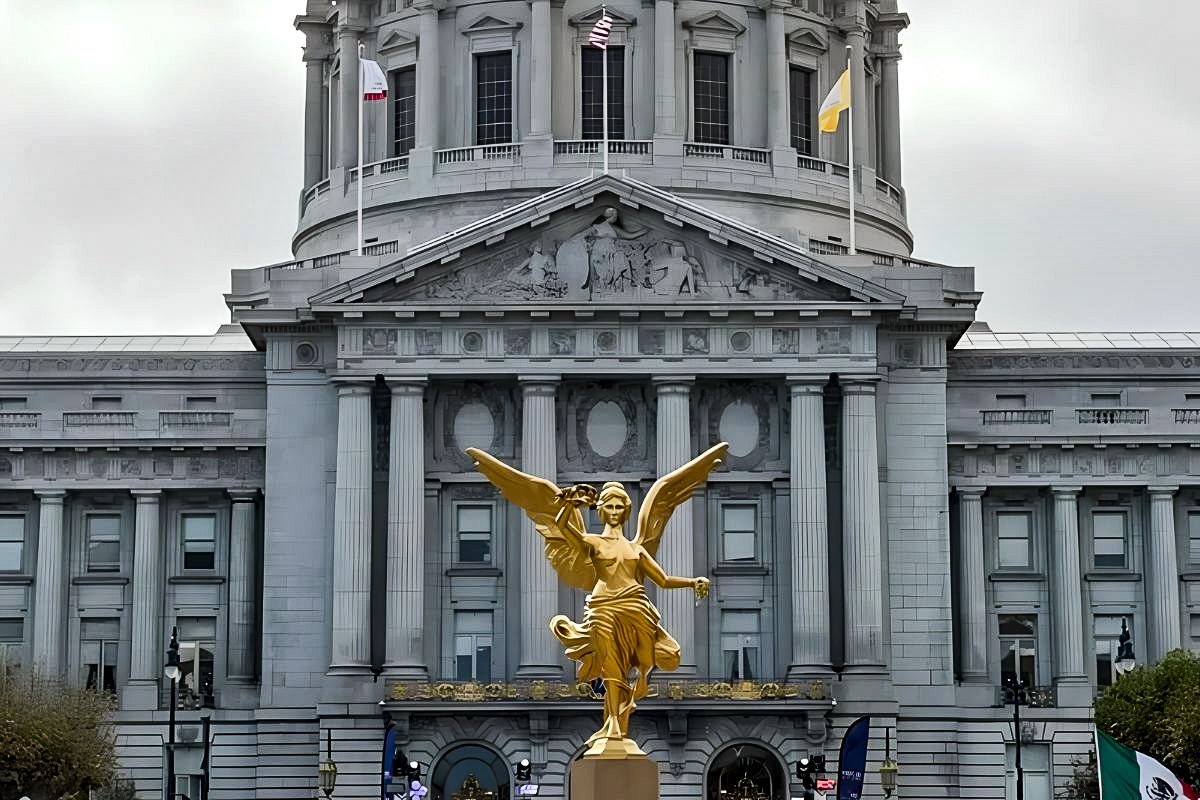
In front of City Hall stood a replica of the Angel of Independence created by Bay Area artist Fernando Escartiz. Golden hued, imposing and with wings spread wide, the figure seemed transported from one of the main arteries in the heart of Mexico City, the emblematic Paseo de la Reforma, to meet with Mexicans who, even living far from their country, continue to carry Mexico within them.
As night fell and City Hall was illuminated in green, white and red — the colors of the Mexican flag — the scene took on another dimension. For a moment, two cities seemed to meet: Mexico City and San Francisco, the former the homeland we left and the latter the city where we have built a new life.
The original monument, whose official name is Independence Monument, is located on Paseo de la Reforma avenue. It was designed by architect Antonio Rivas Mercado and inaugurated in 1910 to commemorate the centenary of the beginning of Mexico’s Independence. At the top of its column is the Winged Victory, a bronze figure covered in gold, created by the Franco-Italian sculptor Enrique Alciati. It measures approximately 6.7 meters and weighs about seven tons.
But its greatness is not only in its dimensions.
In one of the angel’s hands he holds a laurel wreath, a symbol of victory, honor and glory achieved by those who fought for freedom. On the other there is a broken three-link chain, representing the end of three centuries of colonial rule by Spain.
Victory and freedom. Two words that that night took on an especially deep meaning.
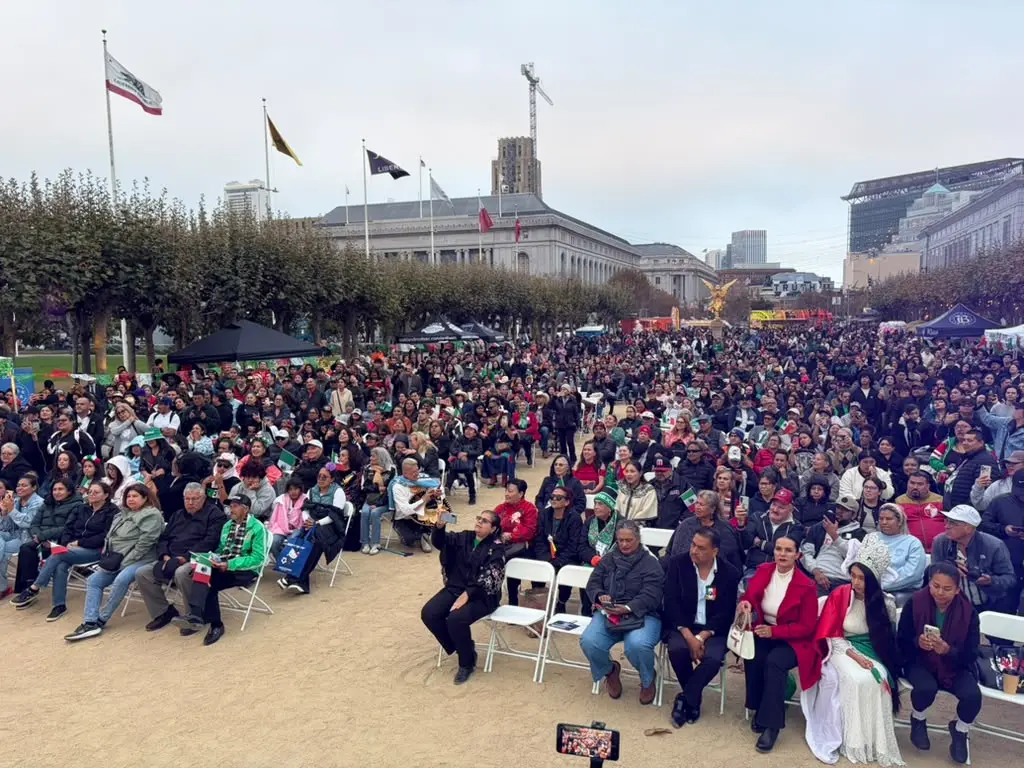 As every year, San Francisco celebrates El Grito marking Mexico’s independence and Spanish Heritage Month. Photo: P360P
In these times, when so many immigrant families live surrounded by uncertainty, when too many are forced to justify their presence, hide their language or temper pride in their roots, seeing the Angel of Independence in the civic heart of San Francisco was much more than admiring a work of art.
It was a message.
Broken chains remind us that freedom should never be taken for granted. They also invite us to think about the chains that we still need to break: the fear, discrimination, racism, inequality and prejudice that continue to limit the lives of so many.
The laurel wreath, for its part, reminds us of our victories; not only the great ones recorded in history books, but also those that happen silently every day: the mother who works tirelessly to offer a better future for her children; the immigrant starting over in an unknown land; the young people who preserve Spanish and embrace their heritage; the workers, artists, educators and community leaders who enrich this city with their efforts and their culture.
Those are victories too. They deserve to be recognized and crowned.
Fernando Escartiz’ replica is not only a reproduction of one of the most beloved monuments in Mexico. It is a bridge between territories, generations and memories. It allows us to bring a piece of Mexico City to San Francisco and contemplate our history from the place that we also call home today.
It was difficult to look at that figure without feeling emotion. The Angel seemed to move forward instead of standing still. With one foot raised, wings spread and gaze fixed toward the horizon, the angel conveyed the feeling that freedom is always in motion, that it is never a finished task and that each generation must learn to defend it.
Behind the statue, City Hall illuminated in the colors of the Mexican flag seemed to publicly recognize the presence, history and contributions of our community. It was not just about projecting three colors on a building, it was a way of telling us: you are here, you are part of this city, and your culture also belongs to this space.
For those of us who have lived between two countries, that image was deeply significant. Many times we learn to inhabit two worlds: we retain nostalgia for Mexico while we build our life in the United States. We do not stop belonging to one place to be part of the other. Our identity is not divided: it is expanded.
The Night of El Grito and the Angel of Independence reminds us of precisely that.
This story was originally published in Spanish by Peninsula 360 Press.

Veronica Escámez is director of the community based non-profit Casa Circulo Cultural in Redwood City.