
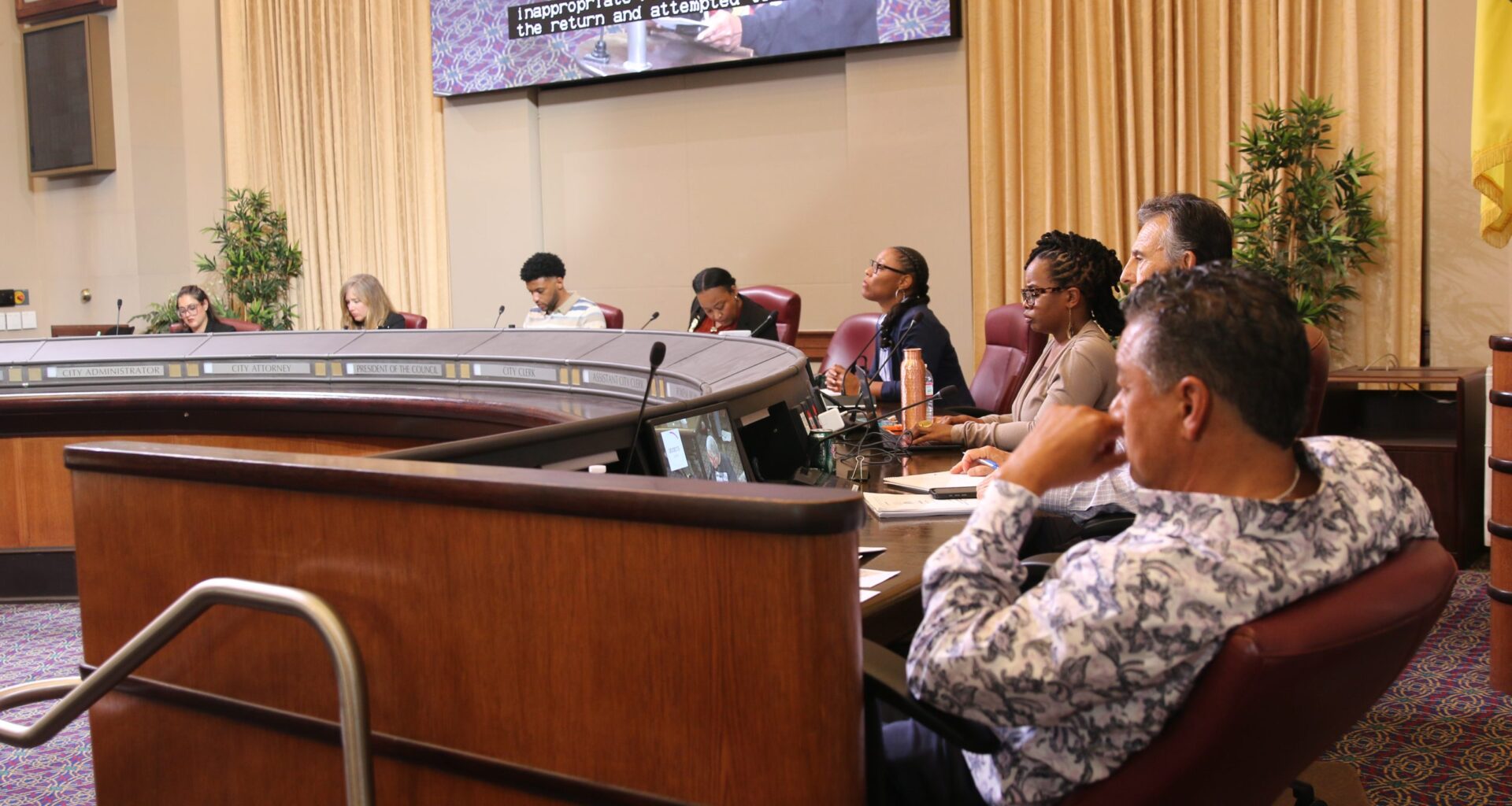
The City Council on Tuesday afternoon approved a new contract with the Oakland Police Officers’ Association.
The contract, which covers July 2026 through June 2031, gives OPOA members raises totaling 14.9% over the life of the agreement, increases longevity bonuses to encourage officers to stay, and includes a “me too” provision that would boost officers’ compensation if other city unions negotiate more favorable terms with the city.
The council approved the contract 7–1, with District 3 Councilmember Carroll Fife casting the sole opposing vote.
OPOA President Huy Nguyen praised the council’s approval, saying in a statement Wednesday that it recognizes “the extraordinary dedication, professionalism, and sacrifice of Oakland’s police officers — the hardest-working police officers in America.”
“Now we need to build on this agreement and continue the work of recruiting and retaining the officers Oakland needs to provide the level of public safety our residents deserve,” added Nguyen.
Bradley Johnson, Oakland’s finance director, said the deal is designed to retain veteran officers, saving the city more money in the long term. He said most officers who’ve left OPD in recent years had done so around the four- to six-year mark.
“Adding the longevity component … is a key mechanism for the retention of officers and reducing the likelihood of us needing to retrain officers through a new academy,” Johnson said.
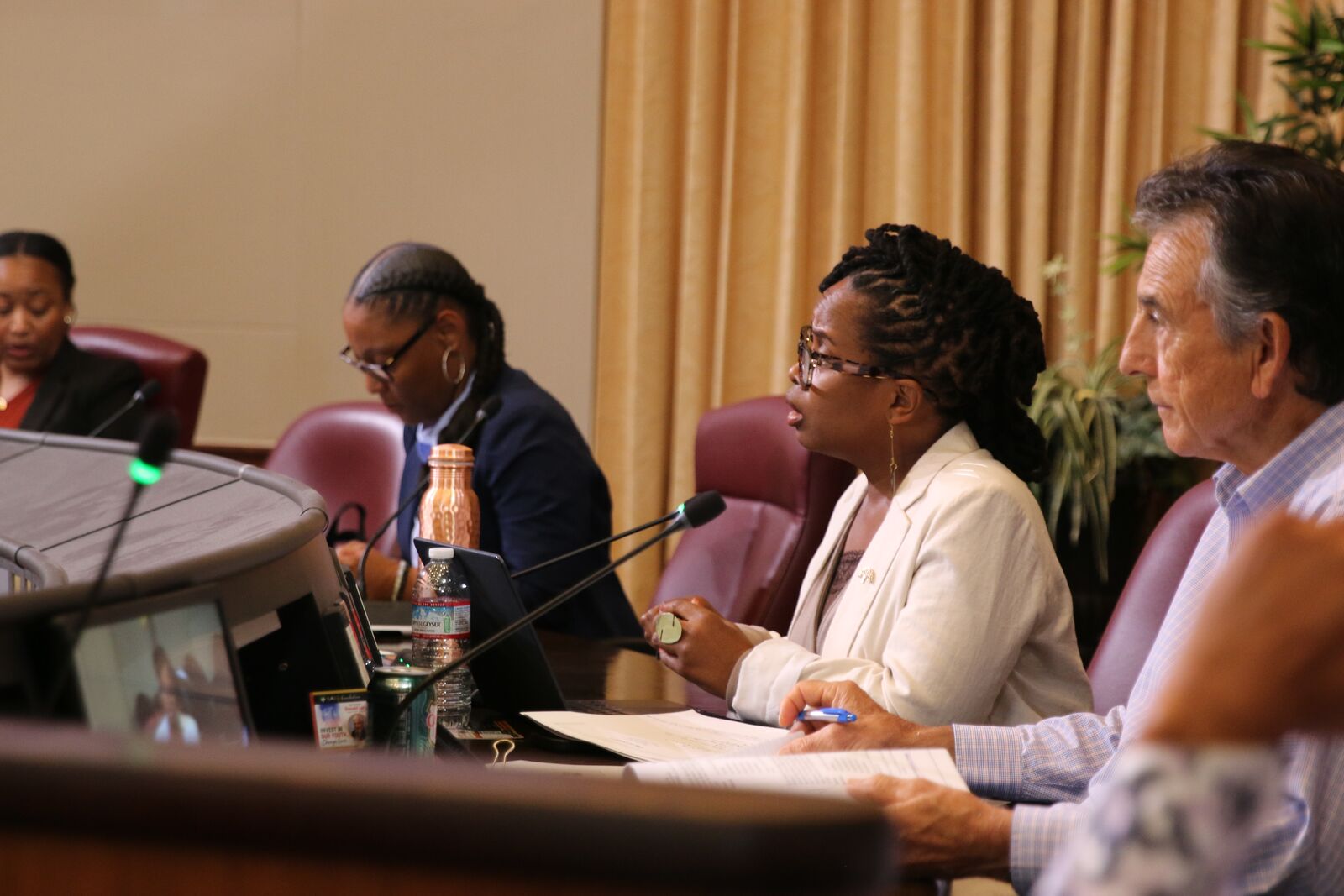 District 3 Councilmember Carroll Fife cast the sole opposing vote against the OPOA contract. Credit: Brian Krans for The Oaklandside
For the police contract, he said, the increased employee contributions toward healthcare and retirement more than offset some of the costs of the wage and longevity increases. Officers will pay 10% of their healthcare premiums by January 2030 and contribute 3% toward their pension by July 2030.
“This is a negotiated agreement that both parties agree to,” Johnson said, adding that the package was “realistic and fair” and affordable within the city’s budget projections.
Mike Petouhoff, chair of the Oakland Budget Advisory Commission, a volunteer group that advises the council on financial matters, praised the new agreement.
“Our officers are vital to our public safety structure, and it’s important they be well compensated,” Petouhoff said. He did, however, urge the council to try to civilianize certain roles within OPD and address the department’s overtime spending.
Council President Kevin Jenkins was unavailable for comment. District 2 Councilmember Charlene Wang, who chairs the council’s Public Safety Committee, was not immediately available for an interview.
Police overtime takes center stage
 The Oakland police union’s contract gives officers a net 14.9% raise over the life of the agreement and increased longevity bonuses, among other terms. Credit: Estefany Gonzalez for The Oaklandside
Residents and members of other city unions packed City Hall ahead of the vote, with most public commenters opposing the proposed contract.
“This proposal is unfair to city workers and the public,” said Xochitl Ortiz, a District 6 resident and member of IFPTE Local 21.
Much of Tuesday’s discussion focused on OPD’s use of overtime.
District 5 Councilmember Noel Gallo said he supported the contract but raised concerns about OPD exceeding its overtime budget, noting that some officers have earned hundreds of thousands of dollars through overtime.
Mary Hao, the city’s human resources director, said overtime spending has decreased under OPD Chief James Beere but said the department’s persistent staffing shortages require officers to pick up more shifts.
“We heard loud and clear from members of the OPOA bargaining unit that, if given the choice, they would not take the overtime because they would like to spend time with their families,” she said.
Johnson, the finance director, said the contract includes new rules around officers choosing compensatory time instead of overtime, characterizing the restrictions as progress toward cutting costs.
Several residents said the new agreement fails to address recommendations outlined in a 2019 report from the City Auditor’s Office on reducing overtime spending. The auditor recommended limiting the number of overtime hours officers can work in a year, establishing an integrated overtime management and scheduling system, and ending the informal practice of buying back comp time, among others.
“Tonight’s agreement does not fix any of this,” said Noel Pond-Danchik, an IFPTE Local 21 member, during public comment.
Should OPD meet the 700-officer minimum required by Measure NN — the property tax and parking tax surcharge passed in 2024 to fund OPD, the Oakland Fire Department, and the Department of Violence Prevention — the new contract also allows OPOA and the city to reopen negotiations over police overtime rules.
The provision, Johnson said, helps OPD and the city meet overtime calculation requirements set by the Fair Labor Standards Act. “The city’s labor improvements for OPD and all of our other bargaining units are more generous than the federal standard,” he said.
But Fife and some community members took issue with it, saying OPD isn’t likely to meet the Measure NN threshold anytime soon.
“Staffing levels across the country for police departments are at all-time lows,” Fife said.
A report released earlier this year by the Public Policy Institute of California found that the number of police officers statewide has decreased since the COVID-19 pandemic, and that officer retention has worsened.
If other unions sign better deals, OPOA can claim the same benefit
 Other city unions are still negotiating with Oakland. Here, an IFPTE Local 21 poster inside City Hall on Sept. 15, 2026. Credit: Brian Krans for The Oaklandside
Also in the new contract is a “me too” clause, which allows OPOA to receive additional compensation if another city union reaches a more favorable deal later. According to the most recent closed-session City Council meeting agenda, other city unions, including IFPTE Local 21, SEIU 1021, and IAFF Local 55, are still negotiating their contracts, which expired on June 30.
Johnson said the provision is intended to prevent a union from being financially penalized for settling its contract before others. It gives them an incentive to accept a deal instead of holding out to see what others get.
In an interview with The Oaklandside after the council’s vote, Jennifer Foster with IFPTE Local 21 described the provision as “unprecedented.”
“For the first time ever, council is allowing a ‘me too’ for police to benefit from wage and benefit improvements of all other unions without having to feel the pain,” she said during the meeting’s public comment portion.
Fife frowned on the clause, saying it didn’t make sense to tie the labor agreement of Oakland’s police officers — among the highest-paid city workers — to the deals other unions, which represent lower-paid workers, are seeking.
Some rallied against OPOA’s new contract before the council meeting
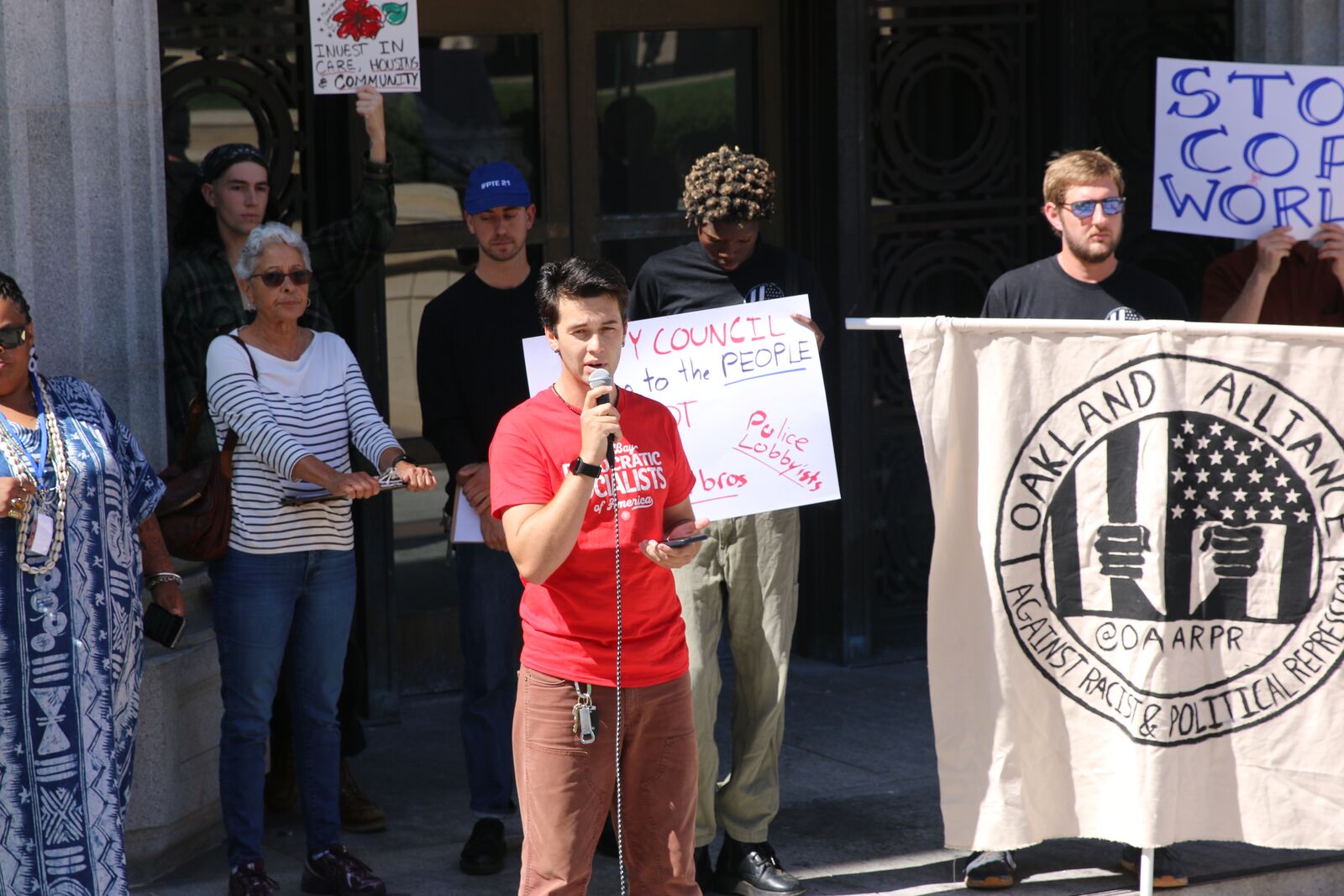 Joshua Estes with the East Bay Democratic Socialists of America speaks during a rally outside of City Hall before the council meeting. Credit: Brian Krans for The Oaklandside
About an hour before the council meeting, several local political groups gathered in front of City Hall to protest what they described as the council’s capitulation to the interests of the police union, landlords, and corporations.
Several speakers said the City Council should redirect money for OPD to other city services like road paving, libraries, senior centers, and affordable housing, which they described as underfunded.
“We cannot police our way out of poverty,” said Grace Aguirre with the East Bay Democratic Socialists of America’s Migrants Defense Committee. “We need a budget that puts housing first, schools first, and community care first.”
In addition to the new OPOA contract, demonstrators pointed to the Encampment Abatement Policy, which cracks down on homeless encampments and RVs, and the council’s approval of OPD’s $2.25 million contract with Flock Safety, a surveillance technology company whose network of automated license plate reader cameras has caused a nationwide uproar.
“We need to take the money being spent on sweeps and invest it in the people instead,” said Ifalayo Arike Harper with Poor Magazine.
“*” indicates required fields