
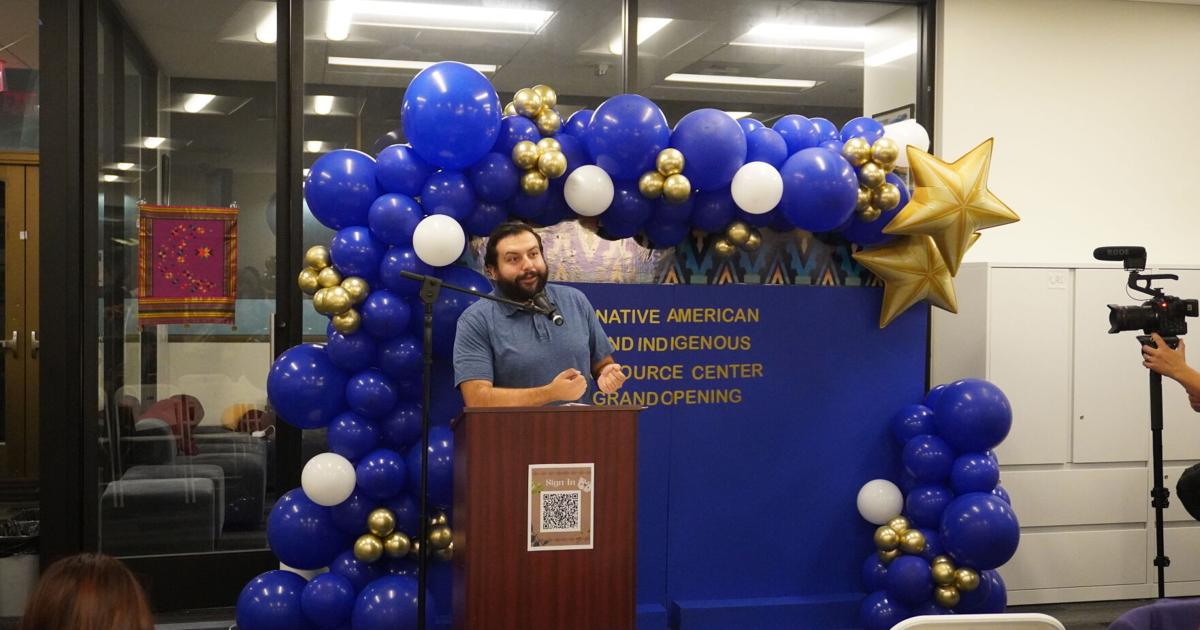
The Native American and Indigenous Resource Center at Cal State Fullerton held its grand opening on Wednesday at the Pollak Library South 170.
NAIRC officially opened last fall, but due to the lack of a coordinator, the grand opening was postponed until this semester.
“The goal is to ensure that the center provides not just a space, but a sustained commitment to our campus community and equity,” said Vanessa Cota, coordinator for NAIRC.
The event included multiple guest speakers: CSUF alumni and Tongva elder community member Virginia Carmelo, Inter-Tribal Student Council President Estre Perez, co-founder of the Native American and Indigenous Alumni of CSUF Anna Tiger, Vice President for Human Resources and Inclusive Excellence Phenicia McCullough and Sponsor Associated Students’ Resolution “Native American Recruitment, Retention and Support” Chase Sheriff.
“Empowerment isn’t just about being given a seat at the table, it’s about realizing we’ve always had a place there. The Inter-Tribal Student Council helped me see that our stories, our traditions and our leadership belong in every space we walk into,” Tiger said during her speech.
NAIRC was established due to the Inter-Tribal Student Council presenting concerns in 2018-2019, over the lack of Native American and Indigenous staff and student enrollment. Sheriff sponsored this resolution to create an institutionalized space to support Native Indigenous students.
“The center will be highlighting indigenous people’s presence, leadership on campus, in the community, and with also hopes to bring in local tribal nations, partners and community members to educate the wider campus because education looks different for everyone in every community,” Cota said.
During CSUF’s 2018-2019 academic year Native Students made up 0.1% of total university enrollment and a record-low of 36 students enrolled during fall 2018, which was projected to continue on a downward trend.
“Native Indigenous students are often underrepresented in higher education at larger rates than any other demographics,” Cota said. “So, I think the continued investment into the recruitment, retention, academic and professional cultural programming is essential to supporting our students and our campus.”
In fall 2018, seven out of 2,051 CSUF employees were Native American, representing 0.3% of faculty at the time.
In the resolution, ASI urged multiple university divisions to seek out partnerships with tribal communities and local educational institutions with high Native American enrollment.
“It’s the first time that an institutional space has been created, supported and funded,” Cota said.
Currently, under the Fullerton Forward 2024-2029 strategic plan, there are efforts to “expand flexible pathways to reach and attract diverse learners.” The strategies include strengthening efforts to recruit and retain students from underserved communities, including Native American and Indigenous groups.
“As students, we gave our all to build something lasting, to create visibility where there was none, to remind the university that Native students are not a checkbox on a diversity form. We are living nations, knowledge holders and caretakers of this land,” Tiger said.
NAIRC will be holding multiple events in November, including a NAIRC x CAPS drop-in session on Nov. 12, NAIRC x ITSC “Navigating Two Worlds” on Nov. 13 and NAIRC x SWANA “Shared Horizons” on Nov. 19.
As a part of the Diversity and Resource Centers, NAIRC will be open to students from 8 a.m. to 5 p.m. Monday through Friday.
“NAIRC represents more than just a physical space, and I want it to be a promise to recognize and uplift indigenous voices at CSUF and within our community,” Cota said. “I want it to be a space for healing, learning, community building and I want everyone to be a part of it. Native and non-Native alike, I want us to visit, to learn and grow together and continue building a more inclusive campus.”