
By Ritu Jha-
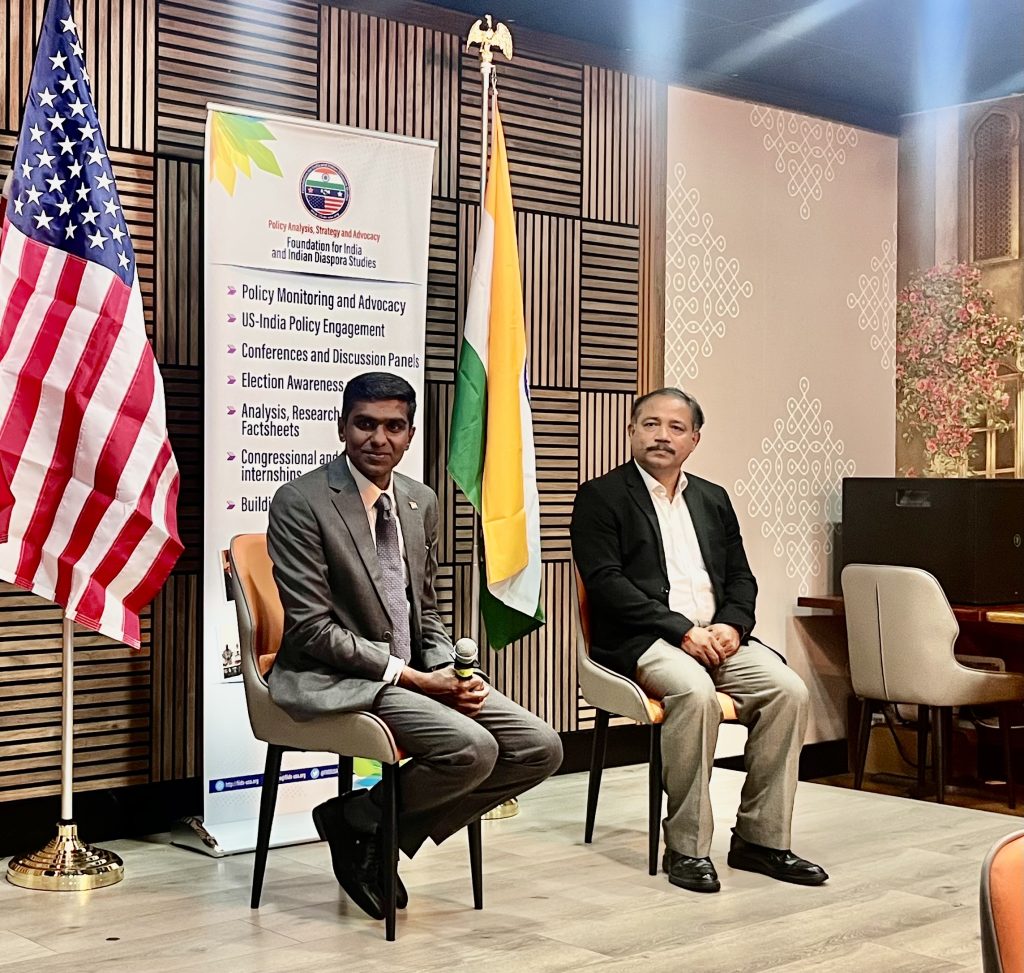
Members of the Indian diaspora raised concerns over visa appointment backlogs, H-1B and H-4 visa processing, family separation and other immigration issues during a welcome reception for newly appointed Consul General of India in San Francisco Satish Kumar Sivan.
The reception, hosted by the Foundation for India and Indian Diaspora Studies, marked one of Sivan’s early community outreach engagements after he assumed charge of the San Francisco consulate on Aug. 24, 2026. He succeeded Dr. K. Srikar Reddy.
A career diplomat with two decades of experience, Sivan previously served as India’s consul general in Dubai. His diplomatic assignments have included postings in Washington, D.C., Beijing and Seoul, as well as administrative roles at the Ministry of External Affairs in New Delhi.
Sivan oversees a multi-state U.S. jurisdiction that includes major technology corridors and more than a million members of the Indian-American community. The reception brought together diaspora members, professionals and community leaders who discussed concerns affecting Indian nationals and Indian-American families.
“Diaspora in different geographies represent different capabilities. But every diaspora in every part of the world is very critical to India’s national growth,” Sivan said.
Sivan described his previous experience serving the Indian community in Dubai and said the diaspora plays an important role in India’s growth and global engagement. He also said community organizations could help consulates address needs that exceed their available resources.
“Community association is our arms and our legs on the ground,” Sivan said. “What the consulate cannot do because of its limited resources, we would like the community to support.”
Sivan also spoke about the future of the India-U.S. relationship, emphasizing technology, shared democratic values and global growth.
“I think the next 2 decades, our Amrit Kaal period, is going to be the most critical relationship, and this is going to deliver not just for our countries; it is going to deliver for the world in terms of technology, and fast-paced but inclusive, balanced growth globally,” he said.
On concerns about consular services, Sivan said improvements would be pursued incrementally.
“You will see things improving,” he said. “I am not going to say that everything will be perfect, but you will see an earnest endeavor to show that improvement daily.”
The visa concerns raised at the reception included cases involving employees who traveled to India and were unable to return to the United States after their visa appointments were postponed.
“We have been in business for more than 11 years, doing business and management consulting with the State of California, Wells Fargo, and all of them,” Silicon Valley entrepreneur Veena Ramachandran said.
Ramachandran said some of her employees traveled to India for the holidays but became stranded after their visa appointments were postponed. She said the delays created difficulties for the employees and the company.
“We are looking at it individually as a company and trying our best, but maybe there is something that we could do to bring our people back,” she said.
Khanderao Kand, president of FIIDS, said the organization had raised visa-processing concerns with U.S. and Indian officials. He attributed the delays to social media vetting announced by the U.S. administration and said FIIDS had proposed prioritizing people already waiting for appointments.
“In November 2025, the U.S. administration decided that they will do the social media vetting of all immigrants, which is actually not needed,” Kand said.
Kand said FIIDS discussed the issue with Ambassador Sergio Gor in New Delhi and later raised it with members of Congress and India’s Ministry of External Affairs. He said the organization was told the matter was largely within the executive branch.
“It is more in the purview of the executive branch, and it is happening from there,” Kand said.
Kand said the delays were affecting H-1B holders who need visa stamping and said some technology companies had issued travel advisories.
“The ongoing immigration hurdles and appointment backlogs have created severe distress across the Indian-American community, impacting career stability, family life, and travel,” Kand said.
He also described the effect of prolonged delays on professionals who are already employed in the United States.
“It is 7-8 months now, and the condition is horrible and inhuman,” Kand said. He argued that existing H-1B workers seeking renewals should be prioritized.
Kand said concerns about social media scrutiny had also made some immigrants reluctant to participate in advocacy efforts.
“The problem is that now people are scared even to sign petitions because they feel that they might be under scrutiny due to this social media vetting,” he said. “The H-1B holders and students are panicked and worried.”
Kand also raised concerns about potential changes to the 60-day grace period available to workers after losing their jobs, saying such changes could create additional difficulties for families affected by corporate layoffs.
“There are about 300,000 students of Indian origin in the United States,” Kand said. “All of them will be subjected to this duration of stay norm that has come into effect.”
One H-1B holder, identified as Alok, whose name was changed because of concerns about being targeted, described how visa delays separated him from his wife and children.
“My wife and I were working on H-1B in Dec 2025,” Alok told indica. He said the couple traveled to India so their parents could meet their 6-month-old daughter and had secured an H-1B visa appointment before traveling.
After completing biometrics, Alok said his visa interview, originally scheduled for December 2025, was rescheduled to July 2026. He said his wife lost her job in April 2026, causing her H-1B visa to become invalid.
Alok said he was able to reschedule his own interview and obtain an H-1B visa stamp in April before returning to the United States in May. His wife then attempted to obtain an H-4 dependent visa appointment.
“After I came to the U.S. in May, my wife tried to book an H-4 visa appointment,” Alok said. “She was told to wait till her original appointment in July is over and then fill out a new DS-160 and find new H-4 appointments.”
He said H-4 appointments had not opened since April and that his wife and their two U.S. citizen children remained in India while waiting for an appointment.
“My family is separated from me, and my wife and children are in India waiting for the visa appointments to open,” he said. “I need this case to be considered with empathy and to get her visa appointment scheduled sooner.”
Alok also described difficulties with emergency appointments, saying applicants must first have a regular appointment before requesting expedited consideration.
“They say that for an emergency to be considered, you need to get that appointment first, and then they will consider it an emergency,” he said. “But if they don’t open the appointment itself, when are we going to get an emergency appointment?”
He also questioned the uncertainty surrounding visa fees and appointment availability.
“We are not buying a lottery ticket,” Alok said. “We are paying for an appointment. There should be some guarantee that at least there will be an appointment.”
Alok said the people affected by the backlog include professionals who already have jobs and established lives in the United States.
“It’s not that someone is coming for a new job; it’s the existing jobs,” he said. “Please consider this a case in point and help us because the families are being separated; people are living in anxiety here.”
Nikita, whose name was changed at her request, described similar difficulties after her visa classification changed from H-1B to H-4.
“The visa class is the same, H-class visa,” Nikita told indica by phone. She said she contacted U.S. Visa Scheduling customer service to ask whether she could retain her existing appointment but was told she could not.
She said she was unable to cancel the appointment and seek an earlier date under the new visa classification. She eventually had to miss the appointment and pay the fees again.
“I had to make a no-show, and then I had to pay the fees again, and now I am starting to look for appointments again,” Nikita said. “My 3 months are wasted in that process, just to make a no-show.”
Nikita said her attempts to obtain assistance through consular channels resulted primarily in automated responses directing her to online scheduling resources.
“Now they are not responding to me,” she said. “I only get an automated email asking me to follow particular web links for U.S. visa scheduling.”
She said applicants were required to schedule an appointment before being able to communicate with officials about their cases.
“Is this a way to treat legal immigrants?” Nikita said. “This is inhuman.”
Nikita also said H-1B visa appointments were being offered only at Chennai and Hyderabad, creating additional difficulties for applicants elsewhere in India.
“Nowadays they are giving H-1B visa appointments only in Chennai and Hyderabad, not in any other Indian consulate,” she said.
Applicants have also reported differing outcomes when seeking emergency appointments for family separation and other urgent circumstances, according to accounts shared at the reception. Community members said thousands of applicants, including families with infants and young children, were communicating through online Telegram groups while waiting for appointments.
The concerns gave Sivan an early look at the issues community members want the San Francisco consulate to address during his tenure.
“You will see things improving,” Sivan said. “I am not going to say that everything will be perfect, but you will see an earnest endeavor to show that improvement daily.”