

More than a dozen community leaders rallied at Oakland City Hall this morning in support of a tax measure that, if passed, would provide a billion-dollar-a-year bailout to Bay Area public transit.
”If we do not succeed, BART will close up to 15 stations and reduce service, and all of the transit operators in the Bay Area, from AC Transit to County Connection to SamTrans to Muni, will have to make deep cuts,” State Senator Jesse Arreguí in, who represents Oakland, said at the rally. “And who’s gonna be impacted by those deep cuts? Seniors, students, working families, people with disabilities that rely on public transit for their everyday lives, to get to work, to go see a doctor, to go to school.”
Arreguín was a co-author with Scott Wiener of Senate Bill 63, which placed the tax proposal, called the Regional Transit Measure, on the November ballot.
The Regional Transit Measure will provide $14 billion of dedicated funding to agencies, including AC Transit and BART in the East Bay, over the next 14 years. To pay for it, Alameda, Contra Costa, San Mateo and Santa Clara counties will add 0.5% to their sales tax, and San Francisco County will add an extra 1%.
“Without new funding, Bay Area transit agencies face catastrophic service cuts that would mean fewer trains and buses, longer waits for riders, and more cars and congestion on already crowded roads and highways,” Connect Bay Area, a committee formed to back the measure, said in announcing today’s Regional Day of Action To Save Public Transit.
The measure has not gone without opposition. The Committee for Affordable Transit was created over the summer to advance the message that the transit agencies should first seek to reduce their administrative overhead, including by lowering overtime costs, before asking taxpayers for more money. Gregg Dieguez, a Montara resident and president of the committee, said in a press release that fewer people use transit because of a new work-from-home culture “at no taxpayer expense.”
In a phone interview, Dieguez told The Oaklandside that the region faces more pressing infrastructure needs such as an upgraded electrical grid and upgrades to water and sewer utilities. The committee, Dieguez said, will organize events in the next few weeks to oppose the tax measure.
The Oakland rally in support of the measure kicked off the regional day of action. Students at San Jose University met advocates at Tower Lawn at noon, and others met outside the Orinda and Millbrae BART stations during the evening commute. The day’s activities concluded with an event at the Powell Cable Car Turnaround in San Francisco featuring Mayor Daniel Lurie, Wiener and Arreguín, along with transit and business leaders.
Labor and business groups back the measure
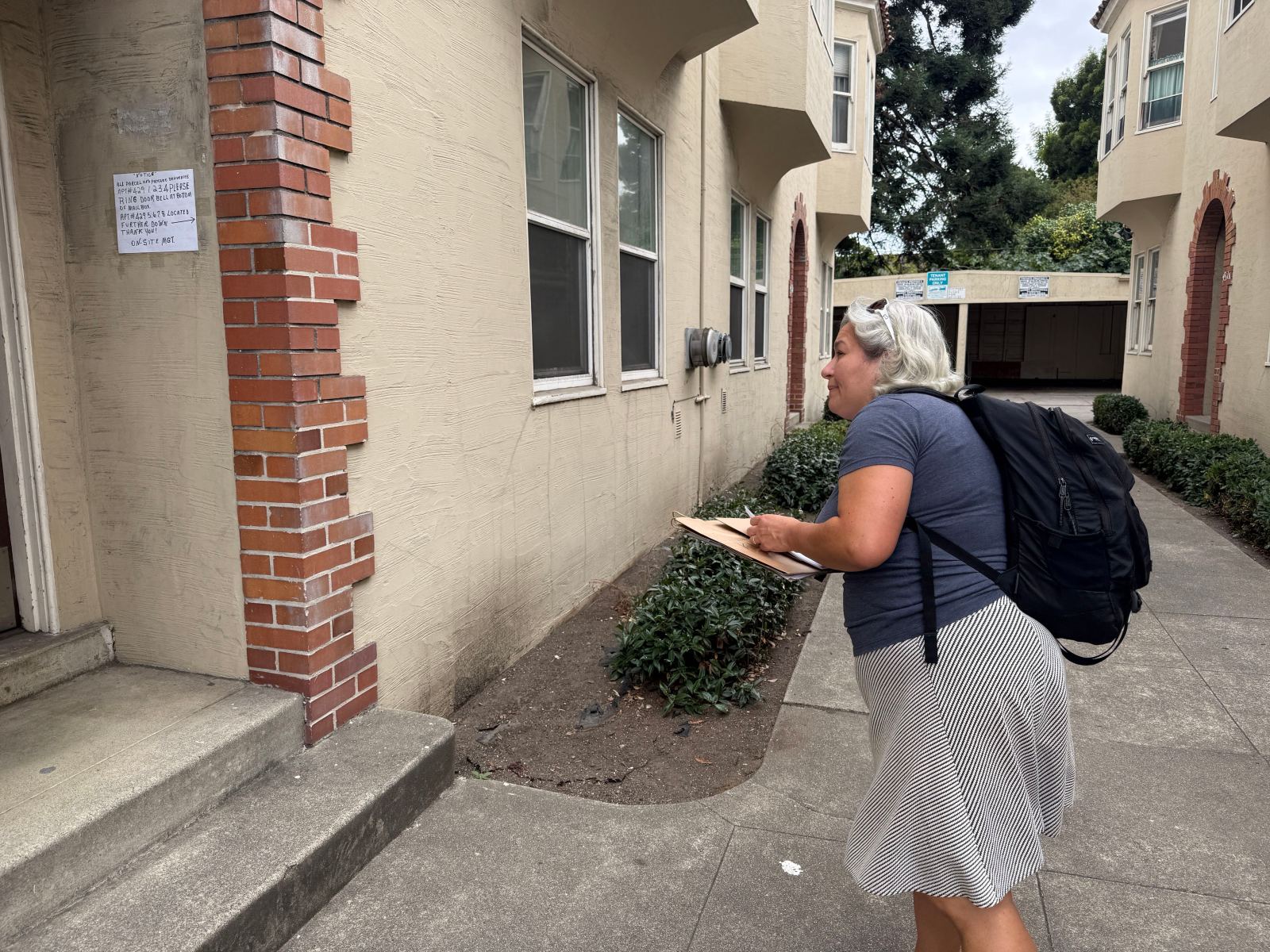 Adriana Valencia, a candidate for the AC Transit board in Ward 3, begins her day of outreach for the Regional Transit Measure, Sept. 17, 2026. Credit: Jose Fermoso/The Oaklandside
In Oakland, volunteers grabbed sustenance before a long day of canvassing, munching on fresh donuts, commiserating and pumping themselves up to spend the day handing out hundreds of colorful flyers to transit users bopping out of BART terminals and waiting at bus stops.
Zach Deutsch-Gross, the executive director of the Oakland-based urban advocacy group TransForm, one of more than 200 regional organizations that have signed in support of the measure, said at the rally that the doors they knock on, the phone calls they make and the neighbors they talk to “will make or break our transit systems.”
”I think that hope goes farther than fear, and so that’s why I’m here today,” he said.
Keith Brown, the executive secretary-treasurer of the Alameda Labor Council, which represents 135,000 workers in Alameda County, called out the labor of transit workers, especially those in unions such as the Amalgamated Transit Union, AFSCME, and SEIU.
“Big shout-out to our transit workers because we know the value of public transportation for working families, to get to work, to get to school, to get to our doctor appointments,” Brown said. “That is the value of public transportation, and we cannot lose that.”
In an interview with The Oaklandside, Emily Loper, the vice president of public policy at the Bay Area Council, a business organization whose executive committee includes leaders of major companies such as McKinsey & Company, United Airlines, Wells Fargo, and Genentech, told us the passing of the bill was paramount to maintain economic gains that have accrued in the Bay Area since the pandemic.
“ The business community understands that our residents depend on transit to get to and from work,” she said. “It’s so much harder to commute to work without it that it jeopardizes their ability to stay and grow in the Bay Area.”
Loper said she felt positive about the campaign, given that recent polling in July, she said, showed voter support for the tax measure in the mid-50s. To pass, the measure needs a simple majority. “That’s why the campaign is really focused on educating voters about what is at risk here,” she said.
Matt Baiza, the campaign manager for Connect Bay Area, spoke with The Oaklandside as he set up tables outside the Civic Center BART station. He said he was proud of the volunteers’ work in gathering 300,000 signatures to get the measure on the ballot, but said that effort was essentially one leg of a race that still needed to be completed.
“ Now it’s about reactivating that community, making sure, especially for transit riders, that they know and understand what’s going on,“ he said.
Baiza noted that there are many ways to get involved in the major volunteer effort over the next six weeks.
“It’s about making sure people feel comfortable in their role and how they’re helping out, matching people to volunteer activities,” he said. “Some are gonna be able to hold signs and make sure that they’re getting that visibility. Others can have deeper conversations. We wanna make sure people understand it’s important at the end of the day that what’s on your ballot is whether or not we are going to save our public transit agencies or not.”
“*” indicates required fields