
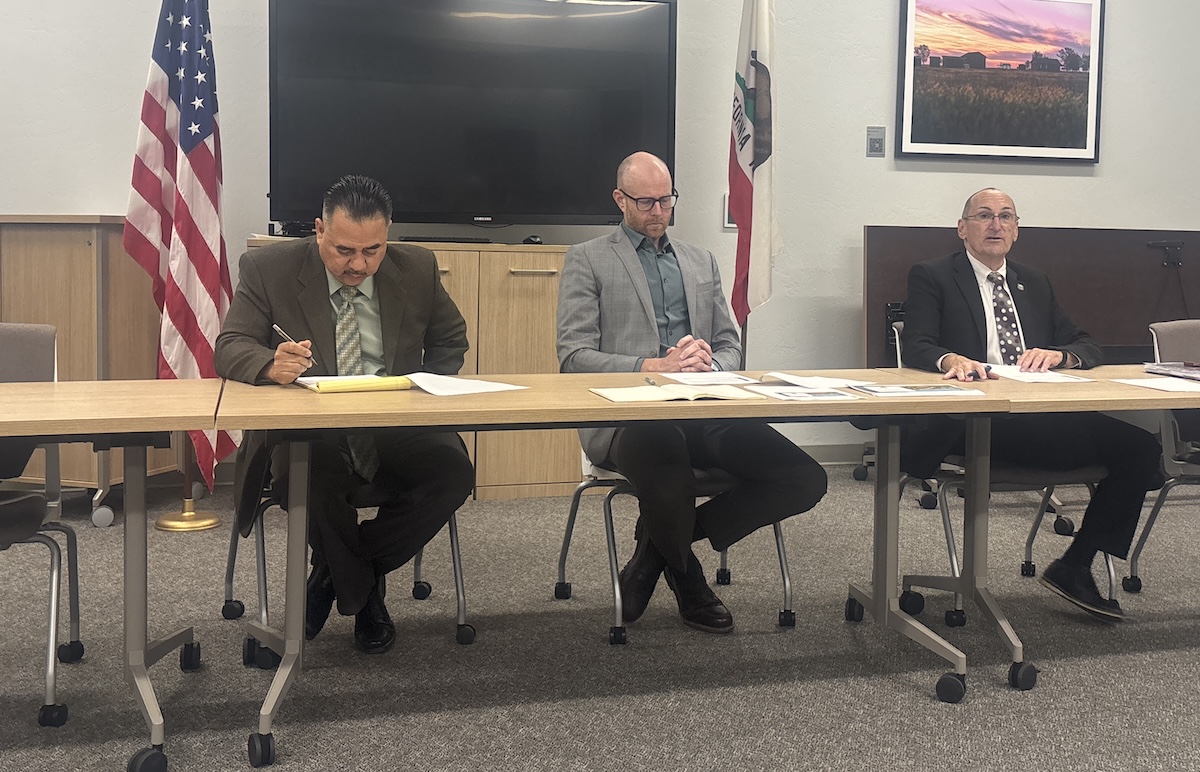
From left, Tulare County Principal CAO Analyst Paul Guerrero, Assistant County Administrative Officer John Hess and County Administrative Officer Jason T. Britt hosted a budget preview presentation for members of the media on Monday, Sept. 14. Photo by Ben Hensley
Fresno and Tulare county supervisors adopted multibillion-dollar budgets this week that reflect different near-term financial positions but share a growing concern: Federal health and food-assistance changes could put increasing pressure on local services in the years ahead.
Fresno County supervisors unanimously adopted a nearly $5.49 billion budget Monday that preserves county reserves but relies on one-time funding to close spending gaps. Tulare County supervisors followed Tuesday with a roughly $2.26 billion spending plan that county officials said avoids departmental cuts while continuing to build reserves and reduce debt.
Here’s what the two budgets show about the counties’ finances and the pressures ahead.
How large are the Fresno and Tulare county budgets?
Fresno County’s $5.49 billion budget includes approximately $2.7 billion in General Fund spending, nearly $2.4 billion of which is dedicated to human services and justice services.
Tulare County’s roughly $2.26 billion budget includes about $1.4 billion in General Fund spending and $256 million in discretionary revenue.
The counties enter the fiscal year in different financial positions. Fresno County is already making reductions and drawing more heavily on one-time resources, while Tulare County officials say they are not requiring broad departmental cuts.
“We are not asking for any cuts or reductions in our departments,” Tulare County Administrative Officer Jason T. Britt said. “So that is positive because I know some surrounding counties are not in that same situation.”
What cuts is Fresno County making?
Fresno County’s Department of Public Health faces a nearly $10 million reduction, including the elimination of 16 allocated positions.
Public Health Director Joe Prado said the reductions reflect declining state and federal funding and will affect some services.
“This is a marquee program for the department, and with less funding available at the federal level, we are going to do less mobile health services,” Prado said. “Now, we are communicating with other funders to see if they could fund and increase the amount of services we are providing.”
Several funding sources Fresno County has used to maintain operations in recent years, including federal American Rescue Plan Act funding and accumulated Proposition 172 public safety funds, are now largely exhausted.
“So we’ve managed to get to this point, but that maneuverability will be less going forward,” Fresno County Administrative Officer Paul Nerland said.
How do county reserves compare?
Fresno County will preserve its approximately $90 million General Reserve but will not make additional contributions this year.
The county’s separate budget mitigation fund, which Nerland said has ranged from approximately $31 million to $34 million in recent years, is budgeted at $13 million.
Tulare County reported a $77.7 million unassigned fund balance from the previous year. Its strategic reserve is expected to stand at approximately $61 million, below the county’s $75 million goal.
Tulare County also has been reducing its debt. Long-term debt stood at approximately $176 million as of June 30, nearly 8% lower than the previous year.
The county is budgeting for 4,994 allocated positions with an overall vacancy rate of approximately 11%.
How could federal Medi-Cal changes affect residents?
Fresno County Social Services estimates approximately 150,000 Medi-Cal recipients — equivalent to nearly 15% of the county’s population — will be affected by new eligibility rules expected to begin taking effect Jan. 1.
Roughly 40,000 recipients are projected to ultimately lose Medi-Cal eligibility.
Tulare County officials expect the effects of federal changes to initially show up among recipients rather than in departmental budgets.
“So right now, the cuts that we’re gonna experience are really gonna start with the client side first,” Britt said. “So the recipients of the programs will start seeing potential reductions.”
Britt said Tulare County’s Health and Human Services Agency has already eliminated some vacant positions it did not expect to have funding for. Future administrative reductions could follow if caseloads decline as recipients lose eligibility.
What happens if residents lose health coverage?
Both counties are preparing for the possibility that residents losing Medi-Cal or other coverage will turn to county-funded indigent health programs.
Fresno County set aside $10 million this year for potential new indigent health care expenses.
Tulare County officials said residents who lose coverage could return to Tulare County Medical Services, potentially shifting those costs directly to the county General Fund.
The size of those future costs remains uncertain.
What changes are coming to CalFresh?
Fresno County faces a projected $7.5 million county share of CalFresh costs under H.R. 1.
That expense has been delayed for three years, so it is not part of the immediate budget, but county officials continue to view it as a future obligation.
Tulare County officials also expect federal changes to food and health programs to affect recipients first, with potential consequences for county administrative funding later if caseloads decline.
What other financial pressures are the counties facing?
Infrastructure represents another significant expense for both counties.
Fresno County’s budget includes $20 million toward the O and P streets campus in downtown Fresno, which is planned to house sheriff administration, the Board of Supervisors and county administration.
Tulare County is awaiting approximately $134 million in federal reimbursement for flood-related road and infrastructure repairs. The county advanced local funding to keep roads passable following the 2023 storms and did not borrow for the work.
Britt said delayed Federal Emergency Management Agency reimbursements could begin forcing Tulare County to postpone road projects by next year.
“That runway is running out,” Britt said.
The effect could become more visible when the Resource Management Agency presents its countywide transportation improvement plan in the spring.
What should businesses and residents watch next?
The counties begin the fiscal year from different positions.
Fresno County is already absorbing reductions and relying more heavily on one-time resources. Tulare County continues to avoid broad departmental cuts while building reserves and reducing debt.
But officials in both counties are preparing for the same broader challenge: maintaining local services as changes in federal and state funding create additional costs and uncertainty for county governments.
For Fresno County, Nerland said the choices become increasingly limited if revenues fail to keep pace with expenses.
“If revenue does not increase, we have to cut,” Nerland said.