
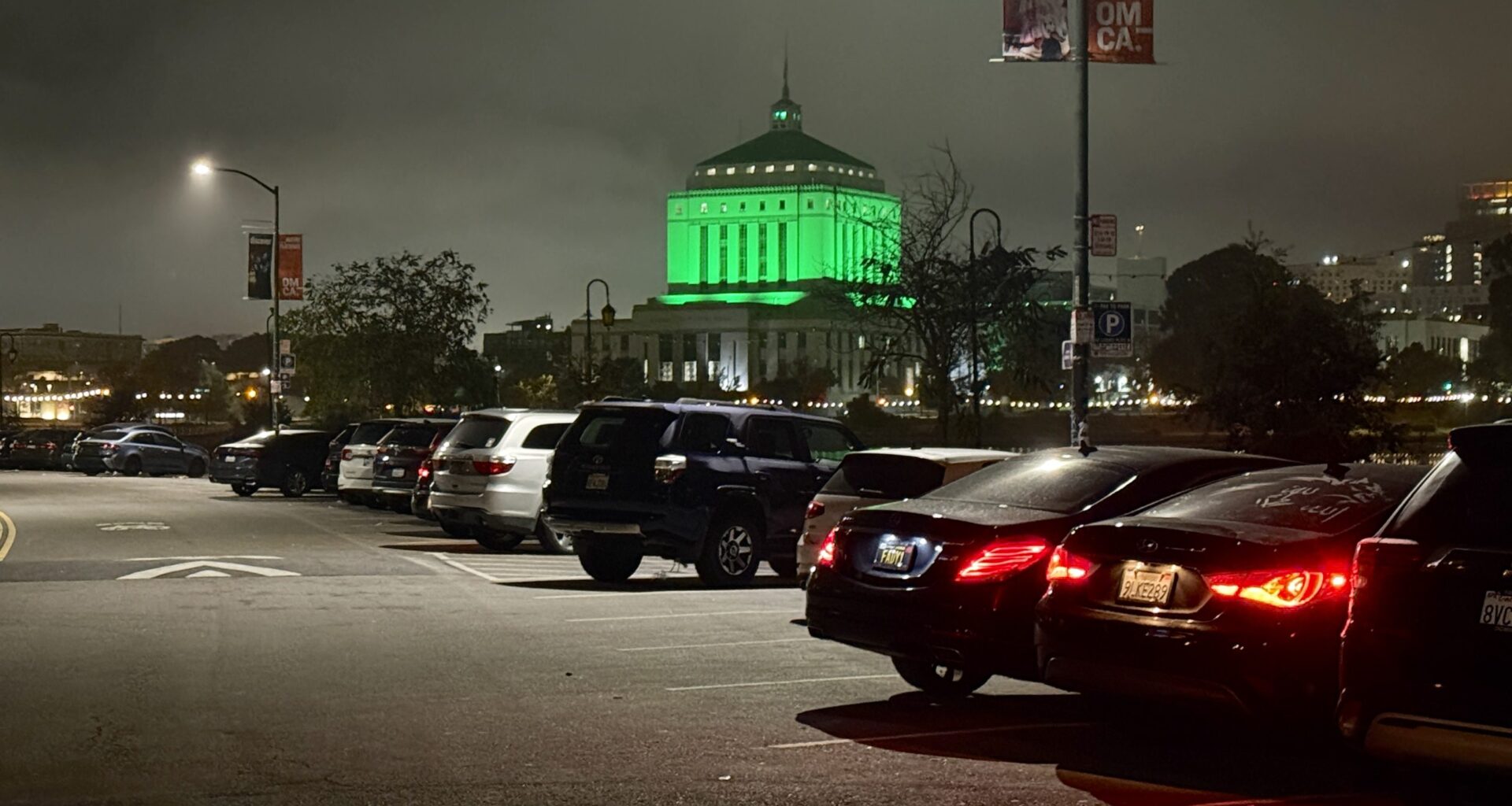
At the southern end of Lake Merritt, at the end of Lakeshore Avenue, there’s a 1,500-foot-long cul-de-sac lined by a couple of dozen parking spots.
On many nights, especially on the weekends, you’ll find groups of folks idling in or around their cars there, talking, laughing, smoking, and playing music until well past midnight. The view is stunning, even cinematic, and it’s the only place around the lake where people can gaze straight out over Lake Merritt from the warmth of a car. This free hang, whether chill or sometimes raucous, is soon coming to an end, or at least getting cut short, thanks to a new parking restriction passed by the City Council last week.
The resolution was brought to a special meeting of the council on Tuesday by District 2 Councilmember Christine Wang, whose district includes that side of Lake Merritt. Parking has been restricted overnight on the east side of Lakeshore Avenue between Lake Merritt Boulevard and 1st Avenue since 2020, banned between 2 and 6 a.m. The new rule will prohibit parking starting at 10 p.m. every day of the week.
“The Lakeshore cul-de-sac continues to attract large late-night gatherings and vehicle activity that have generated significant safety concerns for nearby residents and park users,” the resolution reads in part.
Over the last five years, multiple shootings, deadly stabbings, robberies, and collisions have occurred at the cul-de-sac. A few months ago, a woman and a man were shot, though both survived; in October, someone died after being shot there. Some people have started petitions to close the loop.
A memo by Oakland’s deputy chief of staff, Michael Wimsatt, said the change would strengthen enforcement by allowing drivers parked there to be cited.
At a Public Works and Transportation Committee meeting on Oct. 28, Wang said that she and her staff had talked to residents and property owners who live on Lakeshore Avenue near the cul-de-sac. Wang told The Oaklandside that she took action after the property manager at 1200 Lakeshore Ave. reached out to her office, saying they’ve seen an increase in violence. Some residents said the violence tended to happen after 10 p.m., which is why she proposed that as the parking cutoff.
At the October meeting, Wang also said she had discussed the proposed change with City Administrator Joe Devries and the area police captain, saying, “All appropriate city staff have been consulted on this.”
Wang noted that the Oakland Police Department has limited resources and can’t post an officer at the cul-de-sac all night.
“ We have not banned access to the lake at some sort of unreasonable hour,” Wang said. “The same people who are enjoying the lake are also being victimized by the crime, the shooting, and the violence.”
One group Wang didn’t mention consulting — those who have found community at the cul-de-sac.
In a call with Wang on Sunday, she confirmed that she had not spoken to people who spend time there in their cars before introducing the resolution. She did, however, mention she talked to about 20 people this past Saturday evening, after The Oaklandside first posed the question. Most of them agreed with her decision, she said, and many of those who didn’t were high school students who didn’t like the idea of restrictions on a fun recreational location. Wang said those conversations made her even more confident in her decision because she didn’t want teens out after 10 p.m. in places that have experienced bouts of violence.
The new resolution specifies that the city won’t issue citations until after the city installs “appropriate no parking signs or markings giving adequate notice.” Michael Ford, who heads the city’s parking department, did not respond to a query about when the parking signs will go up.
‘Why did you move here, anyway?’
Marilyn Waller, a longtime Piedmont resident, told us in a call that she had moved to the apartment complex at 1200 Lakeshore Ave. three years ago. She said she didn’t realize how much of a nuisance noise and trash there would be before moving in, but said she still loved living in her building, including the diversity of its residents.
She and her husband, she said, hear “music playing at all hours of the night and morning” and have heard from residents about witnessing fights and people making out in cars. She said the noise often continues until five or six in the morning. It became “intolerable,” she said. She and her husband reached out to city staff and the police, and she said she was glad to hear that the city was moving forward.
When asked about the people who hang out there after 10 p.m., Waller said, “Too bad.”
“People are used to parking whenever they want,” she said, noting they would still be able to walk or scoot into the area if they wanted. “They’ll have to give that up.”
Last Thursday night, the people hanging out in the cul-de-sac were not as happy to hear about the change.
The Oaklandside spoke to several people after 11 p.m. at the cul-de-sac, all of whom declined to provide their names. Most of them disapproved of the early parking ban.
For most of the hour before midnight, the cul-de-sac parking was nearly full. Some people smoked together, while others dozed in their cars; a few quietly stared into the white and yellow glimmer from the lights reflecting off the darkened lake. Two or three clusters of people gathered near car speakers, chatting and listening to music. Toward midnight, someone set off a couple of fireworks.
One young Black woman, hanging out with four friends in front of their cars, told us that while she could understand the desire for residents near the lake to have quiet nights, that desire might not make much sense in that part of Oakland.
“Why did you move here, anyway?” she asked, pointing out that the lake is a public place where people congregate, especially at night, to relax and find some peace of mind after their workdays.
“They moved here — they know what’s going on,” one of her friends interjected.
“I get it, but be for fucking real,” the young woman responded.
Another friend, a tall young Black man, said he wished the city “good luck” with enforcing the new regulation. He predicted that police officers would have to maintain a consistent presence to prevent people from parking there and hanging out. He also worried that the decision was part of a pattern to privatize public spaces in Oakland for the benefit of a small number of people.
“It trickles down,” he said.
Nearby, a man was sitting with a female friend inside a warm car. He also wasn’t convinced that people would stop trying to park here.
“The majority of people who come here are gonna come,” he said. “They’re gonna try to be respectful. Whoever is against that will never understand.”
A woman who had spent her evening helping run a major fundraising event in San Francisco was also relaxing inside her car by the lake last night. She said she had parked there dozens of times to seek some peace and tranquility after work. She said she saw the space as a significant public resource and said it would be a real loss to the community if it were to disappear.
“Where else should we go? Over in Alameda, you can go to the beach, but it’s the same,” where residents in nearby homes complain about the noise, she said.
Two young men, parked in a white van close to 1200 Lakeshore, said they hadn’t heard about the possibility of losing parking privileges after 10 p.m. One said that he would be willing to work with other people to urge the council to reverse the resolution.
“People come here to vibe,” he said.
One cul-de-sac resident, who was walking his dog at night, said he felt conflicted about the council’s decision. He said he saw banning parking after 10 p.m. as a form of gentrification. At the same time, he said, people lose sleep some nights because of the noise problem, which he said had dissipated significantly in the last month due to an increased police presence.
Unfortunately, he said, one or two rowdy people “ruin it for everyone else.”
“Residents are just trying, in a way, to control things more, and that kind of does suck for the people who have lived here for a while, who just want to continue hanging out at the lake, just minding their own business.”
“*” indicates required fields