
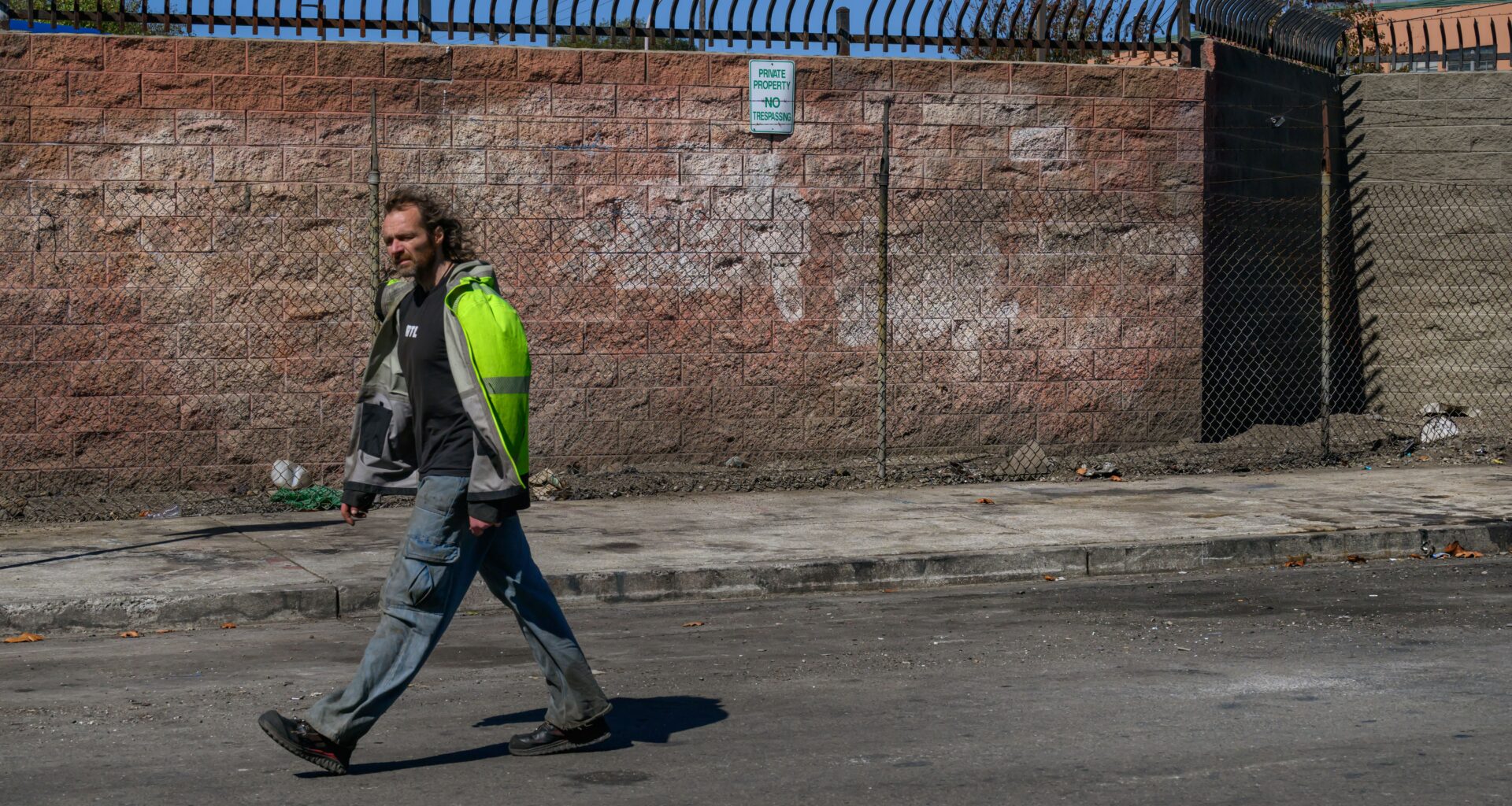
After nearly two years of court battles, Berkeley this week cleared much of one of its largest homeless encampments. Within days, at least one resident was back, and others had moved to neighboring streets.
The court battle between homeless residents and the city is ongoing and has already led to greater protections for residents elsewhere in Berkeley. When sweeping camps, city workers are now required to replace tents and have stricter limitations on towing vehicles that dwellers call home.
While Oakland, San Jose and San Francisco aggressively target encampments, an organized network of homeless residents in Berkeley mounted a legal campaign to delay the operation at camp on Harrison and Eighth streets in the Gilman District.
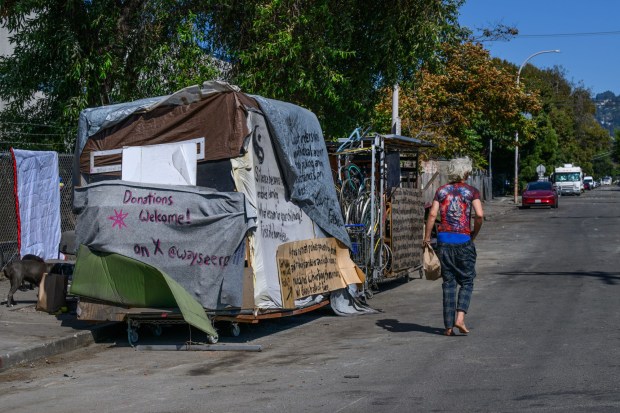 An unhoused person walks along Harrison street after the city of Berkeley dismantled a homeless encampment near the corner of 8th Street and Harrison Street in Berkeley, Calif., on Friday, Sept. 18, 2026. (Jose Carlos Fajardo/Bay Area News Group)
Berkeley officials have said the camp needs to be dismantled because it has damaged city infrastructure, but primarily because the area is infested with rats and needs to be cleared to eradicate them. Last year, two dogs were infected with leptospirosis, a bacteria-borne disease carried by the rodents, at the Harrison Street camp. Separately, two homeless residents living a mile from the encampment were found to have been infected with leptospirosis this spring, leading to one death.
Residents said police and city workers arrived Tuesday after a notice to leave was posted Friday along the industrial corridor, a strip of northwest Berkeley close to the Albany border. The workers loaded belongings and trash into garbage trucks.
But the ultimate impact of the sweep is uncertain. An attorney representing homeless residents said seven people are legally exempted from removal from the Harrison Street encampment until they receive disability accommodations.
One of them, Erin Spencer, said Thursday most other camp dwellers had simply moved nearby. The city has already received “numerous” complaints about people who had moved to neighboring streets, city manager Paul Buddenhagen told city council members Tuesday. At the camp itself, officials are relying on signage to prevent people from returning there, Deputy City Manager David White wrote in an email.
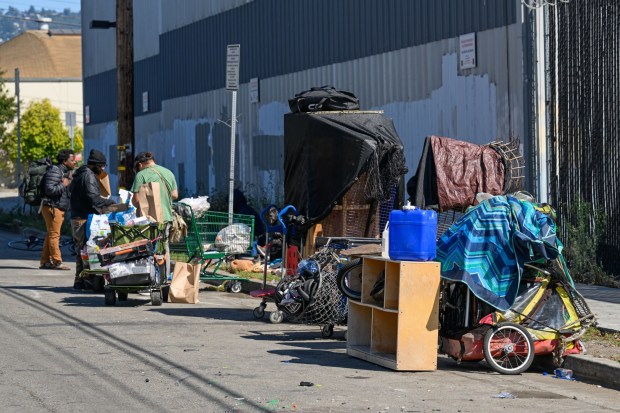 An assortment of items belonging to unhoused people can be seen along Harrison street after the city of Berkeley dismantled a homeless encampment near the corner of 8th Street and Harrison Street in Berkeley, Calif., on Friday, Sept. 18, 2026. (Jose Carlos Fajardo/Bay Area News Group)
“Our hope is that the city’s signage and prohibition will be observed,” he wrote.
In 2025, homeless residents sued to stop the city from forcing them out. While U.S. District Judge Edward Chen allowed the city to proceed with the sweep this week, he granted homeless plaintiffs legal protections that now apply to members of the Berkeley Homeless Union, according to attorney Anthony Prince, who represents the network of unhoused residents.
Several residents remained at the camp Thursday, but most had moved on. Francisco Maciel, a member of a mobile encampment outreach team run by the nonprofit Options Recovery Services, helped one person load a neat stack of belongings from his tent into a transport van. Maciel said the man would be moving into a hotel in Oakland; the man declined to be interviewed as he quickly packed up.
Maciel said most of the residents he’d interacted with did not want to move indoors when offered space at various East Bay shelters. Broadly, however, no county in the Bay Area has enough shelter to meet the need, according to a Bay Area News Group analysis, and the region still suffers from a chronic shortage of affordable housing.
“It’s hard to get back on your feet,” Maciel said. “But we’re trying. The city’s trying.”
Spencer said he has lived on Harrison Street for about three years. City workers have provided dumpsters and portable toilets to residents — while trying to remove the encampment repeatedly.
Berkeley officials launched several operations to close the encampment since 2022 but were blocked by court orders and, at one point, a “sit-in” protest by residents.
One attempt in June 2025 devolved into “pandemonium” when police launched smoke grenades into a person’s tent and then arrested them, according to a court filing by the residents. Other times, city workers would remove dwellers and then discover that people had returned “within days or even hours,” a city memo said.
This week, Spencer said he moved his two makeshift structures down the block, which he had built on wheels after enduring dozens or more sweeps in Berkeley. By Thursday, he had returned to Harrison Street and Eighth Street. The 46-year-old said he’s originally from Colorado and landed in California after he was medically discharged from the U.S. military.

In July of 2024, United States Marine Corps veteran Erin Spencer plays guitar as he hangs out with his dog Bastet and her sibling Diamond at the homeless encampment on Harrison Street near Eighth Street in Berkeley. (Jane Tyska/Bay Area News Group)

In July of 2024, United States Marine Corps veteran Erin Spencer organizes belongings at the homeless encampment where he lives on Harrison Street near Eighth Street in Berkeley. (Jane Tyska/Bay Area News Group)

In July of 2024, United States Marine Corps veteran Erin Spencer with a sign he made at the homeless encampment where he lives on Harrison Street near Eighth Street in Berkeley.. (Jane Tyska/Bay Area News Group)
Show Caption
1 of 3
In July of 2024, United States Marine Corps veteran Erin Spencer plays guitar as he hangs out with his dog Bastet and her sibling Diamond at the homeless encampment on Harrison Street near Eighth Street in Berkeley. (Jane Tyska/Bay Area News Group)
Spencer lives in a wooden shack scrawled with poetry that he shares with his two dogs, Sylvia and Bastet. He said the rat problem is still “unholy” along the strip of warehouses and a U.S. Postal Service lot. Still, he said he doesn’t want to move.
“I grew up rural. I like to sleep outside,” Spencer said. “In another 40, 50 years, I’ll probably still be sleeping outside.”
Prince, the attorney for the homeless residents, said Berkeley officials used the threat of leptospirosis as an excuse to shut down the longtime encampment.
The city is a “failed state,” he said, with “no solutions for the housing and accessibility crisis in this town.”
The court orders are a legal and procedural thicket for Berkeley officials. Chen, the district court judge, ordered officials to evaluate areas in Berkeley where homeless residents say they’d prefer to build encampments, but they aren’t allowed to consider how big those camps might be, according to the city manager.
“Only certain factors such as path of travel could be considered, not the general impact on the surrounding community,” Buddenhagen said.
On Tuesday, Prince filed an allegation that city workers ignored Chen’s ruling about protecting property when crushing a man’s bicycles, trailer and other items, and did so again after destroying another resident’s tent and all of her possessions.
Attorneys for Berkeley filed a response that did not specifically address those claims, and Chen formally reminded city officials of the requirement.
Neither side has claimed victory in the back-and-forth. Nor has Berkeley Mayor Adena Ishii.
“Clearing an encampment is not, by itself, a solution,” Ishii said in a statement. “It doesn’t end anyone’s homelessness; it just changes where the immediate problem of homelessness is visible. Our real goal, and the only thing that actually solves this, is getting people into long-term, stable housing.”