
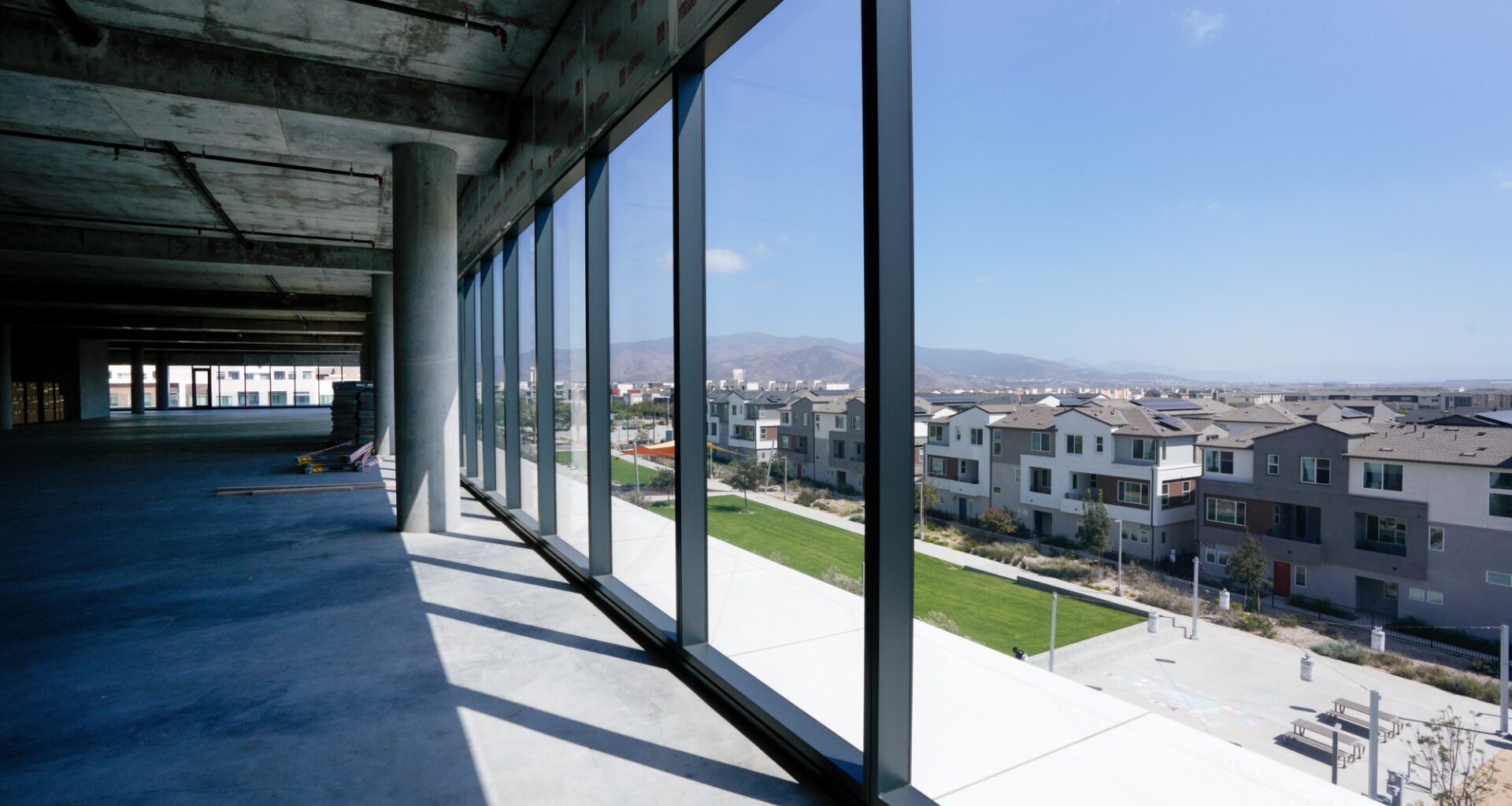
It’s been nearly two years since Chula Vista began negotiations with a young entrepreneur who is promising his startup will build a media mecca in the South Bay region to rival Hollywood.
In a nonbinding letter of intent signed by the parties in 2024, the city pledged to lease the top two floors of its newly built, glass-covered Millenia Library to Aaron Roberts, CEO of the Chula Vista Entertainment Company, parent company of the planned studio proposal, the Chula Vista Entertainment Complex, provided it was able to verify the company’s financial status and viability. A proposed phase two plan to construct a full production lot in an empty parcel of land next to the library was also drafted.
Construction of the media, film and post-production facilities was originally slated to break ground in spring 2026.
That has not happened. The timeline has lapsed, the space remains empty, and CVEC says it has cut ties with its initial investor group and recently engaged new firms to help it obtain financing.
City officials say they are still in the process of vetting CVEC, with no official decision having been made on whether to allow the project to proceed.
“We are in a due diligence process, and so we don’t know what the outcome of that will be,” City Manager Tiffany Allen said of CVEC during an interview with The San Diego Union-Tribune.
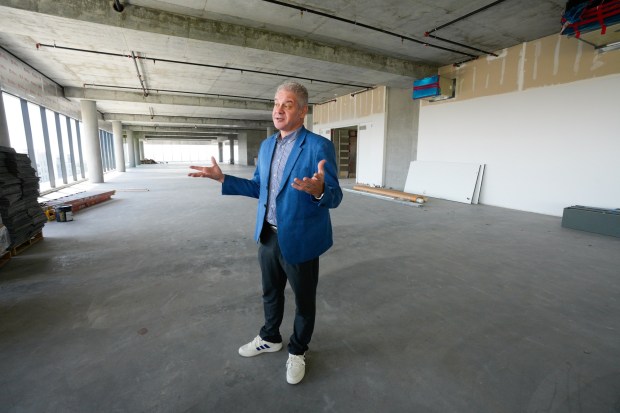 On Tuesday, Sept. 15, 2026, David Graham, Economic Development Director for Chula Vista, stands on the vacant third floor of the Millenia Library building, where the third and fourth floors remain vacant. (Nelvin C. Cepeda / The San Diego Union-Tribune)
The company has no lease, no construction rights and no legal claim to the space, according to Allen and Economic Development Director David Graham.
“You can say (we’re) deciding whether we’re going to date or not,” Graham said. “That’s really where we’re at.”
Allen said they have contracted with consultants HR&A Advisors to conduct due diligence on CVEC, and speculated that staff will present their findings to the City Council by year’s end for a final determination on the project. The city’s contract with HR&A Advisors caps compensation at $500,000 through 2028.
“That’s why this work is so important, to really vet Aaron and his team and their financing to make sure that this is the right tenant, the right partner for the space,” Allen said. “I won’t be taking something forward to the council that I can’t recommend.”
Finding investors
Despite no official word on the project, Roberts and his team said in a recent interview with The San Diego Union-Tribune they remain focused on making CVEC a reality.
Like many startups, CVEC operates on a hybrid basis, with staff split between San Diego and remote locations. Roberts said CVEC rents a live/work townhouse near the Millenia building to house out-of-state team members when they come to the region for work, also using the space as an office space for local and investor meetings as needed.
Roberts said CVEC walked away from an investment group early this year after negotiations reached a point where the terms “would’ve meant giving up more control of the company than we were comfortable with.” He said the company instead turned to smaller “pre-A round” investments — early-stage funding that typically precedes a startup’s first major institutional financing round — from individuals and family offices to fund operations while it works toward larger institutional financing.
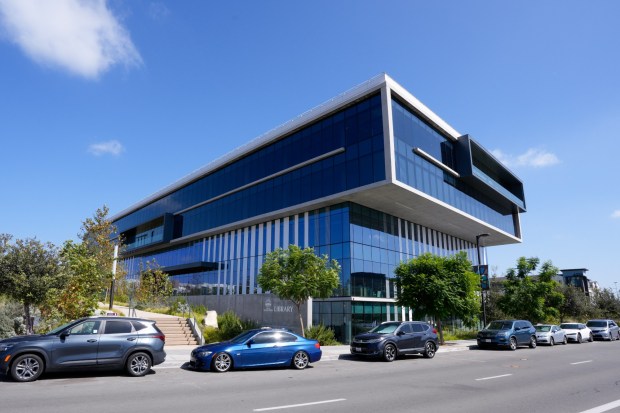 The third and the fourth floor of the Millenia Library building remain vacant in Chula Vista, CA. (Nelvin C. Cepeda / The San Diego Union-Tribune)
“We have an active due diligence with one group,” Roberts said. “We have a new LOI (letter of intent) with another group, the terms of which we are much more confident in. It is what we need and what we want and desire to actually move forward in a way that we can retain our control and keep our mission (moving) forward.”
Drew Burns, who is transitioning into the role of chief financial officer for CVEC, declined to disclose a specific dollar figure raised so far for the studio buildout. However, he said the company has raised “enough to fund our operations at this point,” referring to the overhead associated with running CVEC on a day-to-day basis. He said the company is close to closing its first pre-A funding round.
“In the past year and a half, we have scaled the business and the team in Chula Vista, investing over $1.5M in design, build preparation, and local services,” Burns said in a statement following the interview
The estimated $50 million to $80 million cost for the first two development phases has not changed substantially, Roberts said, though discussions with institutional investors now under consideration would fund all eight planned soundstages at once rather than half that number. Burns said that expanded scope could push the total build-out cost to about $150 million, financed in phases tied to construction and revenue milestones.
Burns said CVEC has also secured about $17 million in letters of intent from production companies and producers committing to bring projects to the studio once it opens, with a goal of increasing that figure by the end of the year.
Grayson Stubbs, CVEC’s head of business affairs who previously worked as director of international business and legal affairs for Lionsgate, said the company is attached to more than 20 feature films and at least a dozen television series in some stage of development. Stubbs declined to name specific titles or investors, citing confidentiality agreements.
“There’s been such a good response from international producers about the project we have in San Diego,” said Stubbs, who is currently based on London. “I actually have a lot of producers, even in London and in Europe, that are curious about exploring shooting and using our facilities in San Diego.”
In a follow-up email, Roberts clarified CVEC’s role on those projects range from providing quick-turn production loans, equity investment or distribution, as well as production-related services — at times a mix of all on a per-project basis.
All CVEC’s production efforts will eventually be handled through their newly created content subsidiary, Vistara Entertainment. Roberts said Vistara will become an officially filed entity by the end of the year as CVEC finalizes its corporate structure. In the meantime, he said, CVEC Corporate is signing content deals that will ultimately be released under the Vistara brand, as Vistara will operate as a wholly owned subsidiary once formed. Burns said that content revenue has also begun contributing to operational costs.
“There are multiple ways a production company/studio can get involved in ‘producing’ a film,” Roberts said in the email. “The truth is, with how the industry is currently, hardly any single film or TV show is produced by one singular entity.”
Roberts said investors interested in funding film content and those interested in funding the physical studio infrastructure are largely two separate groups. Film investors, he said, tend to be high-net-worth individuals or production entities who look for shorter investment turnarounds.
Studio investors, by contrast, are typically institutional or real estate development investors who expect a longer payoff timeline of five to 10 years but a higher potential return. Roberts said the studio investors currently in negotiations with CVEC fall into that latter category.
Asked what the company needs to secure a favorable decision from the City Council, Roberts said CVEC has limited insight into the city’s internal evaluation process.
“It is a black box to us as well,” he said. “We don’t necessarily know exactly what those parameters are, and we’re not supposed to know.”
Roberts said the company’s plans will continue regardless of the council’s eventual decision.
“Regardless of the outcome with the city, we are here to stay,” he said.
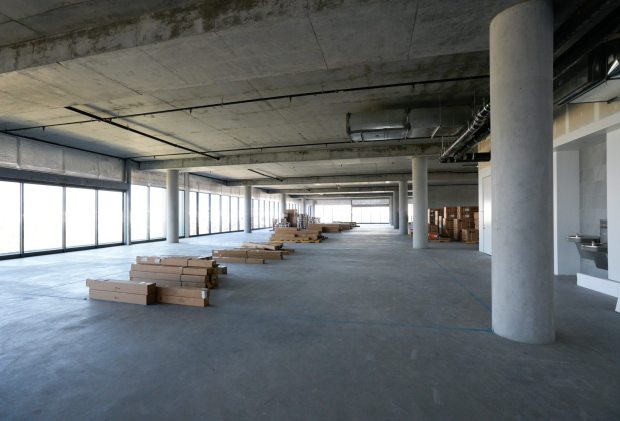 On Tuesday, Sept. 15, 2026, in Chula Vista, CA, the third and the fourth floor of the Millenia Library building remain vacant. (Nelvin C. Cepeda / The San Diego Union-Tribune)
What if…
The idea behind CVEC stems, in part, from the city’s ongoing effort to bring a four-year university to Chula Vista.
In December 2022, the City Council approved $96.4 million to build the Millenia Library, a 168,000-square-foot office-and-library complex developed in partnership with Chesnut Properties, with San Diego State University slated to occupy 50,000 square feet for film, screenwriting, animation and interactive media classes.
State lawmakers backed the plan: Assemblymember David Alvarez secured $25 million and then-Senate leader Toni Atkins added $5 million.
The SDSU partnership collapsed within months. The university told the city in January 2023 that it had not been consulted on the building’s design and that the layout — low ceilings, support columns, no loading dock — could not accommodate production work.
By then, the city had already spent $4 million in soft costs and permits, and then-Deputy City Manager Erick Crockett said a redesign was too costly to pursue.
Graham said the city had explored other uses for the third and fourth floors, including hiring a broker to gauge interest from technology companies, before Roberts approached the city with what Graham described as “an unsolicited offer” to bring a creative-arts and post-production tenant to the space.
“You can imagine, given the state of the office market post-COVID, that there was not a lot of interest,” Graham said.
Roberts, with a background in the San Diego-area film and television industry, said he first approached Mayor John McCann with a pitch in the summer of 2023. McCann has said he met Roberts at a barbecue and encouraged him to bring the concept to Chula Vista.
McCann did not respond to repeated requests for comment.
In an interview in November 2025, Roberts said he had been working on the idea behind CVEC — bringing a film production studio to San Diego — for roughly a decade and formulated a business plan in 2021.
“And then I happened to get connected to the mayor of Chula Vista in the summer of 2023, pitched him the idea, and he was a supporter from day one,” Roberts said.
Roughly a year later, Roberts began formal negotiations with the city.
He sent Allen, then assistant city manager, and then-City Manager Maria Kachadoorian an email in May 2024 introducing CVEC’s legal counsel to begin negotiations, records show. Allen and Roberts corresponded regularly over the following months, as records show the two parties discussing a draft memorandum of understanding, a mutual non-disclosure agreement and eventually a letter of intent.
The NDA was signed Nov. 21, 2024.
On Dec. 3, 2024, Roberts and McCann signed a non-binding letter of intent outlining a three-phase project: a 10-year lease of the library’s third and fourth floors for coworking and post-production space; construction of a roughly 89,600-square-foot virtual production studio campus on an adjacent lot; and additional commercial, retail or hotel space contingent on demand.
The City Council unanimously approved the letter of intent Dec. 10, 2024, along with an agreement with SDSU for a nursing program whose 10-year lease was officially approved by a council vote in April of this year.
A separate 15-year lease agreement was approved by the City Council in May, bringing Sweetwater Union High School District’s Launch Virtual Academy to the city-owned property.
Both programs have moved in and are underway at the Millenia Library.
The letter of intent set a 12-month period for the city and CVEC to negotiate a lease, but that period has come and gone without an executed agreement, and the letter of intent itself does not carry an expiration date.
City officials have said no additional agreement has been signed since.
The City said no council member has received a written briefing memo, staff report or other formal update on the CVEC due diligence process since the council approved the letter of intent in December 2024. Staff said they have continued to engage with CVEC based on that agreement.
The city has not incurred any costs specifically tied to the third and fourth floors remaining unleased, officials said. The space is currently in a “warm shell” state and cannot be occupied without significant tenant improvements, and that maintenance, security and utility costs apply to the building as a whole rather than to those floors specifically.
Should she recommend against moving forward with CVEC, Allen said the city does not yet have a settled alternative plan for the space.
“We kind of reset,” Allen said, when asked what would happen if the city ultimately declines to move forward with CVEC. She said the city could bring back a real estate broker to market the space, or pursue “an RFP for a public-private partnership, something like that.”