
Update: A spokesperson with the Lincoln Club Business League previously told Voice of San Diego that the organization had endorsed Martha Abraham in this race. That turned out to be incorrect and a Lincoln Club spokesperson clarified the group has not made an endorsement. They gave us this official statement: “The Lincoln Club clarified that while an endorsement had previously been communicated and discussions remain ongoing, the organization has not completed its formal endorsement process or issued a formal endorsement in the race.”
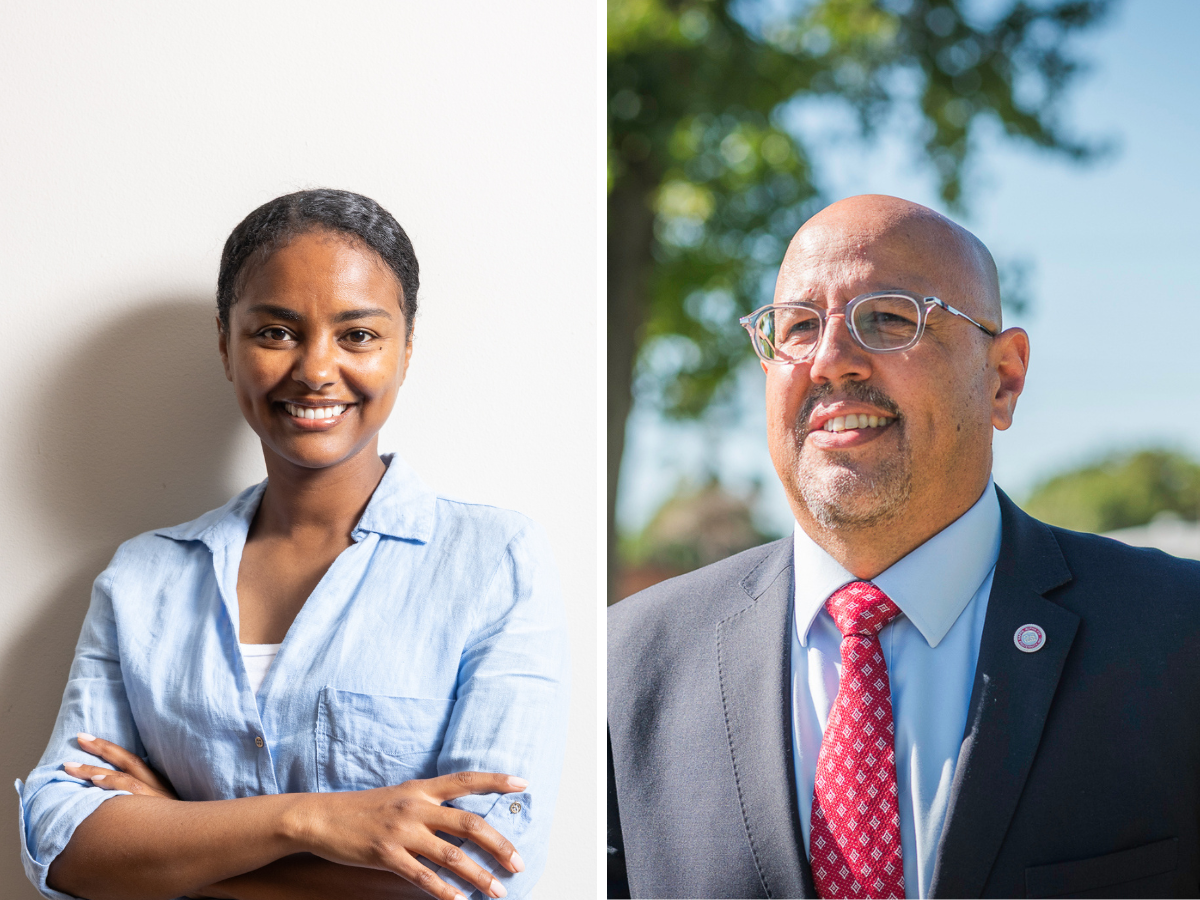
This election, District 4 San Diego Councilmember Henry Foster faces a newcomer who is trying to harness the rage directed at City Hall.
First-time candidate Martha Abraham has mounted a strong challenge. In a primary, where more than 22,000 people voted, she came in second to Foster by 12 votes. Both are Democrats.
Last week, Foster lost the endorsement of the union representing city firefighters.
Abraham’s supporters hope she can oust Foster the way his predecessor and mentor, Monica Montgomery Steppe, ousted the incumbent in 2018. During that election, incumbent Myrtle Cole and newcomer Montgomery Steppe almost tied in the district’s primary.
The question is whether Foster’s record of delivering funding for the district and his thorn-in-the-mayor’s side identity on City Council is enough to withstand Abraham’s challenge. Political observers also say Foster’s focus on the workings of city government can make it difficult for residents to see how his work at City Hall benefits them.
Since launching a bid to unseat Foster last year, Abraham, a nurse and community advocate who only recently became involved in district politics, has gained traction, despite her inexperience in government and concerns about her ties to a community group that has backed conservative-leaning candidates in other races this year.
Foster defended his tenure in a statement to Voice of San Diego.
“When the Mayor proposed closing libraries and cutting Rec Center hours to cover budget shortfalls, I got the funding back – twice,” he said. “I have ensured the Oak Park Library became a reality for our community. I consistently protect District 4 from the burden of balancing the City’s budget on our backs.”
Residents supporting Abraham say they’re simply fed up with the status quo.
“We need help,” said Carol Turner, an 81-year-old resident of District 4 who said she regularly talks with her neighbors about community issues. “We don’t know who’s supposed to help us, but we just need help.”
District 4 covers much of southeastern San Diego. It includes neighborhoods like Emerald Hills, Lincoln Park, Encanto, Mountain View, Chollas View, O’Farrell and more. The district has more than 87,000 registered voters and has long been the center of San Diego’s Black community. Today, only 13 percent of voters are Black.
Community leaders say the district has been underserved for decades. The district struggles to get basic city services and lacks access to fresh food. January 2024 floods devastated parts of the district. The mayor proposed cutting several libraries and rec centers in the area this year but ultimately rescinded the cuts.
In recent years, District 4 residents have become increasingly upset at City Hall.
Turner, for example, lives near the intersection of 69th Street and Imperial Avenue and says she’s still struggling to recover from the flood two years later. The back of her house is off its foundation, and she does not have a drain or sidewalks on her street. She said she’s been asking for these basic services for the past 25 years.
“ I think he needs to get into the community, get more involved in the community, and not send his representatives,” said Turner of Councilmember Foster.
In an interview with Voice, Foster said he appreciates Turner’s comment. He said he’s familiar with the area where Turner lives and said the city will continue to work to address residents’ concerns.
“I try to put my best foot forward to be in the community,” he said. “I consider District 4 my home. I’m going to continue to work to make it the best community I can.”
Why Abraham Is Running
 Martha Abraham, candidate for San Diego City Council District 4. / Photo courtesy of Martha Abraham
Abraham first gained attention in the district by raising concerns about a new development in Emerald Hills and Footnote 7, a controversial change to the city’s land development code that allowed developers to build denser housing in parts of southeastern San Diego.
Footnote 7 was adopted in 2019 to adjust minimum lot sizes from 20,000 feet to 5,000 square feet to certain properties in the Encanto Neighborhoods Community planning area. Only a handful of community plans have 20,000-foot lot sizes, including Encanto, Kearny Mesa, La Jolla, Torrey Pines and more.
Most single-family zone lots in San Diego have minimum lot sizes of 5,000 square feet. With Footnote 7, city officials adjusted Encanto’s minimum lot size to be in line with the city’s common single family lot size.
But it came as a surprise to residents. Why would city officials make this change in Encanto but not in other wealthy, White neighborhoods? Community members found out about the zoning change after city officials announced two housing developments would be built in the district.
At a July 2025 City Council meeting, Abraham called for an investigation into the policy, citing environmental and health issues among residents. She also accused Foster and his predecessor, Montgomery Steppe, of knowing the policy could have a negative effect on the community.
Foster said Abraham’s accusation further confirms her “inexperience and lack of knowledge about land use policy.”
“Since I have been in office, I heard the concerns of my community and led the removal of Footnote 7 and modified the ADU (accessory dwelling unit) regulations,” said Councilmember Foster in a written statement to Voice.
He added home ownership is critical to ensure the sustainability of the district.
County Supervisor Montgomery Steppe said Abraham is misrepresenting her record and “attacking policies she doesn’t fully understand.” Montgomery Steppe said smaller minimum lot sizes can create more housing opportunities for residents, and she believes the change should be applied equitably across the city. She also supported the repeal of Footnote 7.
Foster led the effort for the footnote’s repeal, which took effect in 2025.
“That was just a very, very hard decision,” said Foster about the repeal on the VOSD Podcast in March 2025. “I truly believe that large lots are discriminatory. Again, for me it was about process and engagement.”
Some residents felt he didn’t do enough to stop high-density housing projects already in the pipeline before the repeal, including the Emerald Hills Housing Project and the Klauber Development in Encanto. For Abraham, it was the issue that kicked off her candidacy.
“I think that when they approved that Klauber Project, seeing the whole fiasco that went on at City Council, I was like ‘We can’t live this way.’ Enough is enough. So, that is what started it for me,” said Abraham.
Foster’s Tenure
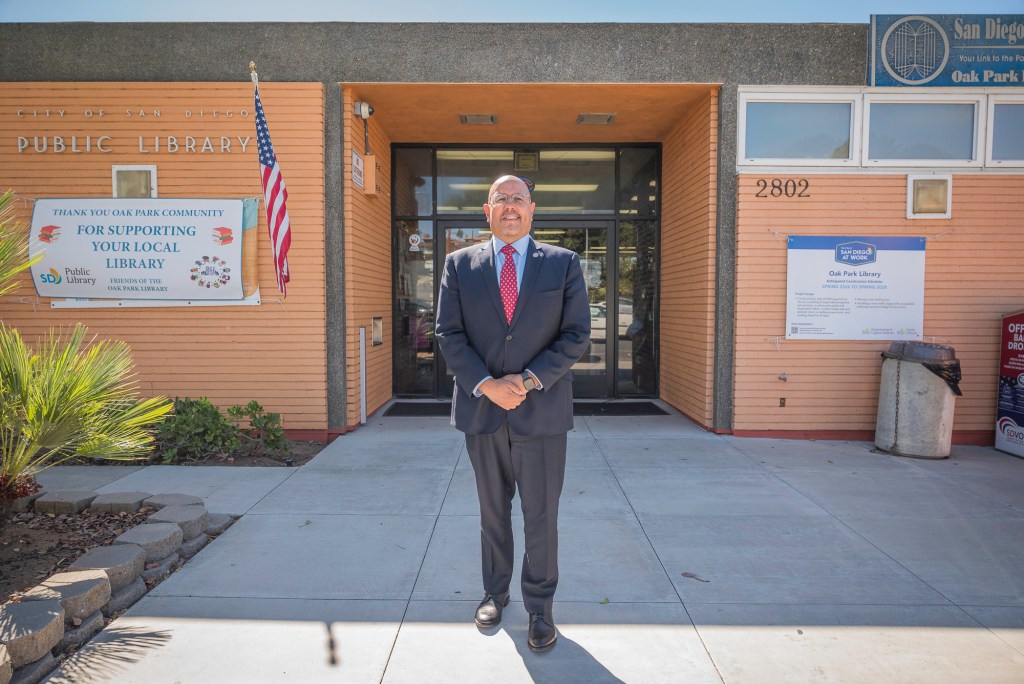 San Diego Councilmember Henry Foster at Oak Park Branch Library on Thursday, Sept. 3, 2026. / Vito Di Stefano for Voice of San Diego
Foster won a special election in 2024 to succeed Montgomery Steppe who was elected to serve on the County Board of Supervisors.
He previously worked as Equal Opportunity Contracting Program manager at the city and served as Montgomery Steppe’s chief of staff both at San Diego City Hall and the county of San Diego. Both have deep roots in the community as third-generation residents and have worked together closely over the last eight years.
Community leaders told me Foster’s been effective during his tenure on the City Council. He has served as the Council’s Budget Chair for the last three budget cycles and became a voice of dissent against Mayor Todd Gloria.
He’s also secured full funding for a new library in Oak Park and secured nearly $24 million for new stormwater infrastructure along Streamview Drive. Foster has strongly advocated for the San Diego Black Arts and Culture District, which recently hosted the first Encanto Block Party in two years.
Long-time community advocate Elida Chavez said it took years to secure dollars for the district. She said Councilmember Foster played a large role in advocating for those funds.
“He made sure we got ours. He has years of experience and knows the process in working with everyone on the City Council. He knows how it works,” she said in an interview with Voice.
Dwayne Crenshaw is another long-time community activist from District 4 who’s now based in Sacramento. He lost to former Councilmember Myrtle Cole in 2013. He said Foster’s years of experience and understanding of city government work to his advantage. But what he does at City Hall often doesn’t connect with residents.
“That doesn’t translate out, because it’s not, perhaps, sexy to the day-to-day community, large concerns or issues that are easily played pro or con and that it pokes emotions around,” he said in an interview with Voice.
He said Foster came up through Montgomery Steppe’s shadow, and “was at the right place at the right time.” He added Foster doesn’t have the vocal advocacy people came to expect.
Foster responded to Crenshaw’s comments.
“I appreciate his recognition that I bring the appropriate experience, advocacy, and focus to the table, which I hope the community recognizes,” he said.
Montgomery Steppe, a Foster ally, said, District 4 residents aren’t happy with the direction the city is going – though she blamed Gloria, not Foster, for residents’ dissatisfaction.
“ I think fundamentally, folks in District 4, just like across the city, are not very happy with the way the services are being deployed that are under the mayor’s watch,” she said in an interview with Voice.
What’s at Stake
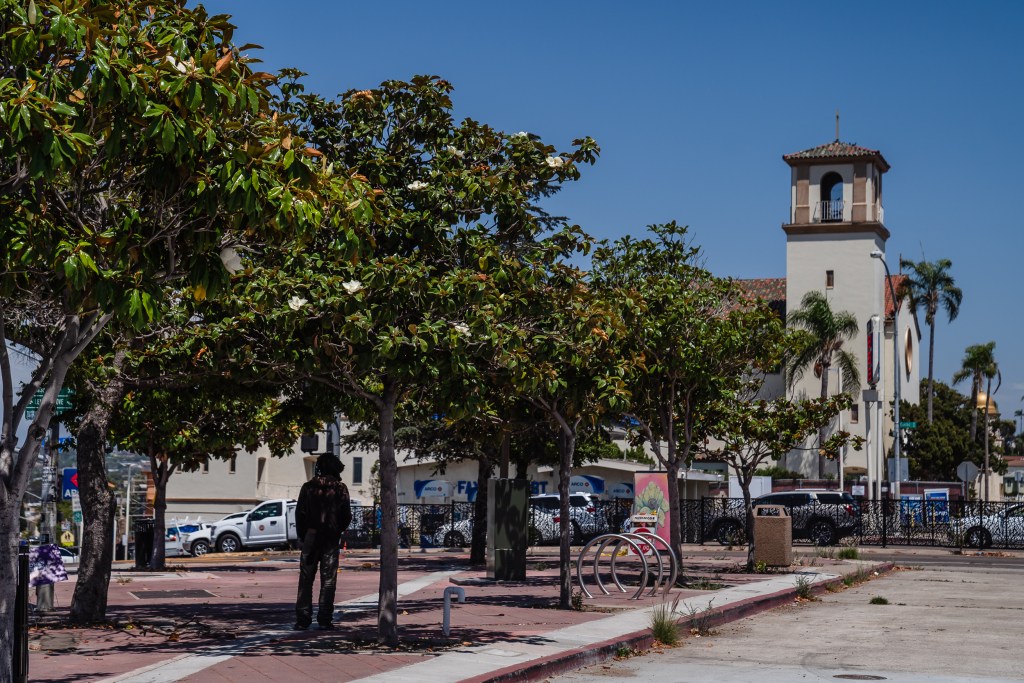 Lincoln Park neighborhood on Aug. 1, 2023. / Photo by Ariana Drehsler
Endorsements for the race, or lack thereof, reveal interesting coalitions aligning with each candidate.
The union that represents city of San Diego firefighters quietly dropped their endorsement of Foster last week, even though, as we reported, he has advocated for them in behind-the-scenes negotiations.
Abraham, on the other hand, has been able to connect with residents who are upset at the controversial developments and fire up voters on the city’s lack of investment in the district.
According to the Union-Tribune, Abraham more than doubled Foster’s $8,557 fundraising total during the last six months of 2025 with $19,506 in donations.
Fundraising has shifted dramatically since then. Foster has now raised more than $110,000 — more than twice Abraham’s $43,200.
Jared Sclar, Abraham’s campaign consultant, said Abraham ran an intensive grassroots campaign.
“Foster had substantial institutional support, while Martha’s campaign depended heavily on direct contact with voters,” he said in an email statement.
In a mailer sent out to District 4 voters, she said she opposes the city’s “bait-and-switch” trash fee, paid parking, and the $10 parking meters downtown.
Councilmember Foster voted against the trash fee, noting that the inaccurate estimate from 2022 was an honest mistake. He voted yes on paid parking in Balboa Park and yes on $10 meters downtown near Petco Park.
“These people got here because of our vote. We elected them, so in turn they should serve the people. But that is not what’s happening,” said Abraham in an interview with Voice in March.
On her campaign website, she said her priorities are to preserve affordable housing and prioritize green space and climate equity for residents. She also wants to prioritize stormwater repair and invest in the economic future of the district.
Abraham has also benefited from the support of a newly minted political advocacy group this year that is backing conservative-leaning candidates. Crenshaw said the coalition wasn’t top of mind for voters until this election cycle.
“It’s delivering strange results,” said Crenshaw in an interview with Voice. “Martha’s strong showing in the primary, Richard Bailey in District 2 – his candidacy. I would actually say its outside influences.”
Foster’s supporters blamed the group for the results in the primaries.
That community group, San Diego United Communities is the fast-growing coalition of residents that want more restraint on development in neighborhoods and are supporting candidates who think the city has allowed things to go too far.
Turns out, a lot of the candidates they support are more conservative.
They are supporting several City Hall newcomers, including Richard Bailey in District 2 and Mark Powell in District 6. Abraham, Bailey, and Powell all have similar campaign priorities that align with the group’s messaging that they are fed up with current leadership and want to repeal new fees.
The group has made several headlines on their opposition to the redevelopment of Emerald Hills, Balboa Park parking, and general public displeasure of city hall. Former Mayor Kevin Faulconer and former Republican Richard Bailey have also spoken at their rallies.
San Diego United Communities was founded by Margaret Virissimo in 2025. She’s also co-founder of Protect Point Loma, a group that pushed back on Mayor Gloria’s plan to open a large homeless shelter near the airport.
“We are coming together for one reason,” said Virissimo in a video the group posted earlier this year. “To save San Diego at the ballot box.”
Government Affairs consultant Herman Collins said the group supports conservative candidates, and their goal is to change the political makeup of the City Council and target Foster.
Montgomery Steppe said the group has fueled a lot of anger at the councilmember.
“They have fanned the flame of some of the discontent, right? And directed that more so to the councilmember,” said Montgomery Steppe.
In fact, Foster said they played a big role in the primaries.
“ I think they have come in and they have really spread a lot of misinformation and played on the emotions of the community,” he said in an interview with Voice. He provided examples of how the group communicated Footnote 7 and accessory dwelling units (ADUs) to the public.
He said both have state requirements, and because of the way state law is written, an elected official and local city cannot simply deny a project. He said the state has specific mandates as to what local governments can and cannot do.
“They are misrepresenting that to the public, state law supersedes what we [City Council] can do,” he said. “A Coronado Mayor has never been in Emerald Hills advocating on behalf of District 4 for a damn thing.”
Patty Ducey-Brooks, spokesperson for San Diego United Communities, didn’t like the attacks made against their organization.
“It really becomes obvious that when someone wants to attack an organization that’s trying to do good will in the community and provide people with a voice, they attack it,” she said in an interview with Voice. “There’s something wrong when that happens in our world today. That’s very divisive. They’re trying to silence the public.”
Sclar said Abraham has not sought or received the organization’s endorsement, is not affiliated with the organization and has no control over its political activities.
“Any political activity undertaken independently by an outside organization is just that: independent of Martha’s campaign,” he said in an email statement.
Campaign disclosure forms reveal leadership from the group donated to Abraham’s campaign. Bailey has also donated to Abraham’s campaign.
A post on Instagram shows San Diego United Communities hosted a Meet and Greet event with Abraham earlier this year. Additionally, founder of San Diego United Communities, Margaret Virissimo, attended Abraham’s campaign launch in April of this year.
Voter attitudes in the district are changing, and some community leaders say demographics are changing, too.
Data from The Ballot Book shows registered Democrats dipped about five percentage points in District 4. In the 2022 primaries they had an advantage of 33 percentage points above registered Republicans. This year, the advantage dipped to 28 percentage points above registered Republicans.
As Voice reported in 2021, the district has seen a decreasing number of Black voters, as rising housing costs have pushed many residents out of the area.
Political Data (PDI) from this year’s primaries reveals that of the more than 87,000 registered voters in the district 42.6 percent of voters are Latino, 30.4 percent of voters are White, and only 13 percent are black.
Lanell Brown, who runs a youth drop-in center in Mountain View, has lived in District 4 since the 1980s and said the neighborhood is gentrifying. He’s noticed more White people moving into his neighborhood since the pandemic.
“Before, you would never see a White couple pushing a White baby down the street in a stroller. There’s a lot of White people and they’re buying up all the houses that the Black people are selling to them,” he said.
For Turner, who has owned her home in the district since 1964, she wants the next elected official to be more involved in the community.
“Not just for a photo,” she said.
Related Posts