
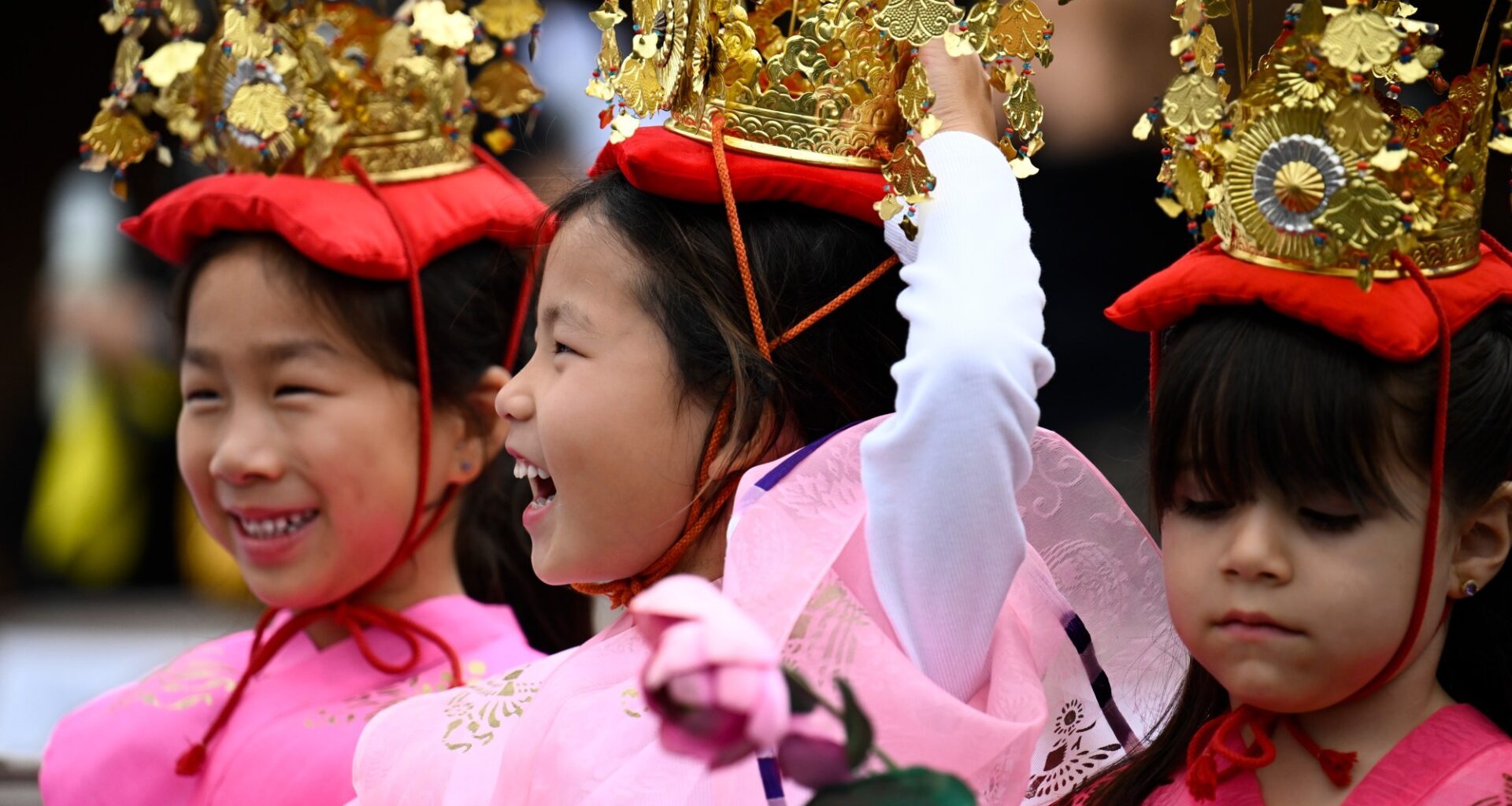
One hundred years ago, in the spring of 1926, Ralph Honda’s and Karen Matsumoto Copeland’s grandfathers, both immigrants from Japan, helped build San Diego’s first Buddhist Temple in downtown San Diego.
On Sunday, descendants of the temple’s founding families joined newer generations to celebrate that milestone and launch the temple’s Jodo Shinshu Buddhist community into its next century. After a rare Kieshiki ceremony, a once-in-a-lifetime ritual where people receive a Buddhist name, there was a group photo, a procession of children and clergy in traditional Japanese Buddhist ceremonial outfits, a religious service and a luncheon.
Sunday was the culmination of two weeks of special events and two years of planning.
LuAnn Lee, the event’s chairperson, said the temple has preserved traditions over the years while adapting and modernizing. It welcomes a diverse population, not just Japanese immigrants and their descendants. Some members speak Spanish, she said.
Even as the temple has grown, many of the same families are a constant presence. People who came Sunday, Lee said, included friends she grew up with.
“The centennial is a great feat,” Lee said, “but it’s not to stop. It’s to continue. It’s a launchpad. It’s our turn now, to make it last, so my grandkids and their grandkids, and their kids, can carry it on and have a place where they can gather, as our ancestors did.”
Matsumoto Copeland, 77, grew up in Chula Vista and regularly views the temple’s services over a livestream from Bandon, Ore., where she lives now. She comes in person several times a year. She flew in for Sunday’s celebration because the temple has been a steady presence in her family’s life over three generations.
“My grandfather emigrated from Japan, arrived in California on the day of the (San Francisco) earthquake in 1906,” she said. He ended up traveling to Washington state and worked on a railroad alongside Chinese immigrants. “They didn’t ask questions. He needed money.”
Eventually, he became a farmer in Mission Valley and helped build the temple, her mother told her.
Later, he was sent to the Poston Internment Camp in Arizona. A treasured family photo shows her grandmother’s funeral in 1936, at the temple.
The centennial means a lot to her, she said, both because of her family’s involvement and because the temple has been “such an important part of the community.”
Honda, 69, who heads the temple’s operations (and who is a former Union-Tribune editor), heard his father speak about his grandfather’s effort to help build the temple. That helped bridge the language barrier with his grandfather, who mostly spoke Japanese. Between his father’s stories, community conversations and studying archival photos, Honda understood his grandfather and others sacrificed a lot to get the temple going.
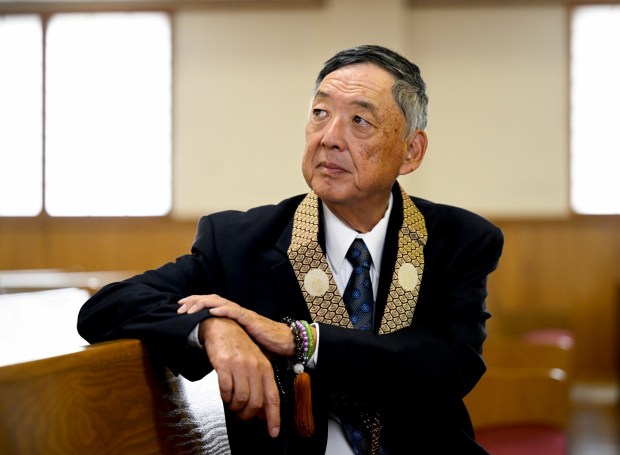 Ralph Honda is a community leader at the Buddhist Temple of San Diego. It turns 100 this year and marked the occasion on Sunday. (Denis Poroy for The San Diego Union-Tribune)
San Diego’s Japanese immigrants, many of them farmers, started to come together in prayer after heavy rains caused deadly flooding of their farms in Otay Valley, Honda said.
“That was kind of the starting point of families gathering in homes, to have religious services and to remember the loved ones who passed away.” Ten years later, in 1926, the temple opened at Sixth Avenue and Market Street in downtown, he added.
Three years after that, it moved to its present location in Grant Hill, in a building whose cornerstone, visible from the sidewalk, says “August 1930.”
The temple’s early years overlapped with the Great Depression, and soon after came the internment of Japanese Americans during World War II, Honda said.
In 1926, San Diego’s Japanese community was already several decades old. The first known immigrant to San Diego County came in 1887 to work on the Hotel del Coronado’s construction, according to a Japanese Historical Society newsletter from 2004. Many worked in gardens in Coronado and in agriculture throughout the region.
“I have a lot of appreciation and gratitude for that generation, because they went through a lot to establish the temple,” Honda said. “We’re very grateful to them, because it’s here for us, today.”
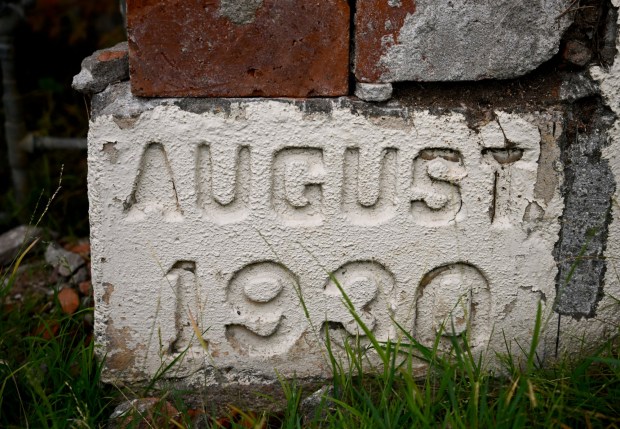 A cornerstone is on the corner of The Buddhist Temple of San Diego shows when the building was constructed. The temple turns 100 this year. (Denis Poroy / For The San Diego Union-Tribune)
Pieces of the temple’s history are spread throughout the building, at 2929 Market St. One is a group photo of the 1930 cornerstone ceremony, showing at least 100 people in their Sunday best on a sunny day, some smiling, some looking into the lens with solemnity. A photo of the temple’s 90th anniversary shows a much larger community, still in neat rows, this time in color.
On Sunday, people lined up in the same spot, in similar rows. One sign of the times: A drone flying overhead, controlled by a photographer, snapped some pictures.
The Rev. Sterling Davenport, the temple’s minister, said the celebration is about the future, not just the past. The temple works to involve children and young adults through scholarships and trips to Japan.
People “went out of their way over 100 years ago to create this facility, create an opportunity for people to listen to Buddhism,” Davenport said. “… That brought their community together and it allowed them to create an opportunity for new people … in future generations to experience that same opportunity.”
“So I think for us, looking back at this, it’s reflecting on their love, their care, their compassion, and creating opportunities for future generations to share the Buddha Dharma,” or the Buddha’s teachings.
The morning’s first event was the Kieshiki ceremony, where around 40 people adopted a Buddhist name and affirmed they accept the Buddhist path. The ceremony is typically held during special temple milestones, and Buddhists may participate once in their lifetime.
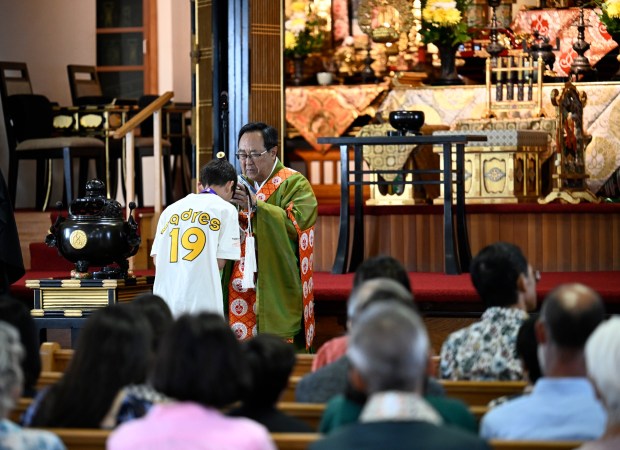 Rev. Marvin Harada gives a blessing during a Buddhist naming ceremony at The Buddhist Temple of San Diego as part of the temple’s 100th anniversary celebration. (Denis Poroy for The San Diego Union-Tribune)
Lisa Umekubo and her son Matteo Mascola of Chula Vista each received a Buddhist name. Half came from the bishop. Umekubo chose the other half for her love of mountains and her spiritual journey. It is Kai Zan.
“I think it brings us closer to our ancestors. I’m fourth-generation Japanese. So it’s a special ceremony,” she said.