
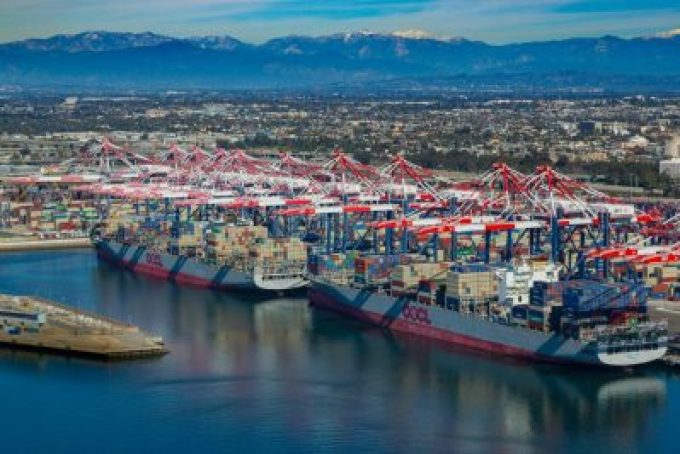
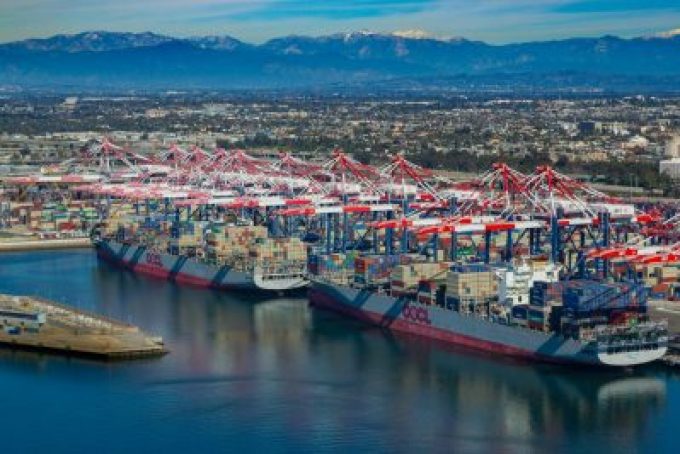
Long Beach and LA ports
By Ian Putzger Americas correspondent
21 September 2026
The port of Long Beach announced record traffic volume for the past month, but its management is in no mood for celebrations. CEO Noel Hacegaba attributed the increase to disruptions rather than market growth and warned of economic concerns as well as capacity challenges.
At 919,922 teu, the port’s August throughput was up 2% year on year, setting a new record for the month. Imports were up 3.6%, while exports climbed 4%. The rise in imports brought the port’s tally for the first eight months to 6,687,078 teu, a rise of 1.3% over the same period in 2025, which was a record year.
Next door the port of Los Angeles reported throughput of 956,000 teu for August, matching the volume of 12 months earlier, which had been a record-setting year. In the three months from June through August, the port handled over 2.9m teu, which constituted the best three-month run in its history.
The momentum is expected to continue this month. Mr Hacegaba anticipates strong volume in September, which will likely continue into October, possibly to the first week of November, he said, citing predictions from carriers and cargo owners and the congestion at Asian ports caused by storms.
The National Retail Federation recently upped its projections for September, stating that volumes may crest this month, as the peak season is lasting longer than anticipated.
Nevertheless Mr Hacegaba struck a note of caution in his remarks on the latest results and the outlook for the coming months, pointing to several factors that boosted August volumes at the port of Long Beach.
He mentioned the restrictions at the Panama Canal, which have induced carriers and cargo owners to move more of their traffic through US west coast ports. Earlier this month Gene Seroka, executive director of the port of Los Angeles, told media that the situation at the Panama Canal, in conjunction with disruptions in the Middle East affecting the Suez Canal, had caused a shift of more than 5% in cargo from ports on the US Atlantic and Gulf coasts.
According to him, cargo owners have shifted a small portion of their imports as a hedge on the draft restrictions on the Panama Canal and may “have further guidance in the weeks and months ahead”.
Mr Hacegaba cited ongoing frontloading as another reason for the strong volumes through Long Beach.
“Tariffs and geopolitical uncertainties are accelerating diversification of sourcing,” he added, pointing to the rise of imports from Vietnam as more cargo owners pursue a China-plus-one strategy.
While US retail numbers have continued to defy warnings of consumers running out of spending power as inflation remains on the ascent, Mr Hacegaba pointed to signals that suggest a likely turn for the worse ahead. He noted the Conference Board data was down in August for a second month in a row, with consumer confidence and new construction on the decline.
The fact that cargo volumes are still strong while consumer confidence is softening is not necessarily contradictory, as sourcing decisions were made some time ago, he remarked.
For now, the strong volumes are causing pressure on the inland transport side. Anne Reinke, president and CEO of the Intermodal Association of North America, who joined Mr Hacegaba on his media briefing, warned that dray capacity is “dramatically constrained”, with rates soaring.
This has been corroborated by JB Hunt, which recently announced that it was handling record intermodal volume and that its spending on drayage drivers was going up. Other intermodal service providers have confirmed that capacity is tight, exacerbated by a shortage of drivers.
Rail volumes are also up. The driver shortage caused by Washington’s clampdown on non-domiciled truckers and those with insufficient English language skills and the ensuing rise in trucking rates have prompted domestic shippers to shift to intermodal transport. In July domestic intermodal volume was up 12% over July 2025.
Both Ms Reinke and Mr Hacegaba urged cargo owners to strengthen their partnerships with intermodal service providers in order to secure adequate capacity, adding that the uncertain outlook on Panama Canal transit limits is further reason to seek strong intermodal partners.
Mr Hacegaba remarked that the diversification of sourcing is expected to boost volumes through the port, which has ramifications for the rail infrastructure.
“Speed to market is key,” he said, and went on to highlight the port’s Pier B project, a $1.8bn undertaking to expand and modernise the rail yard. Begun in 2024, it is planned for completion in 2032.
“Pier B reduces processing time from four days to one,” he said.
Check out today’s News in Brief podcast featuring Stephanie Loomis, Noatum Logistics, talking about the Transpacific.