
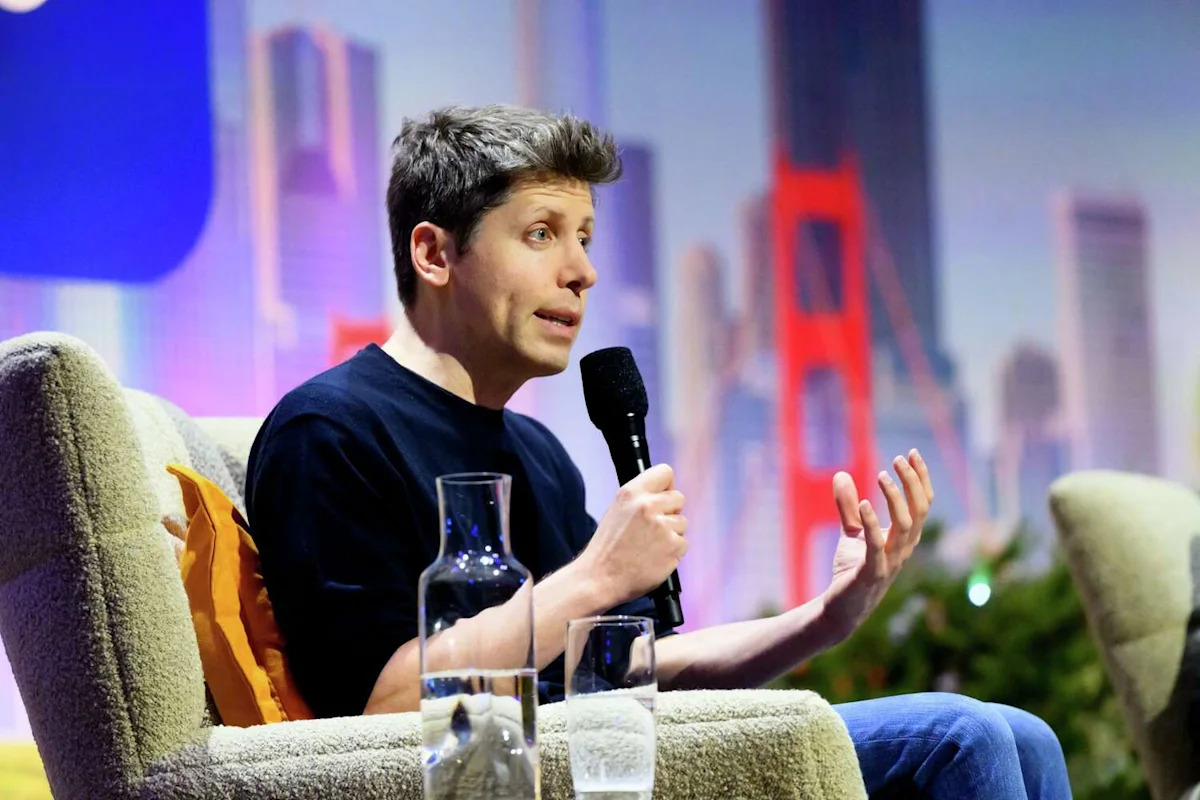
 OpenAI, led by CEO Sam Altman, shown at Dreamforce in San Francisco last week, is said to be nearing a deal for more office space in the city. (Noah Berger/For the S.F. Chronicle)
Even as OpenAI’s Sam Altman joins calls for guardrails on the pace of artificial intelligence development, the company’s appetite for physical expansion – and the real estate it needs to support its growth – shows no sign of slowing.
The company is said to be on the verge of signing a deal for a sublease that would span about 100,000 square feet, or roughly one-third of 500 Terry A Francois Blvd., according to multiple real estate insiders.
The six-story office building is owned by the Sobrato Organization, and represents a logical expansion for the AI pioneer: The company already leases the entirety of the neighboring 315,000-square-foot 550 Terry A Francois Blvd. building, as well as two other large office properties nearby on Third Street and another on Owens Street.
The sublease, if completed, would push OpenAI’s Mission Bay footprint above 1.1 million square feet. Neither OpenAI nor Sobrato provided comment on the deal, which as of last week remained pending.
 OpenAI leases all of 550 Terry A. Francois Blvd. in San Francisco, and could be taking more space at the nearby 500 Terry A. Francois Blvd. building. (Lea Suzuki/S.F. Chronicle)
What is interesting about the potential transaction is that OpenAI, which has emphasized protecting its data, models and products as it grows its footprint, wouldn’t be the property’s sole tenant.
The building is leased by San Jose-based tech giant Cisco, which has used it primarily to house its Meraki cloud-networking division. The company renewed its 247,000-square-foot lease in the building three years ago, and has about four years remaining in its term.
A source with insight into OpenAI’s real estate strategy said that the company is likely settling on a sublease because there is “no more space to lease anywhere else” in the neighborhood, at least not at the scale that OpenAI needs near its campus.
Mission Rock, located on the northern end of Mission Bay near Oracle Park, is among the newest office developments in the neighborhood, yet its first phase has quickly attracted major tenants like Visa, which moved its headquarters and roughly 1,000 employees there in 2024, as well as the Golden State Warriors, Capgemini, Coinbase and Nvidia.
The project, which is being co-developed by the San Francisco Giants and Tishman Speyer, was recently approved by the Port of San Francisco, which owns the land, for up to $10 million in predevelopment funding to accelerate its next phase, which could include more office space. The developers have said the timing of the project’s future phases depends on the market.
In San Francisco, fast growing AI startups have needed space immediately, prompting them to turn to short-term leases to accommodate rapid growth. Some have used subleases to bridge the gap while expanding: Cognition took over a former Cruise building in SoMa on a five-year term, while Anthropic initially leased space from Slack before converting it into a long-term lease.
OpenAI itself has followed that playbook, taking over offices previously leased by Uber, Gap and Dropbox.
The company made a splash in Mission Bay at a time when employers were abandoning downtown offices: Its 2023 takeover of two newly constructed buildings at Uber’s campus totaled 486,000 square feet, and at the time was the largest office lease recorded in San Francisco since 2018. In retrospect, the deal was an early sign of an office market recovery that remains uneven, but is gaining momentum.
OpenAI followed that deal with a 315,000-square-foot lease at 550 Terry A Francois Blvd. in 2024, then signed a 280,000-square-foot sublease at 1800 Owens, the former Dropbox headquarters, earlier this year. The company also considered leasing space at 455 Mission Bay Blvd., a former biotech building, but ultimately did not move forward with that deal.
The latest deal comes after OpenAI confidentiality filed preliminary IPO paperwork this summer, though Altman has since said that the company will not go public in 2026, citing concerns over AI safety. He has yet to commit to a new timeline.
Subscribe
There’s more to San Francisco with the Chronicle. Subscribe today for just 25¢.
This article originally published at Exclusive: OpenAI’s San Francisco empire could grow with another major office deal in the works.