
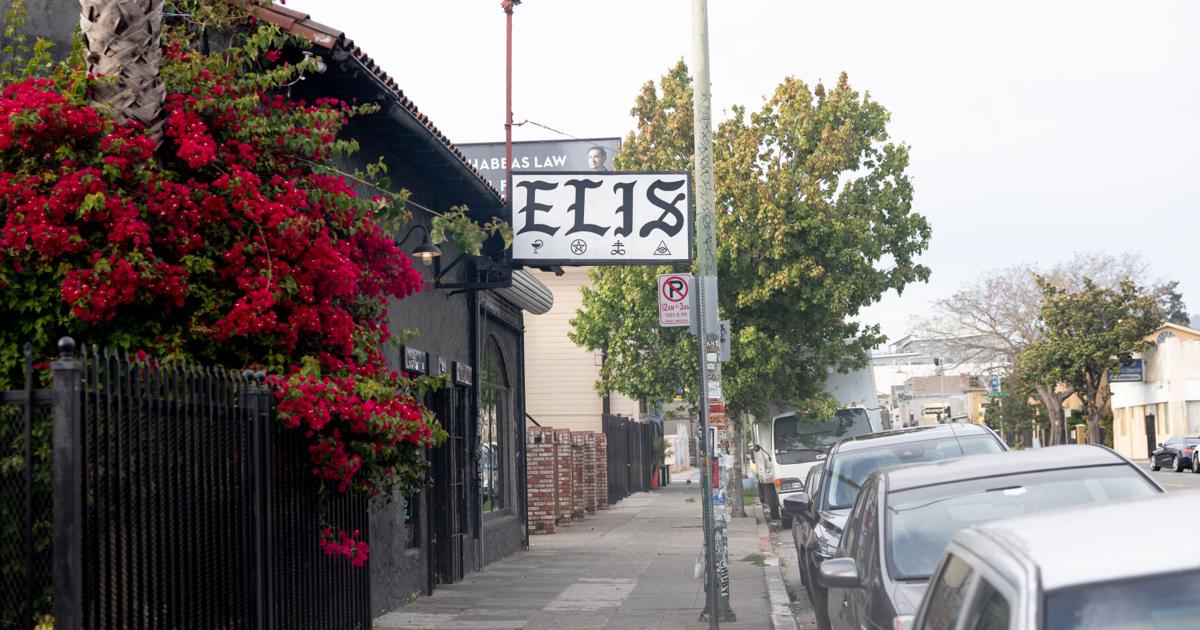
Historic East Bay institution Eli’s Mile High Club is set to close indefinitely. During the performances of hundreds of bands the bar has hosted, crowds often poured into the venue’s famous back patio — now part of a convoluted legal dispute.
Since Eli’s opened on Martin Luther King Jr. Way in 1974, it has weathered a number of setbacks and a changing neighborhood, with tags, stickers, as well as regulars who recall its early days to memorialize its long history.
A bullet hole used to adorn the wall before being covered with artwork, according to Bill MacBeath, who first came for the bar’s longstanding blues shows in the ’80s. Back then, he said, it was one of many blues bars in the area.
An East Bay Express newspaper clipping — “The Ballad of Frankie and Eli” — on the wall may tell the story of this bullet hole: The bar’s founder, Eli Thornton, was murdered by his “former lover” Frankie Williams in the bar.
Despite its impending closure, Eli’s owner, Matthew Patane, has emphasized their goal to reopen after they “handle what needs do’n,” according to an Instagram post.
Eli’s has long outlived its original owner, and now, as it faces its latest challenge, a community of regulars, newcomers, students and bands are rallying to support one of Oakland’s last remaining blues bars.
The bar’s backdoor neighbor, Greg Barron, sued Eli’s in 2025 for allegedly causing flooding in his property, amounting to an alleged $166,960 in property damage.
Issues with the bar’s patio go back to 2024. The city of Oakland told SFGATE that the patio was closed for “safety and encroachment issues.”
A bartender and patrons said the closure was a difficult loss for the bar and its large crowds.
“This is one spot where you could have a drag show, a blues night on Mondays with elders and incredible music … punk and metal, and then everyone can be in the backyard,” said bassist and producer Akiyoshi Ehara.
For Ehara’s Bay Area band The Seshen — which gathered at Eli’s to “pay respects” to one of its favorite venues — this watering hole is one of the few such places remaining.
“It’s a place where real Bay people can come and be comfortable,” said Ehara’s friend Juju.
Echoing their remarks, Alicia Walters said Eli’s is “one of the last holdouts” in a long line of bars and venues in the area that have shuttered, going as far back as the construction of I-980, which cut through the area and broke up the “Harlem of the West.”
“This is a meeting place for I think what the ground floor of Oakland actually feels like in a lot of ways,” Ehara said.
“It’s a true mixing ground,” chimed in percussionist Mirza Kopelman.
That mixing ground includes generations of Eli’s fans, including UC Berkeley students, who mostly frequent Eli’s on Monday nights for blues.
Regular Nick Platz recalled meeting many friends and partners at this treasured spot and said he made a donation to the bar’s growing GoFundMe, in exchange for one of the bar’s napkin holders covered in stickers.
Platz said he took the napkin holder in lieu of dancing on the bar, which Eli’s offered on Instagram for anyone who donated $100.
“So many outrageous nights started here,” Platz said.
The fundraiser has garnered the support of more than 1,400 donors, raising more than $90,000 since March 2026. According to Patane’s GoFundMe description, the funds will serve “to get through zoning, permitting, and the restructure of the patio according to the city request.”
The case is scheduled for case management and settlement conferences in January 2027, after which it could proceed to a jury trial.
“If this place goes down, it’s another in a long stream of the history of well-visited community arts places where all kinds of music that are rooted in Oakland, and particularly Black music in the community, gets completely demolished,” Walters said.
Mahesh Rao, keyboard and synth player for The Seshen, reminisced about a growing list of local music venues that have closed in the past decade “to the detriment of the community” and in favor of competing development interests.
“We’re just in a dive bar right now, just having some drinks, and it means a lot more than that,” Rao said.