
This is an edited transcript of Oaklandside 510. You can listen to the episode wherever you get your podcasts.
Over the past month, data centers have gone from a quiet real estate story to one of the most contentious issues in Oakland: a downtown developer’s proposal, two tech companies moving into West Oakland, an organized opposition campaign, and a city councilmember’s push for a moratorium. I’m joined by our news editor, Darwin BondGraham, who’s been tracking all of it.
— Tasneem Raja, editor-in-chief, The Oaklandside
Darwin, can you paint the picture of what’s actually happening right now — are data centers coming to Oakland?
There is a very early-stage proposal to site a data center in downtown Oakland, on 20th and Franklin streets, but that’s just a proposal at this point — it’s a long way from becoming a reality.
There has been real interest in building data centers across California, but Oakland is not really a place that’s gotten a ton of that interest. Real estate prices are high here, electricity prices are high, and for a bunch of other reasons, most of the data centers are in Santa Clara County, near the tech companies.
There’s a pretty big one under development in Hayward right now, and another planned for San Francisco. A thing to remember is there’s already a data center in Oakland — it’s on 2nd Street in the Jack London District, operated by a company called Digital Realty. It’s been there for about 20 years, but it’s not part of this new wave of big data centers for AI.
When people think about data center development in the modern context, they’re thinking about huge, sprawling facilities. Help us understand the scale of what we’re talking about here.
The data centers being proposed or built or thought about in San Francisco or Oakland are going to be city blocks — vertical, not the giant Amazon-warehouse-looking buildings. That said, you go down the highway to Hayward, and that data center is going to be really big.
Let’s get more concrete about what’s actually being proposed for Oakland. You’ve been reporting on Behring Companies. What is Behring, and what’s it planning to build here?
They’re a real estate investment company that’s been around a while, heavily focused on buying, building, and operating properties in the East Bay. Back in 2017, they began work on what was a 39-story luxury apartment tower at 1900 Broadway. That’s built, that’s finished. They own some neighboring properties and had planned to build more housing there; similar tall towers. Housing was profitable back then.
Then the pandemic crushed the rental housing market, especially the commercial office market in Oakland, and that hasn’t recovered. So Behring’s plans for these properties appear to be shifting. They’re trying to jump on the data center bandwagon, I think — proposing to site a data center in one of the buildings they bought years ago, rather than tearing it down and putting up more housing.
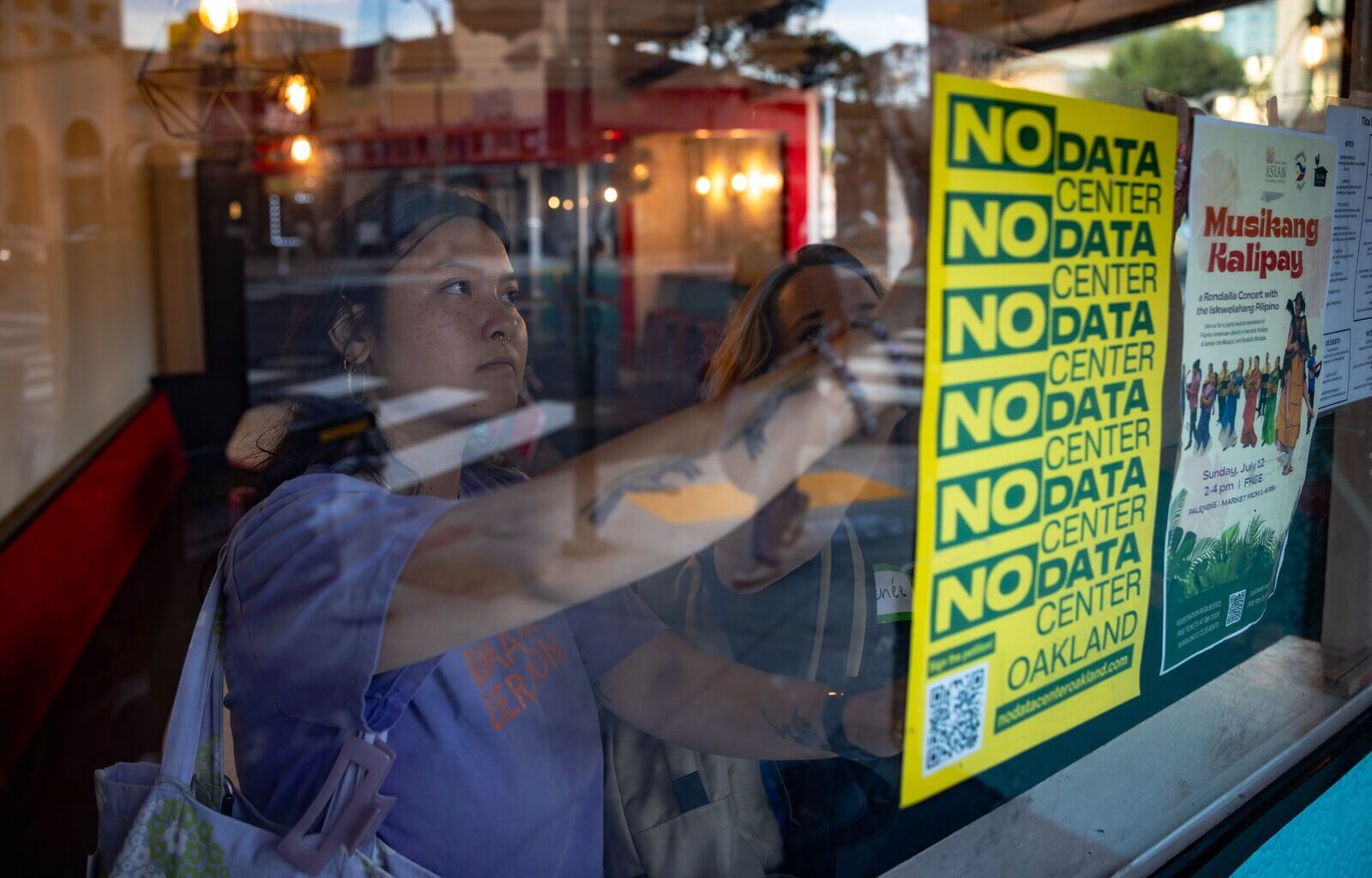
At the same time, we’re seeing organized opposition to the concept of more data centers in Oakland, and specific opposition to this proposal: activists canvassing downtown, “No Data Center” flyers going up in bar windows, conversation among city councilmembers. What are people upset about?
It feels a bit like the opposition to data centers erupting all across the country right now, in red states and blue states, conservative and liberal communities alike. The No Data Center in Oakland group has a petition, a website, and other materials arguing that they don’t trust a data center will be an economic boon for everyone in the city — they think it’s quite the opposite.
Big, powerful tech companies will build and run data centers that are going to be used to gather more data on people — more surveillance. They fear it’s part of the tech-fueled, K-shaped economy we’ve all been experiencing, where the rich and powerful pull away with more wealth while the rest are left struggling with housing prices and inflation.
They’ve also brought up environmental impacts, noise, and water consumption. PG&E bills around here are already pretty expensive, and if a data center goes in, bills go up a lot higher. All of that is quite similar to what we’re seeing in other communities.
For its part, Behring says the data center piece of its construction plan is small — about 20,000 square feet, roughly 1.5% of what they’re calling a much bigger “innovation campus.” Is that claim holding up in your reporting?
Yeah, probably. The building they’re offering up as a data center isn’t the size of these new data centers getting built elsewhere — it’s a four-story, 82,000-square-foot building. For comparison, that Hayward data center I mentioned earlier is 300,000 square feet. And there are data centers in other parts of the U.S. that are over a million square feet.
So if a downtown Oakland data center gets installed in that building — and that’s a big if at this point — it’s going to be on the small-to-medium side, as far as data centers go.
That building has a fascinating history; it used to house a Department of Energy supercomputer. Does that have any bearing on what people are talking about right now?
Darwin: Totally. In the early 2000s, the building was home to a supercomputer named Seaborg, named in honor of Glenn T. Seaborg, a Nobel Prize–winning UC Berkeley chemist. That supercomputer, run by the Lawrence Berkeley National Laboratory and the federal Department of Energy, was basically a bunch of big server stacks that took up an entire floor of the building. They used it to run scientific experiments and models — investigating supernovas, nuclear fusion, climate change, that kind of thing.
Behring Companies has argued its data center plans aren’t a lot different from what Berkeley Lab used to run out of that same building. They’ve made this case to the city, and they’re hoping Oakland will grant them the right to proceed without a conditional use permit — basically avoiding having to jump through a bunch of hoops. If they don’t need that permit, they can just find someone to bring in a data center and install it.
All of the buzz about the AI industry possibly coming into Oakland in a big way isn’t just about that one building. Tell us about Tesla and Prometheus — the AI startup co-founded by Jeff Bezos — and what they’re interested in doing in West Oakland.
These companies are quite a bit further along than Behring’s proposed data center, but oddly, less is actually known about what they’re up to. Prometheus is reportedly leasing space in the American Steel blocks, the massive industrial warehouse in West Oakland — not far from Pacific Pipe, the climbing gym, and Prescott Market and Raimondi Park.
The company was started by Jeff Bezos and a former Google employee named Vik Bajaj. They say they’re going to apply artificial intelligence to manufacturing — things like building jet engines and pharmaceuticals, though the specifics are vague.
Tesla has also leased space in that same building. When I went over there last month and walked around, I noticed construction going on, with signs up saying it was a Tesla work site. Planning and building documents filed with the city describe it as a “non-public-facing vehicle repair and cleaning facility” for Tesla’s robotaxis. Beyond that, we don’t have a ton of information.
So it’s a little confusing, but to be clear, what Prometheus and Tesla are doing at American Steel isn’t the same kind of thing as a data center. Is it fair to say that’s getting folded into the same fear driving opposition to the downtown proposal?
Yeah, I think so. These things are getting lumped together by a lot of people. There’s a lot of excitement right now about anything pushing the limits of new technology — robotaxis, AI manufacturing. At the same time, some people are very worried about these technologies, viewing them as potentially disruptive to the economy and to job security, with fears of rising inequality tied up in it.
Remember, Tesla’s owner, Elon Musk, is literally the wealthiest person on Earth, and Bezos is the third richest person alive — billionaires chasing the title of trillionaire while the rest of us worry about grocery prices. AI is wrapped up in all of that fear, but also all this excitement, and the data centers that power it are highly controversial for those same reasons.
That brings us to what the city might be doing about this. Councilmember Carroll Fife, who represents West Oakland and downtown, has introduced a 45-day moratorium on data center approvals. Can you walk us through what that would actually do, or what it wouldn’t do?
A city council committee will hear from Fife about her proposal next week, open to the public to observe and comment on. Let me read from her proposal directly, because it’s pretty detailed about what she’s trying to accomplish:
“The duration of the temporary moratorium will be 45 days, which will allow the City to start a process of developing comprehensive data center policies and regulations tailored to address the unique operational, environmental, infrastructure, and public safety impacts associated with such uses. An extension of the moratorium period, if needed, will require City Council approval.”
I’ll add that a very similar moratorium has been introduced in San Francisco. Oakley, a small city in East Contra Costa County, recently passed a data center ban. Even San Jose — a city with the most data centers on the West Coast — residents there are also pushing for a moratorium.
Do these moratoriums actually work? Are we seeing data center development get blocked because of governmental actions like these?
I think it’s to be determined. Fife would say, and her legislation says, this is a temporary thing — she doesn’t want to shut this down completely; she’s just trying to buy the city time. We’ll see if it works.
Let’s talk about the organizing on the ground through the “No Data Center in Oakland” campaign. Who’s actually behind this, and how did it come together?
This is pretty interesting. A lot of the anti-data-center organizing going on across the country right now is very grassroots, but some of it has also been led by a group called the Party for Socialism and Liberation, or the PSL — and that’s who’s behind a lot of the organizing in Oakland. PSL is a communist political party, created in the early 2000s when some members of another communist party broke away and formed their own group. They believe in the overthrow of capitalism.
Groups like this have a history of identifying hot-button issues emerging and joining those social movements, often helping lead the protests — they did that in the anti-Iraq War movement in the early 2000s, and joined and helped lead parts of the racial justice protests that preceded the Black Lives Matter movement.
That’s led to some accusations from conservative media and other pundits that the anti-data-center movement is being secretly orchestrated by China or some other shadowy communist threat. Based on our reporting so far, the reality seems a little simpler: there’s a lot of discontent with data centers, and groups like the PSL appear to be joining that and trying to channel it.
Is Oakland looking at a genuine economic opportunity it’s been passed over for before, or a warning sign about what’s happened in other cities left in the wake of a tech boom that came and went? Where do you land after reporting all of this out?
Darwin: Setting aside the massive questions about how the economy is changing, inequality, environmental problems, the affordability crisis, and credible fears that AI will leave a lot of workers high and dry — I think the most immediate question for Oakland is that we’ve sort of been here before.
We’ve seen previous tech industry booms generate incredible levels of wealth in the Bay Area, and some cities and places prospered a lot from that. But Oakland hasn’t ever really gotten that benefit. People here still remember when Uber pulled that head-fake maneuver, saying they were going to move their headquarters here, and then didn’t.
So I think for a lot of Oaklanders, the concerns are dual: that we might get passed over again and not benefit, but also that we’ll see friends and neighbors displaced or priced out again because tech does move here.
Last thing — what should people be watching for next? What happens at the council meeting, and where does this all go from here?
They take Councilmember Fife’s moratorium legislation up next week at the committee level. That could get a vote by the full City Council the week after, or soon thereafter.
Our reporters will be paying attention to Behring’s plan and those two projects in West Oakland — but I want to put a call out to listeners. If you hear about any big tech industry moves in Oakland, we’re super interested. Please tip us off, let us know, and we’ll look into it.
This episode of Oaklandside 510 was produced by Mark Nieto and hosted by Tasneem Raja. Send us tips at editors@oaklandside.org.
“*” indicates required fields